
The almost unknown bet that changed the history of humanity.
A 40-shilling bet between Halley, Hooke and Wren one winter night in 1684 pushed a reclusive Newton to unveil gravity and change history forever.
If there is a turning point that changed the course of humanity, it was Isaac Newton's revelation of the force of gravity. From this finding, many natural phenomena made sense. Newton's discovery made it possible to explain with great accuracy the most diverse phenomena and to catapult technological development in all areas: from the apparently simple movement of the pendulum of a clock, to supreme achievements of the human race such as the launching of the first space rockets and the arrival of man on the moon.
It is true that gravity was discussed before Newton, but it was the latter who explained its nature and was able to demonstrate its mathematical formula; In addition to revealing that it was the same force that made an apple fall from its tree always vertically, which made the moon rotate around the earth.
Newton's genius was at odds with his personality, somewhat difficult to understand for many. He was a reserved and somewhat sullen man; He had reflected on the gravity alone and, although it seems inexplicable, he had no intention of telling anyone ... in fact, we would never have found out, had it not been for a fortuitous meeting of friends that ended in a singular bet.
The story that I will tell you next is documented in an old book that I found called Memoirs of the Life, Writings and Discoveries of Sir Isaac Newton, published in 1860. The story has been completed with references found in other works and even letters handwritten by Newton himself and which are currently part of the archives of the Royal Society, the oldest scientific society in the United Kingdom.
- or -
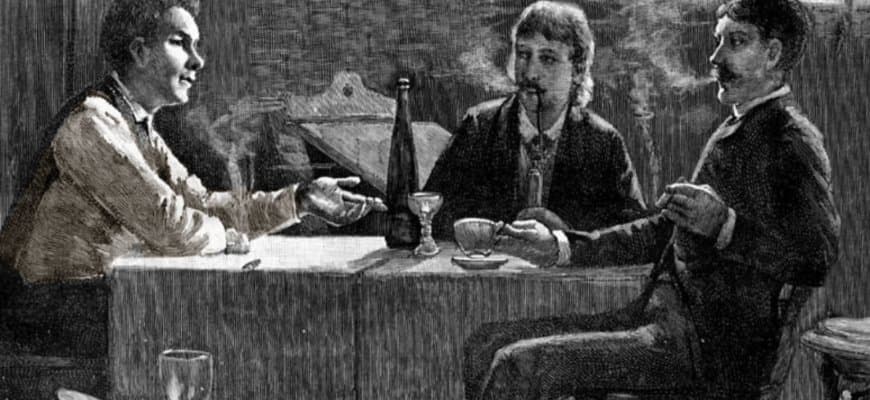
It was a cold winter night in January 1684, and three friends had gathered for dinner at a London restaurant. They were not ordinary people, in reality it was an unusual meeting between three of the most brilliant men of science of that Europe of the seventeenth century: Edmond Halley, Christopher Wren and Robert Hooke.
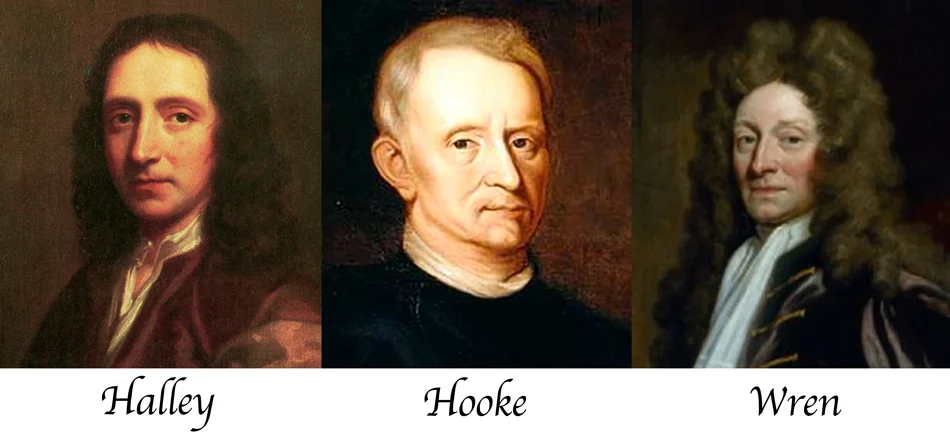
Who were Halley, Hooke and Wren?
Hooke had recently gained fame as a biologist, being the first person in history to observe a cell - in fact, it was he himself who coined the term we now use. But on the day of the meeting he was obsessed by another diametrically opposite scientific issue: gravity. He had given a lecture at the Royal Society in London entitled: On Gravity and he had anticipated that the force of gravity decreases with distance. As we can see, the apple of gravity fell when ripe, but no one could explain it exactly.
Halley was the youngest of the three, but despite his youth, his reputation as an astronomer had already begun to develop. Several months before the aforementioned dinner in London, he was obsessed with the idea of gravity and tried to relate it to the laws of the movement of the planets that the German Johannes Kepler had discovered years before. He had collected a great deal of information from his astronomical observations. He was excited to be able to demonstrate the veracity of Kepler's claims with measurements. Halley was in the right direction for the great gravity find, but he still couldn't solve the problem mathematically.
On the other hand, Wren already had a very active life in the field of architecture. His buildings rose up all over London and of the three characters, he was the one who led a more comfortable financial life. Few know his passion for science, as he is best known for being one of the most important architects of all time and who was entrusted with the reconstruction of much of London's buildings after the Great Fire of 1666. His passion for astronomy was not only a hobby, but he even became a full professor of astronomy at the University of Oxford and, like the others, he was willing to unravel the secrets of gravity.
The bet
The conversation that night focused on the movement of the planets and their elliptical orbit. They were trying to explain why the planets rotated in this particular way. Hooke had concluded that gravity was related to the inverse square of distance, but everyone wanted to know if he could prove it mathematically. Hooke. that he was somewhat conceited, he boasted of knowing the answer to the enigma but refused to tell it to maintain the suspense.
In the end, Wren decided to launch the challenge: 40 shillings (just under $ 2,000 today) to anyone who could mathematically demonstrate the nature of that invisible force that attracted the planets. This would no doubt encourage everyone to solve the puzzle and help loosen Hooke's tongue as well, in case Hooke knew anything; but Hooke only said that he was going to keep them intrigued for a while longer, just for sheer pleasure.
From that night on, Halley tied her head in knots trying to prove the matter mathematically. He only came up with a particular solution, but could not find a general proof. He searched for the solution for months, day and night, until he came up with a new approach to solving the problem. Go to the crazy Newton and ask him if he had any clues. At the time, Newton was rumored to be a mathematical genius.
Halley is said to have set out from London to Cambridge one morning in August 1684 and met Newton on a bench in the gardens of the prestigious university.
Isaac Newton enters the scene
What happened on that bench in Cambridge is one of the most important conversations in the history of science, and we know it in some detail thanks to the mathematician Abraham de Moivre, who years later set down the account as told by Newton himself. After the customary greetings, Halley got straight to the point and put to him the question that had been keeping him awake: what curve would a planet trace if it were attracted by a force inversely proportional to the square of the distance? Newton answered instantly, without blinking, that it would be an ellipse.
A stunned Halley asked how he could be so sure. And Newton let fall the sentence that sums up his genius and his indolence in equal measure: he knew because he had already worked it out. An overjoyed Halley asked to see the proof at once. Newton rummaged through his papers… and couldn't find it. He had done it years earlier, for himself, out of pure intellectual pleasure, and had then misplaced it the way one loses a shopping list. He promised Halley he would redo the calculations and send them to him.
The remarkable thing is that Newton had the answer to the riddle obsessing the most brilliant minds in Europe —the one Hooke boasted of knowing and Halley chased without sleep— tucked away in a drawer, with not the slightest intention of publishing it. Without Halley's visit, it would probably have died there.
From a nine-page note to the work that founded physics
Newton kept his word, but the matter got away from him — fortunately for humanity. In November 1684 he sent Halley a brief nine-page treatise titled De motu corporum in gyrum ("On the motion of bodies in orbit"). Halley read it and understood at once that he was holding something colossal: not the answer to a tavern bet, but the key to the laws that govern the entire universe. He went back to Cambridge to beg Newton to develop it.
And Newton, who knew no restraint once he became obsessed, shut himself away for nearly two years. He barely ate, barely slept, and out of that frenzy came the three volumes of the Philosophiæ Naturalis Principia Mathematica (1687) — the Principia, without question the most influential scientific work ever written: the three laws of motion, the law of universal gravitation, and the mathematical machinery to explain everything from the fall of an apple to the orbit of comets. Science was split in two: before and after that book.
One final detail remains, the most unjust and the most beautiful of all. When the Principia were ready, the Royal Society had no money to print them: it had spent its publishing budget on a commercial flop, a lavish History of Fishes that almost nobody bought (Halley, in fact, ended up being paid his Society salary in unsold copies of that book of fishes). So it was Edmond Halley himself —the young astronomer who had started it all with a question— who paid out of his own pocket to publish Isaac Newton's masterwork. Without Halley, there would have been no bet; without the bet, no question; without the question, the calculations would still be in the drawer; and without his money, they would never even have been printed.
There was a bitter epilogue, of course: Hooke loudly claimed the inverse-square idea was his, and Newton —as vindictive as they come— erased almost every mention of his rival from the Principia. But gravity was already loose in the world. And all of it —the rockets, the satellites, the landing on the Moon, the pendulum of his wall clock— began on a cold winter night when three friends, to keep up the suspense and prick one another's pride, bet forty shillings on the shape of an orbit. The best forty-shilling investment in history.
References
- David Brewster, Memoirs of the Life, Writings, and Discoveries of Sir Isaac Newton, 2 vols., Edinburgh, Thomas Constable and Co., 1855. archive.org
- Memorandum by Abraham de Moivre on Halley's visit to Newton (c. 1727); manuscript, Joseph Halle Schaffner Collection, University of Chicago Library; transcribed in I. Bernard Cohen, Introduction to Newton's Principia, Cambridge, Harvard University Press, 1971.
- “Edmond Halley,” Encyclopædia Britannica; cf. Royal Society records on the presentation of De motu corporum in gyrum (Dec. 1684) and the financing of the Principia (1687). britannica.com
Categories
The books · born from this blog
Atahualpa con su abrigo de pelo de murciélago
y otras 49 historias verdaderas que parecen mentira
Available on Amazon
Tocar madera
Pequeña historia de las supersticiones que el mundo no ha podido soltar
Available on Amazon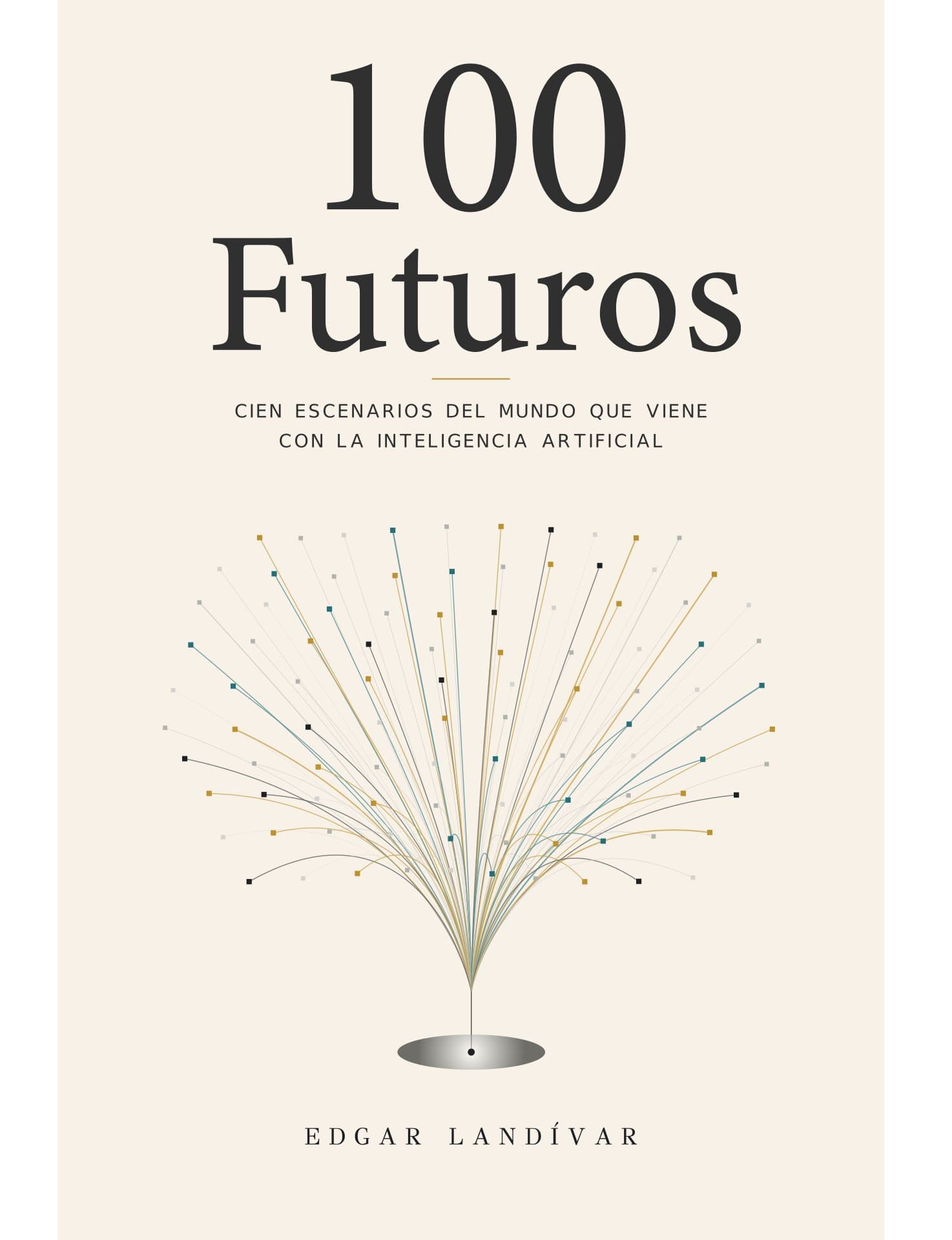
100 futuros
Cien escenarios del mundo que viene con la inteligencia artificial
Available on AmazonYou may also like
The History of Zero: The Number We Took Ages to Accept
The history of zero: from a dot in an Indian manuscript to Brahmagupta's rules and the Florence ban. How we finally learned to write nothing down.
The oldest recorded voice: sound before Edison
In 1860, 17 years before Edison, a French typesetter recorded the oldest human voice we can hear today. This is how we finally heard the past.
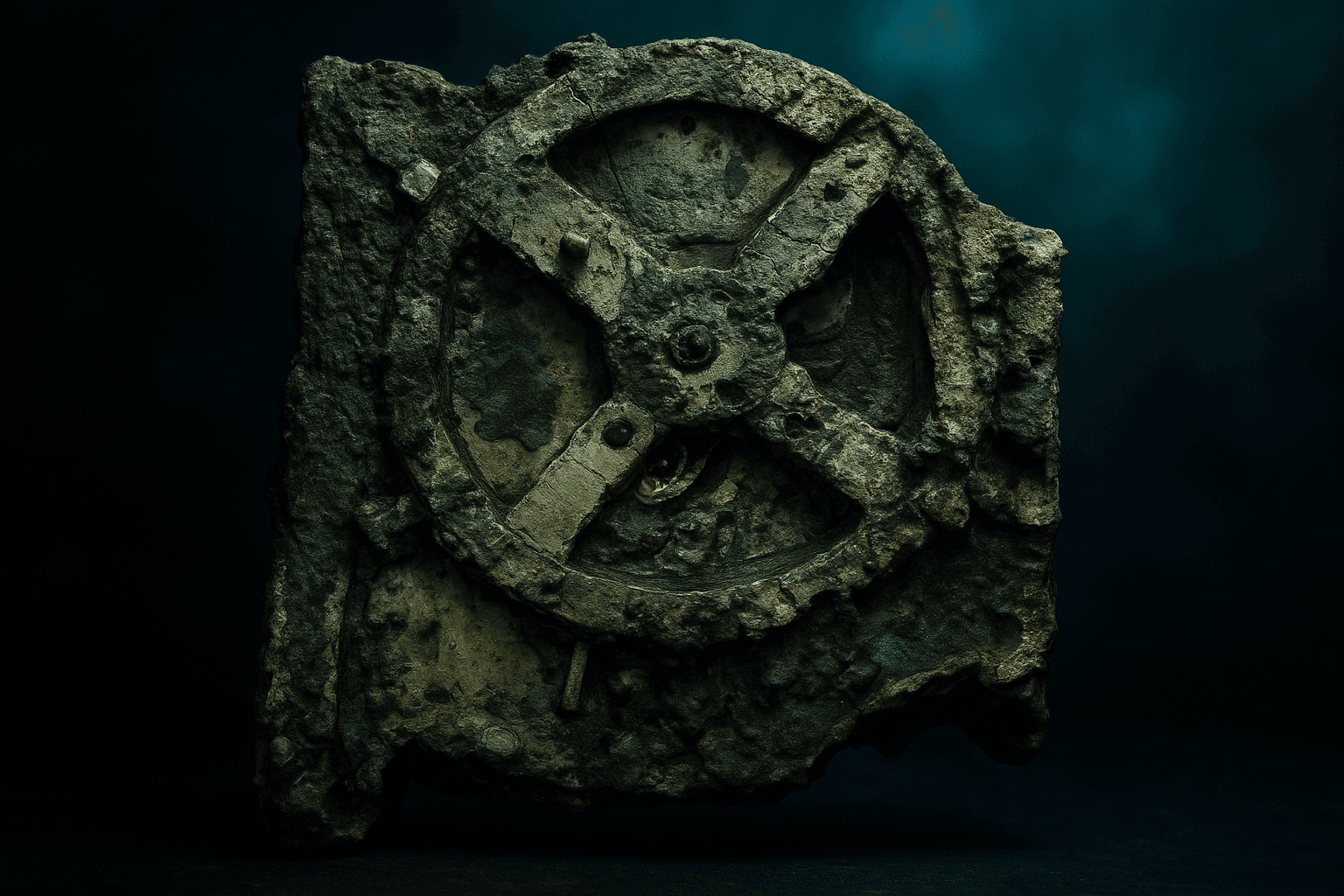
The Antikythera Mechanism: A 2,000-Year-Old Computer
The Antikythera mechanism is the oldest known analog computer: a bronze Greek machine, found in a shipwreck, that could predict eclipses 2,000 years ago.