
Algorithm: From Baghdad to ChatGPT, a Word's Journey
«Algorithm» comes from al-Khwarizmi, a 9th-century mathematician in Baghdad. This is how his name traveled from the House of Wisdom to the apps of today.
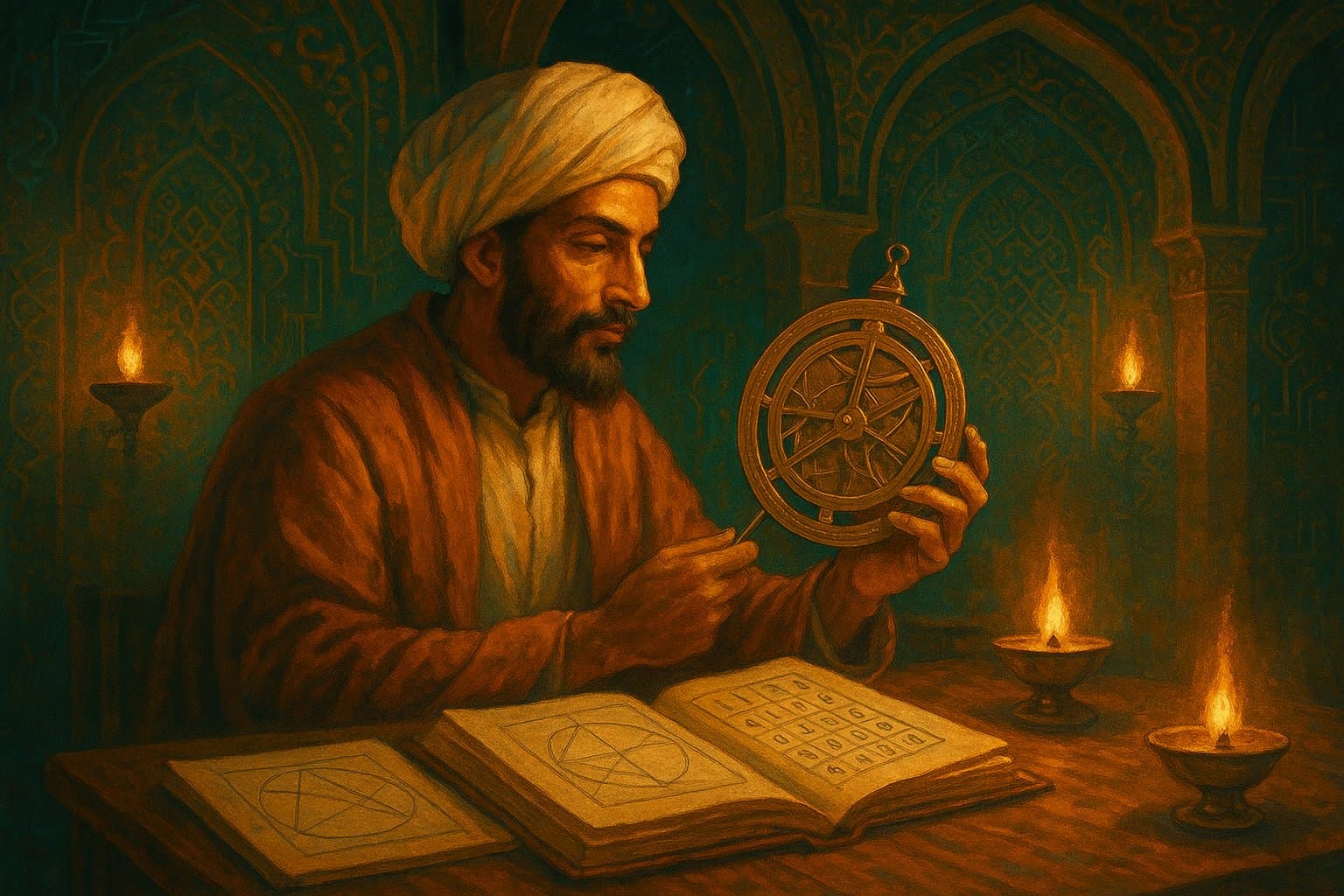
Today the word algorithm sounds like the most modern thing imaginable: it decides which video shows up on your screen, which route your GPS takes, and how ChatGPT answers. But the term was not born in Silicon Valley, nor in any twentieth-century laboratory. It comes from the name of a single person: a mathematician who worked in Baghdad more than twelve hundred years ago. The word that defines our digital age is, in fact, the distorted surname of a medieval scholar.
The man behind the word
His full name was Muhammad ibn Musa al-Khwarizmi (c. 780 – c. 850), and he was one of the great scholars of the Islamic Golden Age. He worked at the House of Wisdom (Bayt al-Hikmah) in Baghdad, the great center of study and translation that the Abbasid caliph al-Ma'mun had turned into the intellectual heart of the world. There, around the year 820, al-Khwarizmi wrote treatises on mathematics, astronomy and geography that would change the history of knowledge.
The curious thing is that «al-Khwarizmi» was not a personal name but a place-name: it means «the one from Khwarazm», the region south of the Aral Sea, in present-day Central Asia, where his family came from. Just as we might say «the Londoner» or «the Roman» today, his contemporaries simply called him «the one from Khwarazm». From that geographical nickname would emerge, centuries later, one of the most used words on the planet.
How a surname became a method
One of al-Khwarizmi's books explained the decimal numbering system he had learned from Indian sources: the numerals we now call «Arabic» and the revolutionary idea of zero as a placeholder. When that work reached Europe and was translated into Latin in the twelfth century, the translator Latinized his name as Algoritmi, and the text circulated with a title that began: Algoritmi de numero Indorum («Algoritmi on the number of the Indians»).
European readers, who did not know that «Algoritmi» was the name of a man, understood something else: they thought the word denoted the method of calculating with Arabic figures. So «algorithm» came to mean the procedure for doing sums with the new system, and little by little, any ordered sequence of steps for solving a problem. A person's name had turned into the name of a technique.
The hidden relatives: cipher and algebra
From that same root came words we still use without suspecting their origin. The medieval Latin algorismus gave English «algorism» and, by way of Old French, the word «cipher» itself wandered alongside it: for centuries, calculating with the new figures was simply «ciphering».
And there is an even more famous relative. Al-Khwarizmi's other great treatise was titled Kitab al-jabr wa al-muqabala, and from the word al-jabr —meaning «restoration» or «reunion of the parts»— we get «algebra» directly. Curiously, in medieval Spain that same term was also used for bones: an algebrista was someone who knew how to «restore» or set dislocated bones. If you enjoy these stories of words with a double life, look also at the origin of «sarcasm» or where «avatar» comes from.
From the House of Wisdom to your phone
For centuries, «algorithm» was a technical word used only by mathematicians. Its great leap came in the twentieth century, when computing pioneers needed a precise term for «a finite list of instructions that solves a problem»: exactly what a machine can execute step by step. From there to artificial intelligence and the systems that decide what is human and what is not was only a short step.
So every time someone complains about «the algorithm» of a social network, they are, in a way, mispronouncing the name of a Persian mathematician who lived in Baghdad when Europe had not yet invented the mechanical clock. Few words have traveled so far: from a Central Asian place-name to the House of Wisdom, from there to the Latin translators of the twelfth century, and from there, a thousand years later, to the most everyday corner of our digital lives.
References
- «Al-Khwarizmi», Encyclopædia Britannica. britannica.com
- University of Melbourne, «Why are algorithms called algorithms? A brief history of the Persian polymath you've likely never heard of». findanexpert.unimelb.edu.au
- «Al-Khwarizmi», Wikipedia. en.wikipedia.org
- Douglas Harper, Online Etymology Dictionary, s. v. «algorithm». etymonline.com
Do you enjoy the stories behind words? Continue with the origin of «avatar» or explore the whole etymology series.
The books · born from this blog

Atahualpa con su abrigo de pelo de murciélago
y otras 49 historias verdaderas que parecen mentira
Available on Amazon
Tocar madera
Pequeña historia de las supersticiones que el mundo no ha podido soltar
Available on Amazon
100 futuros
Cien escenarios del mundo que viene con la inteligencia artificial
Available on AmazonYou may also like

Placebo: the Latin word that means «I shall please»
«Placebo» means «I shall please» in Latin and began as a medieval funeral chant. Here is how it jumped from the church to medicine and its famous effect.

The Origin of the Word “Quarantine”: 40 Days in Venice
Where does the word quarantine come from? From the 40 days that Venice and Ragusa forced ships to wait during the Black Death. Here is its story.

The Origin of the Word “Dollar”: a Bohemian Valley
Where does the word dollar come from? From a silver-mining valley in Bohemia and a 16th-century coin. The story of the thaler that conquered the world.