
The Year Without a Summer of 1816
In 1815 Mount Tambora erupted and darkened the planet. 1816 became the year without a summer: failed crops, famine and the birth of Frankenstein.
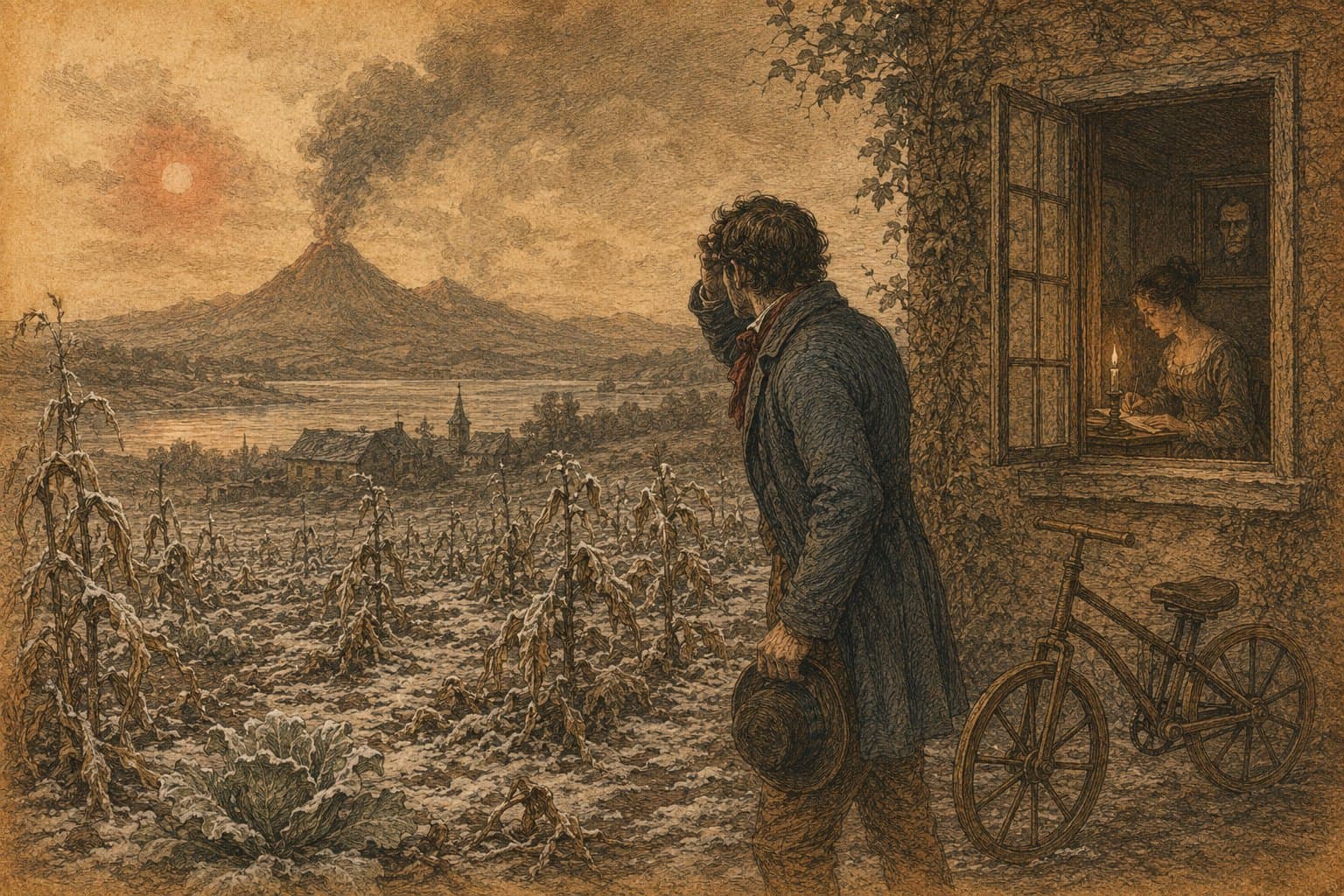
There was a year when summer simply never came. In June it snowed in New England, in August frosts killed the crops across Europe, and the sun rose each morning dim and reddish, as if seen through dirty glass. They called it the year without a summer, and behind that impossible weather lay a culprit twelve thousand kilometres away: an Indonesian volcano almost no one in the West knew existed.
The largest explosion in recorded history
In April 1815, the volcano Tambora, on the island of Sumbawa (present-day Indonesia), erupted on a colossal scale: the largest on historical record. The mountain lost more than a thousand metres of height in a single blow. The explosion killed tens of thousands of people directly and was heard more than 2,000 kilometres away. But its most lasting effect was not the roar, but what it hurled into the sky.
Tambora injected into the stratosphere an immense quantity of ash and, above all, sulphur gases. Up there, those compounds formed a fine haze of particles that the wind spread across the whole planet and that acted like a blind: it reflected part of the sun's light back into space before it reached the ground. The entire Earth cooled by about one degree. It does not sound like much, but it was enough to break the delicate machinery of the seasons.
1816: snow in June and failed harvests
The disaster struck the following year, far from the volcano. In the Northern Hemisphere, the spring and summer of 1816 were abnormally cold and chaotic. In the northeastern United States snow fell in the middle of June and there were frosts in every summer month; farmers nicknamed that year «eighteen hundred and froze to death».
In Europe, still exhausted after the Napoleonic wars, relentless rain and cold rotted the crops. The price of bread soared, there were food riots, looting and one of the continent's last great famines. Typhus followed, exploiting the misery to spread. As in so many episodes of collective panic —I think of the dancing plague of 1518—, people suffered without understanding the cause of their misfortune, because no one connected that leaden sky with a volcano on the other side of the world.
From the gloom came Frankenstein
And here the story takes an unexpected turn. That cold, rainy summer, a group of young English friends were spending their holidays on the shore of Lake Geneva, in Switzerland. Among them were the poet Lord Byron, Percy Shelley and his future wife, Mary Shelley. Trapped indoors day after day by the foul weather, to amuse themselves they challenged one another to each write a horror story.
Out of that confinement, forced by Tambora's climate, came a novel that changed literature forever: Frankenstein; or, The Modern Prometheus. At the same gathering, the physician John Polidori sketched The Vampyre, the tale that would lay the foundations of the modern vampire myth. Two of Western culture's great monsters were born, quite literally, of a volcano.
The bicycle and other unexpected consequences
The knock-on effects were astonishing. Because the shortage of oats made horses —the «engine» of the age— expensive and scarce, the German inventor Karl Drais looked for a way to move without animal power and built the draisine, the two-wheeled machine regarded as the ancestor of the bicycle. In the United States, thousands of families ruined by New England's failed harvests migrated west, redrawing the human map of the country.
The year without a summer is one of those cases in which a single natural event shakes all of history: the economy, migration, literature and even transport. A reminder of just how much our civilization rests on the fragile balance of climate, and of how a mountain that explodes in Indonesia can end up inventing both Frankenstein and the bicycle. It is hard to believe, just as it is hard to believe that around those very years someone sold an entire country that did not exist.
References
- Gillen D'Arcy Wood, Tambora: The Eruption That Changed the World, Princeton University Press, 2014.
- William K. Klingaman and Nicholas P. Klingaman, The Year Without Summer: 1816 and the Volcano That Darkened the World, St. Martin's Press, 2013.
- C. R. Harington (ed.), The Year Without a Summer? World Climate in 1816, Canadian Museum of Nature, 1992.
Do you enjoy true stories that sound made up? Continue with Poyais, the country that never existed or explore the history series.
Categories
The books · born from this blog
Atahualpa con su abrigo de pelo de murciélago
y otras 49 historias verdaderas que parecen mentira
Available on Amazon
Tocar madera
Pequeña historia de las supersticiones que el mundo no ha podido soltar
Available on Amazon
100 futuros
Cien escenarios del mundo que viene con la inteligencia artificial
Available on AmazonYou may also like
Porcelain: the Chinese secret Europe tried to steal
For centuries Europe paid fortunes for Chinese porcelain without knowing how it was made. This is the story of a hundred-year industrial espionage.
The History of Glass: The Material That Changed the World
Glass went from Egyptian luxury to everyday object thanks to Roman glassblowers, and later gave science its telescope and microscope.
Gunpowder Before Cannons: Alchemy, Fire and War
Chinese alchemists chasing eternal life invented gunpowder by accident. Before cannons came fireworks, fire lances and centuries of fire medicine.