
Poyais: The Country That Never Existed
Gregor MacGregor invented a Central American country, Poyais, and sold bonds and land to hundreds of Britons who sailed off to a nation that never existed.
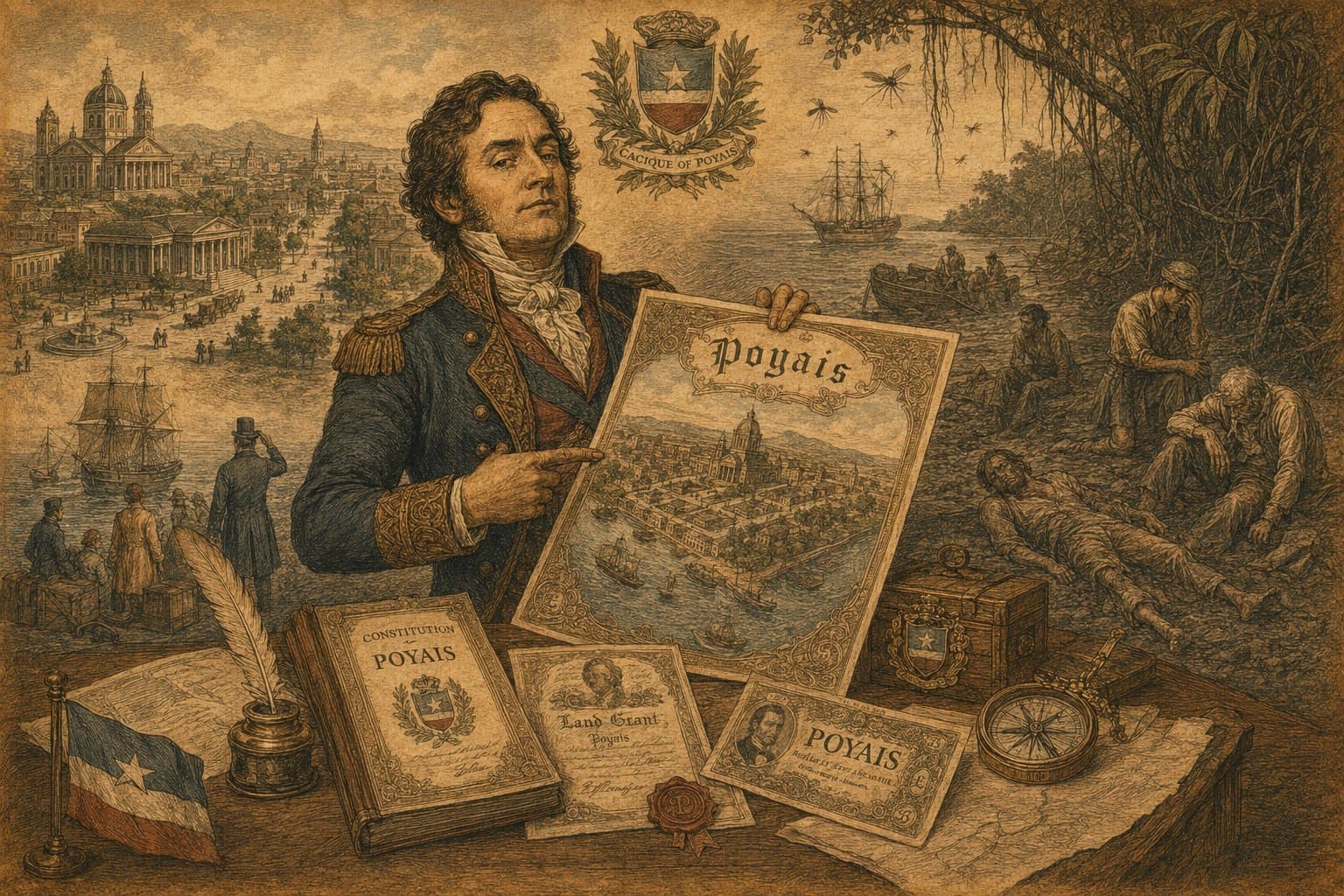
The history of great swindles is full of cons involving jewels, paintings and financial pyramids. But Gregor MacGregor did something no one had attempted before and no one has matched since: he invented an entire country, called it Poyais, designed its flag, its currency and its constitution, and sold pieces of it to hundreds of people who crossed the Atlantic to live in a nation that existed only in his imagination.
A Scot in the wars of independence
MacGregor was a Scottish soldier with a genuine service record, though one he inflated at every turn. After serving in the British army, he travelled to South America and fought in the wars of independence alongside Simón Bolívar, rising to general. From those years he returned with a title far juicier than any medal: he claimed that an indigenous king of the Mosquito Coast, in present-day Honduras, had granted him an enormous territory and the rank of cazique —«His Highness Gregor, Cazique of Poyais».
In 1821 that territory did exist on the map, but it was impenetrable jungle, almost uninhabited, without a single building. It made no difference. MacGregor returned to London and Edinburgh determined to turn that nothing into a fortune.
The best-designed paper nation in history
The astonishing thing about the fraud was its thoroughness. MacGregor did not merely describe wonders: he documented them. He invented a capital, St. Joseph, with avenues, a theatre, a cathedral and a parliament. He had a tourist and commercial guidebook to the country printed —signed by a fake author, «Thomas Strangeways»— in which Poyais appeared as a fertile land, with a gentle climate, rivers laced with gold nuggets and friendly natives eager to work for the European colonists.
He issued Bank of Poyais banknotes, sold Poyaisian government bonds on the London Stock Exchange for hundreds of thousands of pounds, and handed out land certificates and even commissions as army officers and public officials. He opened offices, threw banquets, distributed titles. To a Briton of the era, dazzled by the new American republics, Poyais was an irresistible opportunity. As in tulip mania, when a flower became a financial bubble, collective fever did the rest.
The voyage to nowhere
Between 1822 and 1823, some 250 colonists —many of them Scots who sold everything they owned and exchanged their pounds sterling for worthless Poyaisian dollars— set sail for their new home. When the ships dropped them on the coast of Central America, they found no port, no city, no theatre, no cathedral. Only mangrove, mosquitoes and an empty beach.
Convinced at first that the capital lay a little further inland, they waited. The rainy season came, and with it malaria and yellow fever. They died by the dozen. When British settlers from nearby Belize came to rescue them, only a fraction of the two hundred-plus who had left were still alive; the most cited figures speak of barely fifty who made it back. It was a disaster comparable, in miniature, to the Darién scheme that nearly bankrupted Scotland a century earlier.
The swindler who died a hero
And MacGregor? While his colonists lay dying, he had already fled to France, where he had the nerve to run the same fraud again, once more selling Poyais land to French investors. He was arrested and put on trial, but incredibly he was acquitted. He spent years recycling versions of the con with diminishing success.
The most extraordinary part is the ending. An old man now, MacGregor returned to Venezuela, the country for whose independence he had fought in his youth. There they treated him not as a criminal but as a founding hero: they restored his rank of general, granted him a pension and, when he died in Caracas in 1845, buried him with military honours in the cathedral, mourned as a hero. As implausible as his invented country was his impunity: the man who sold a make-believe nation ended up resting beneath a patriot's headstone. He was not the only one who dreamed of founding a homeland to fit his ambition, like those Germans of Klein-Venedig, when Venezuela almost became German.
References
- David Sinclair, The Land That Never Was: Sir Gregor MacGregor and the Most Audacious Fraud in History, Da Capo Press, 2004.
- Tamar Frankel, The Ponzi Scheme Puzzle, Oxford University Press, 2012, chapter on MacGregor.
- «Thomas Strangeways» (pseud. of G. MacGregor), Sketch of the Mosquito Shore, Including the Territory of Poyais, Edinburgh, 1822.
Fascinated by great frauds and bubbles? Continue with tulip mania and the giant stones of Yap and what money really is, or explore the history series.
Categories
The books · born from this blog
Atahualpa con su abrigo de pelo de murciélago
y otras 49 historias verdaderas que parecen mentira
Available on Amazon
Tocar madera
Pequeña historia de las supersticiones que el mundo no ha podido soltar
Available on Amazon
100 futuros
Cien escenarios del mundo que viene con la inteligencia artificial
Available on AmazonYou may also like
The Ten Days of October That Never Existed
In 1582 Pope Gregory XIII erased ten days: October 4 was followed by October 15. Here is why the Julian calendar failed and the Gregorian took its place.
Ada Lovelace and the First Program Never Run
In 1843 Ada Lovelace wrote history's first algorithm for a machine that was never built. This is the story of the first computer program, a century early.
Rubber Before Goodyear: The Gum That Melted
Before vulcanization, rubber was a gum that melted in summer and cracked in winter. From the Maya to Goodyear, here's how it was finally tamed.