
Porcelain: the Chinese secret Europe tried to steal
For centuries Europe paid fortunes for Chinese porcelain without knowing how it was made. This is the story of a hundred-year industrial espionage.
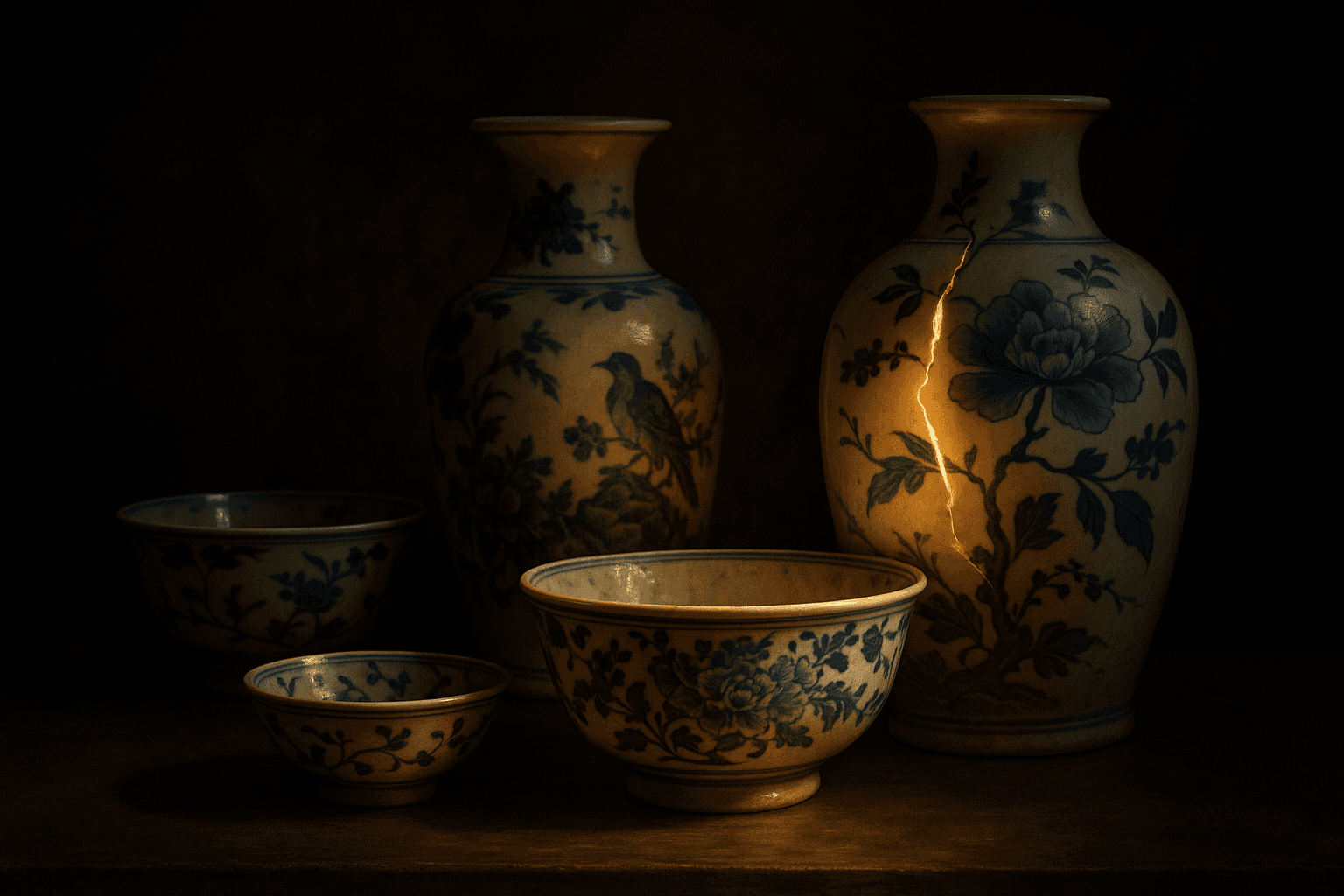
For nearly a thousand years, China guarded a formula worth more than gold: the recipe for porcelain. That white, translucent, ringing material we now see in any dinner set was once a mystery so coveted that it enriched empires, ruined alchemists, and pushed a missionary to become one of the first industrial spies in history. Europe craved it for centuries without the faintest idea of how it was made. This is the story of that secret and of everyone who tried to steal it.
A name that comes from a seashell
The word porcelain has nothing to do with pottery. It comes from the Italian porcellana, the name of a shiny sea shell —the cowrie— whose smooth, pearly surface reminded people of the Chinese material. And porcellana, in turn, derives from porcella, "little sow," because the shell's opening resembled a pig's vulva. It was Marco Polo, back from Asia and imprisoned in Genoa around 1299, who popularized the comparison when he described the Chinese ceramics he had seen. So one of the world's most refined materials ended up being named, indirectly, "little piglet."
In English something different happened: porcelain became known simply as china, after its country of origin —a permanent reminder of where the monopoly lay. For a long time, the answer to "where does this come from?" was always the same: from China, and nowhere else.
The impossible recipe
True porcelain —so-called "hard-paste"— was born in China around the 8th century. Its secret lay in two ingredients Europe could not identify: kaolin, a pure white clay, and petuntse, a ground feldspathic rock that, heated above 1,300–1,400 °C, melts and forms a natural glass that seals the piece from within. That combination, fired at extreme temperatures, produced a material that was white, waterproof, so thin it let light through, and that rang like a bell when struck.
The heart of that industry was Jingdezhen, an entire city devoted to porcelain for centuries, with kilns burning day and night and an astonishing division of labor: a single piece might pass through dozens of hands before leaving the kiln. Europe received the finished product through the Dutch East India Company, paid outrageous prices, and had no way to reproduce it. Without identified kaolin and without kilns capable of such heat, European potters managed only opaque, fragile imitations.
The missionary who became a spy
The first blow to the secret came not from a thief but from a priest. François Xavier d'Entrecolles, a French Jesuit stationed in China, lived near Jingdezhen, and among his converts were many kiln workers. Trading on that trust, and his command of Chinese, he patiently gathered the details of the process: which materials were used, in what proportions, how they were prepared, and what accounted for that impossible whiteness.
In 1712 he wrote a long letter to the order in France, precisely describing the use of kaolin and petuntse; in 1722 he sent a second, even more detailed one. These were the first technical accounts of porcelain-making to reach the West, and they fueled Europe's obsession with discovering the arcanum, the "secret." Decades later, the English potter Josiah Wedgwood would copy passages from those letters into his notebook to imitate Jingdezhen's assembly line. A missionary had become, almost without meaning to, one of the first documented industrial spies.
The prisoner who made gold… and achieved something better
While d'Entrecolles was sending his letters, another battle for the same secret was being fought in Saxony —by force and ambition. Augustus the Strong, Elector of Saxony and King of Poland, was a self-confessed addict of Chinese porcelain —he spoke of his own "sickness"— and was determined to make it at home. To that end he locked up a young alchemist, Johann Friedrich Böttger, who boasted he could turn metals into gold. Böttger could not make gold, of course, but together with the scientist Ehrenfried Walther von Tschirnhaus he began experimenting with clays and kilns capable of reaching extreme temperatures.
On January 15, 1708, they achieved the first firing of European hard-paste porcelain. Tschirnhaus died shortly after, and in 1709 Böttger announced complete success. In 1710 Augustus founded the royal manufactory at Albrechtsburg Castle in the town of Meissen: the first porcelain factory in Europe. The alchemist who promised gold had delivered something that, to his king, was worth more.
A secret impossible to keep locked up
Meissen protected its formula like a state treasure. The process was the arcanum, and those who knew it —the arcanists— were only a handful, closely watched. But a secret that depends on people always escapes in the end. In 1719, an arcanist named Samuel Stöltzel fled to Vienna and sold the recipe for a handsome offer, and a rival factory was born. From then on, the formula leaked across Europe in the hands of craftsmen who moved from court to court selling what they knew.
As happened with the history of glass or with gunpowder before cannons, porcelain shows that technical knowledge is almost impossible to contain forever: it travels in letters, in heads, and in defectors. What China guarded for nearly a millennium, Europe had within a couple of decades once the missing piece was found. And that material, which once cost fortunes and sparked espionage, now sits forgotten and ordinary in anyone's coffee cup —as invisible in its commonness as lithium was before it moved the world.
References
- "History | Porcelain Manufactory Meissen," Meissen: Böttger, Tschirnhaus, the first firing of 1708 and the founding of the manufactory in 1710. meissen.com
- "One of the Earliest Industrial Spies Was a French Missionary Stationed in China," Atlas Obscura: d'Entrecolles, Jingdezhen and his letters of 1712 and 1722. atlasobscura.com
- "Porcelain — Etymology, Origin & Meaning," Etymonline: the word's origin in porcellana, the cowrie shell and porcella. etymonline.com
- "Meissen porcelain," Wikipedia: the arcanum, the arcanists, Samuel Stöltzel's flight and the spread of the formula across Europe. wikipedia.org
Do you enjoy these stories of materials that changed the world? Continue with the history of glass and the history of matches, or explore the whole history section.
Categories
The books · born from this blog
Atahualpa con su abrigo de pelo de murciélago
y otras 49 historias verdaderas que parecen mentira
Available on Amazon
Tocar madera
Pequeña historia de las supersticiones que el mundo no ha podido soltar
Available on Amazon
100 futuros
Cien escenarios del mundo que viene con la inteligencia artificial
Available on AmazonYou may also like
The History of Glass: The Material That Changed the World
Glass went from Egyptian luxury to everyday object thanks to Roman glassblowers, and later gave science its telescope and microscope.
Gunpowder Before Cannons: Alchemy, Fire and War
Chinese alchemists chasing eternal life invented gunpowder by accident. Before cannons came fireworks, fire lances and centuries of fire medicine.
The War of the Currents: Edison vs. Tesla
In the late 19th century Edison, Tesla and Westinghouse fought the war of the currents to decide whether the world would run on direct or alternating current.