
Tulip Mania: When a Flower Became a Financial Bubble
In the Holland of 1637, a single tulip bulb came to be worth more than an Amsterdam canal house. The story of the first great financial bubble.
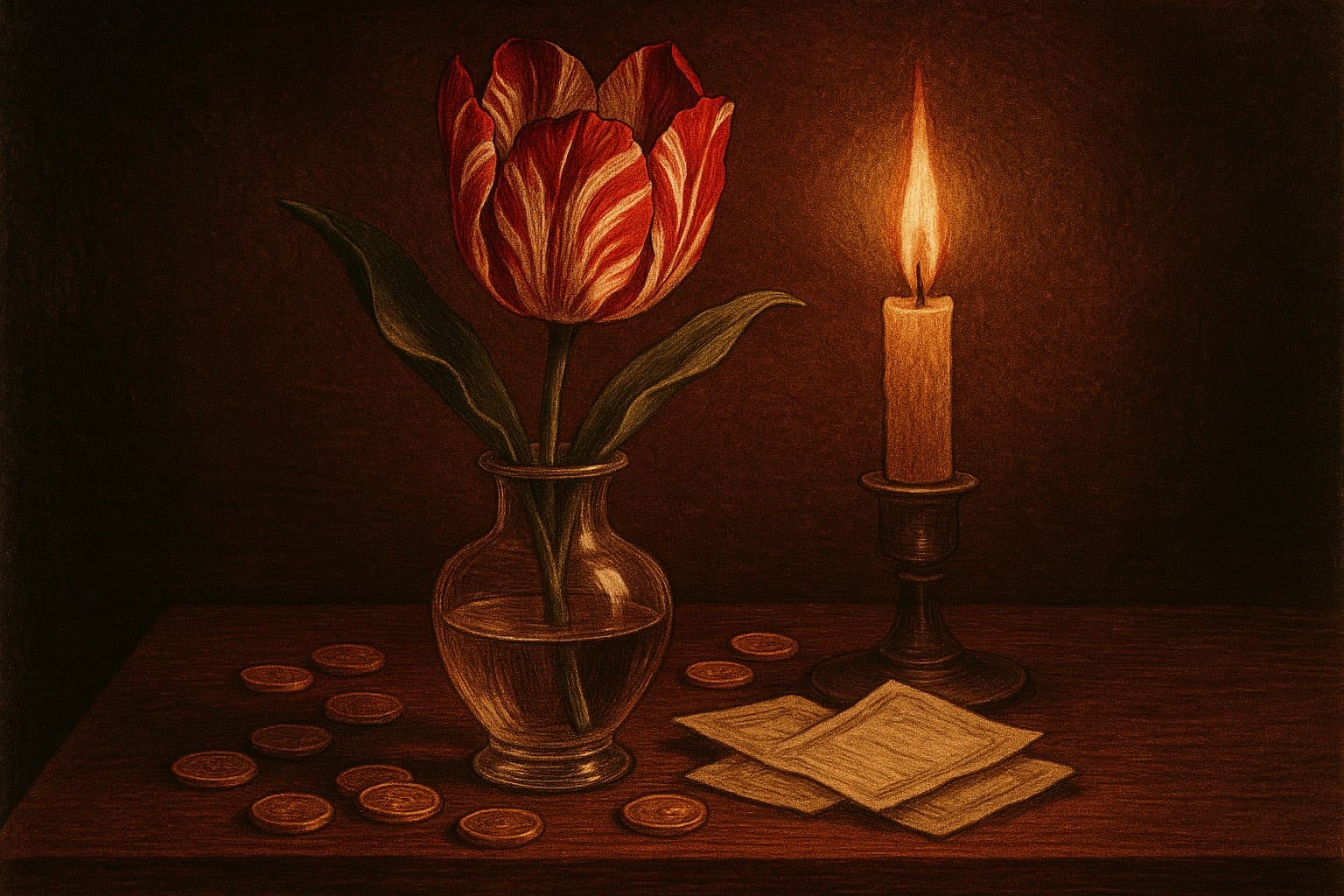
In the winter of 1637, in Holland, a single tulip bulb —a thing that looks like an onion, buried underground with no flower in sight— came to be quoted at more than the price of a fine house on an Amsterdam canal. A skilled craftsman earned about three hundred guilders a year; for one bulb of the Semper Augustus variety, ten thousand were asked. Tulip mania entered the dictionaries as a synonym for collective financial madness, and every time something rises in price without explanation —dot-com stocks, cryptocurrencies, whatever this decade brings— someone pulls it out of the drawer. But the real story is stranger, and more interesting, than the fable.
From Istanbul to Amsterdam
The tulip is not Dutch: it arrived in Europe from the Ottoman Empire in the mid-16th century, where it was the flower of the sultans. Even the name gives it away: it comes from the Turkish tülbend —turban— after the shape of the bloom. The botanist Carolus Clusius planted it in the garden of Leiden University around 1593, with such good fortune that Holland's first commercial tulips were, quite literally, stolen from his garden one night.
In Golden Age Holland —newly enriched by world trade, full of merchants with fresh money and the urge to show it— the tulip became the perfect status symbol: beautiful, exotic, scarce and hard to grow. An entire society devoted to excess was nothing new in history, the Sybarites had already patented the genre, but the Dutch added something new to it: financial engineering.
The sick flower that was worth gold
Here comes the first irony. The most coveted tulips were the “broken” ones: those with petals streaked in flames of color over a white or yellow background, like the legendary Semper Augustus, red and white, of which barely a dozen bulbs were said to exist. What nobody knew at the time is that those spectacular flames were the symptom of a virus —the tulip breaking virus, spread by aphids— which also weakened the bulb and made it multiply more slowly. In other words: Holland went mad over a disease. The most expensive flower in the world was worth so much precisely because it was sick.
The wind trade
A tulip bulb spends most of the year underground, and there lies the second oddity: almost nobody was buying flowers; they were buying promises. Contracts were signed in winter for bulbs that would be dug up months later, and those papers began to be resold from hand to hand, ever more expensive, while the bulb never moved from its hole. The Dutch gave it a perfect name: windhandel, “the wind trade”. None of this happened at the Amsterdam exchange, but in taverns, over beer and tobacco, in informal auctions called “colleges”.
A pamphlet of the era calculated what a single bulb of the Viceroy variety was worth: two loads of wheat, four of rye, four fat oxen, eight pigs, twelve sheep, two barrels of wine, four casks of beer, two of butter, a thousand pounds of cheese, a complete bed, a suit of clothes and a silver cup. All of it, for an onion with a pedigree.
The Tuesday the music stopped
On February 3rd, 1637, at an auction in Haarlem —a city which in those very days, macabre detail, was being ravaged by the plague—, the bulbs found no buyers. For the first time in months, nobody bid higher. The news ran from tavern to tavern, and within days the castle of promises collapsed: prices down ninety percent, contracts nobody intended to honor, buyers nowhere to be found. In the end the authorities cut their losses: contracts could be voided by paying a penalty of around three and a half percent. The wind trade was settled with wind.
The other bubble: the story itself
And here is the third irony, the best one. The stories we all know —families ruined en masse, suicides in the canals, the sailor who mistakenly ate a priceless bulb believing it was an onion, the Dutch economy destroyed— come almost entirely from moralizing pamphlets of the era, written to shame the greedy, and were amplified two centuries later by the Scotsman Charles Mackay in his famous book on the madness of crowds (1841). Modern research in the Dutch archives found something else: the tulip trade involved a rather small circle of well-off merchants, documented bankruptcies were few, and the Dutch economy sailed on unbothered — the following years were among the most prosperous of the century.
Tulip mania happened, the prices were real and so was the crash. But the national catastrophe was, in good measure, a second bubble: that of the story, which kept being resold —ever more inflated, like the bulbs— for almost four hundred years. We've seen the pattern on this blog before, with other stories too good to fact-check: the better the tale, the more its sources deserve a second look.
A postscript to close the circle: the Semper Augustus, the most expensive flower in history, no longer exists. The same virus that painted its flames ended up driving the variety extinct. The bubble Holland lost its mind over was, quite literally, unsustainable — even for the flower itself.
References
- Anne Goldgar, Tulipmania: Money, Honor, and Knowledge in the Dutch Golden Age, University of Chicago Press, 2007. press.uchicago.edu
- Charles Mackay, Memoirs of Extraordinary Popular Delusions and the Madness of Crowds, vol. 1, ch. "The Tulipomania", London, Richard Bentley, 1841. gutenberg.org
- Anne Goldgar, Tulipmania: Money, Honor, and Knowledge in the Dutch Golden Age, University of Chicago Press, 2007 (on the February 1637 price collapse). press.uchicago.edu
Categories
The books · born from this blog
Atahualpa con su abrigo de pelo de murciélago
y otras 49 historias verdaderas que parecen mentira
Available on Amazon
Tocar madera
Pequeña historia de las supersticiones que el mundo no ha podido soltar
Available on Amazon
100 futuros
Cien escenarios del mundo que viene con la inteligencia artificial
Available on AmazonYou may also like

Alfonso Graña, the Spaniard who became king of an Amazon tribe
Alfonso Graña fled hunger in Galicia, vanished into the Amazon and ended up crowned king of the Jívaros of the Upper Marañón. The true story of Alfonso I.
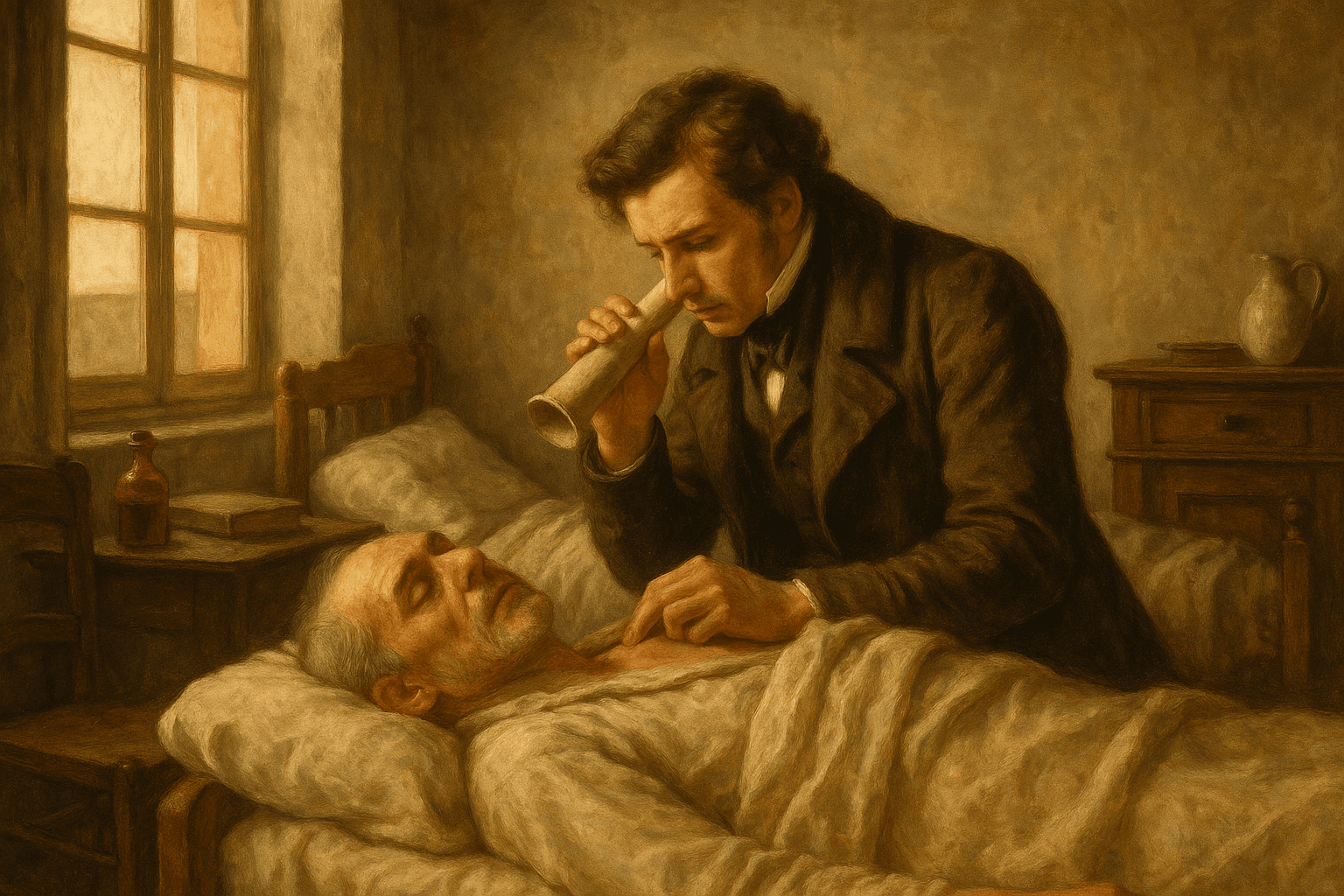
The history of the stethoscope and Laennec's modesty
In 1816 a French doctor felt too awkward to press his ear to a patient's chest, so he rolled up paper — and the stethoscope was born.

Placebo: the Latin word that means «I shall please»
«Placebo» means «I shall please» in Latin and began as a medieval funeral chant. Here is how it jumped from the church to medicine and its famous effect.