
Why did so many Peruvians fight the Battle of Pichincha? An essay and chronicle of the Santa Cruz Expedition
On May 24, 1822, the freedom of Quito was decided. But a huge part of the patriot army did not come from Ecuador: it came from Peru.

Composition of the patriot army
Peruvians
37.9% · 1,226
Gran Colombians
35.1% · 1,134
British (Albion)
13.4% · 433
Ecuadorians
8.0% · 260
Argentines & Chileans
3.0% · 96
Artillery & others
2.6% · 83
When you think of the Battle of Pichincha, the natural reaction is to imagine it as an Ecuadorian feat.
And it was, of course.
On May 24, 1822, on the slopes of the Pichincha volcano, the freedom of Quito was decided. The old Royal Audiencia stepped out of Spanish rule, opening the way for its incorporation into Gran Colombia and, later, for the birth of Ecuador as a republic.
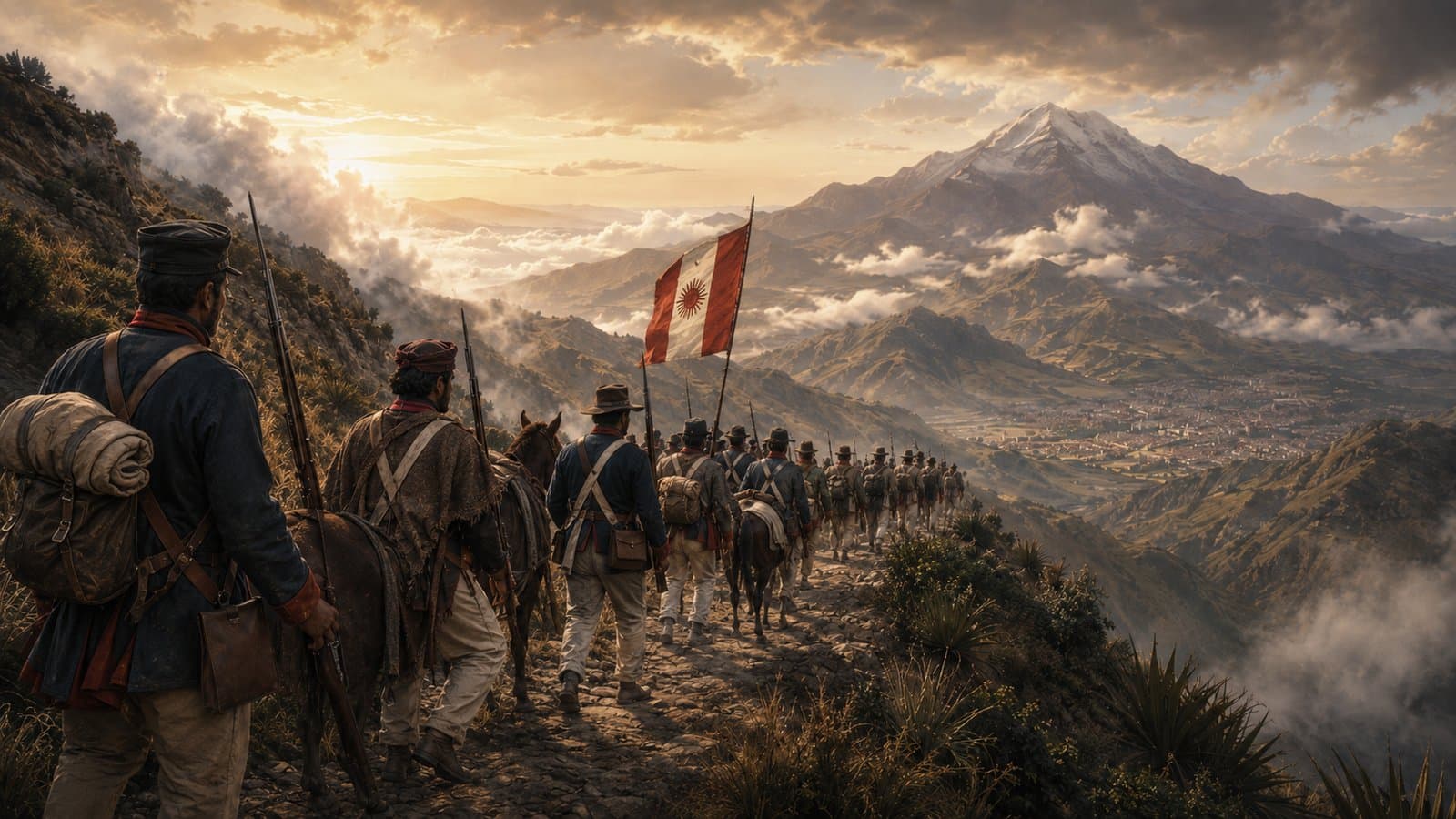
But there is a detail that tends to surprise anyone who reviews the composition of the patriot army carefully: a huge portion of the troops who fought alongside Sucre came from Peru.
They were not a handful of romantic volunteers nor a small symbolic gesture. It was a full division. The so-called Peru Division, commanded by Andrés de Santa Cruz, was made up of roughly 1,600 men and was sent by San Martín's Protectorate to support the final campaign for Quito. That division was made up mostly of Peruvian troops, though it also included Río de la Plata, Chilean and Upper Peruvian soldiers.
And so the inevitable question arises:
Why did so many Peruvians come to fight a battle we now remember as Ecuadorian?
The short answer is that, in 1822, independence was not yet a collection of separate national stories. It was a single war: huge, messy, continental.
And the long answer is far more interesting.
Our mental borders did not yet exist
Today we look at the past with modern maps.
We see Ecuador, Peru, Colombia, Bolivia, Chile, Argentina. Each country with its colors, its anthems, its school textbooks and its holidays. But in 1822 that map did not yet exist the way we picture it today.
Ecuador was not yet Ecuador. Quito was part of the old Royal Audiencia. Guayaquil had declared its independence in 1820 and was debating its own future. Gran Colombia was trying to consolidate its power in the north. Peru had proclaimed its independence but still had a very strong royalist presence on top of it. Bolivia did not even exist yet as a republic.
In that world, saying "Peruvians at Pichincha" was not the same as saying "foreign soldiers fighting someone else's war." It was rather an auxiliary force sent from one of the great fronts of the American independence to another, closely connected front.
The independence wars were wars of routes, ports, mountain ranges, strategic cities, and armies moving through territories that had not yet finished becoming countries.
That is why Pichincha should not be seen only as a local battle, but as one piece of a much larger operation.
Sucre needed men
Antonio José de Sucre was not flush with troops.
After the setbacks suffered in the Quito campaign, his forces were not enough to advance safely into the Sierra. The sources describe that, before joining with Santa Cruz, Sucre had about 1,700 men. On February 9, 1822, in Saraguro, he met the Peruvian Division sent by San Martín, and the patriot army grew to around 3,000 men.
That changed the situation completely.
It was not just about adding soldiers like one adds chips on a table. The campaign toward Quito required crossing difficult terrain, sustaining supply lines, occupying cities, pursuing royalist forces and, finally, fighting in extremely harsh high-altitude conditions.
The Pichincha was not a comfortable battlefield. It was not a wide plain where two armies could deploy elegantly. It was a battle on slopes, among ravines, vegetation, exhaustion and lack of air.
In that context, the presence of a large auxiliary division was not a luxury. It was almost a necessity.
Peru was also playing for its own independence
There is something that is sometimes forgotten: in 1822 Peru was not fully liberated.
The independence proclaimed by San Martín in Lima did not mean the war was over. The royalists still held enormous strength in the Andes. The Viceroyalty of Peru had been, for a long time, the main Spanish stronghold in South America.
From that perspective, liberating Quito was not a courteous gesture toward the northern neighbors. It was a way to reduce the enemy's room to maneuver.
As long as active royalist forces remained in Quito, Cuenca or the south of present-day Colombia, the threat could project into other regions. The wars did not respect borders that did not yet exist. An abandoned front could revive, cut communications, isolate allies or complicate the general campaign.
In fact, Sucre had conceived his advance toward Cuenca and then Quito as a way to avoid an unfavorable frontal clash while also cutting communications between Quito and Lima. He also needed to wait for the reinforcements San Martín had promised to send from Peru.
Put another way: the fate of Quito shaped the fate of Peru, and the fate of Peru shaped the fate of Quito.
It was a war of communicating vessels.
Guayaquil was at the center of the board
But there is another reason, more political and delicate: Guayaquil.
Guayaquil had declared its independence on October 9, 1820. Its position was crucial. It was a port, a commercial gateway, a military point and a symbolic piece. Its fate was not decided in advance. Some factions favored a union with Peru, others preferred Gran Colombia, and still others imagined an autonomous path.
San Martín had an interest in Guayaquil. Bolívar did too.
Sucre was not just running a military campaign toward Quito. He was also taking part, directly or indirectly, in a geopolitical dispute over the future of Guayaquil and the whole region.
The Santa Cruz Expedition must be understood in that atmosphere. It was military aid, yes. But it was also political presence. When an army sends a division of more than a thousand men into a contested territory, it is not just sending rifles. It is sending influence.
This does not diminish the merit of the Peruvian collaboration. On the contrary. It makes it more human, more historical and more real. The independence wars were not pure marble tales. They were processes full of ideals, ambitions, needs, fears, calculations and urgencies.
As almost everything in history.
The route from Peru made sense
There is also a very practical explanation: geography.
The Santa Cruz Division departed from Callao toward Paita and from there began its overland advance. It then set out from Piura, crossed the Macará river, entered through Loja and finally met Sucre at Saraguro on February 9, 1822.
Seen on a map, it makes complete sense.
The route of the Peru Division
Callao → Quito · 134 days · 2 phases
- 9 JAN 1822 Callao The Peru Division embarks for Paita.
- JANUARY 1822 Paita → Loja Disembarkation and overland advance through Piura, Macará, Cariamanga and Loja.
- 9 FEB 1822 Saraguro Meeting with Sucre. The patriot army grows to 3,000 men.
- 20-21 FEB 1822 Cuenca Cuenca is liberated by the United Army.
- 21 APR 1822 Riobamba Battle of Tapi. Victory of the patriot cavalry.
- 24 MAY 1822 Pichincha Battle of Pichincha. Quito is liberated.
- Maritime leg (Callao → Paita)
- Santa Cruz's Peruvian Division
- United Army after Saraguro
Northern Peru was a natural platform to enter the south of the Audiencia of Quito. Piura, Loja, Cuenca, Riobamba, Latacunga, Quito. The campaign advanced along a kind of Andean spine.
It was not easy, of course. Nothing in the Andes is. But it was a viable route, and above all a militarily logical one.
In addition, the Peruvian presence meant Sucre's advance did not depend solely on troops sent from the north by Bolívar. It was a continental pincer: from Gran Colombia southward, and from Peru northward.
Quito sat at the center of that pressure.
Battle of Pichincha
Slopes of the Pichincha volcano · ~3,500 m above sea level · ~3 hours of combat
Patriot army
3,232
men
CommanderAntonio José de Sucre28 years old
Royalist army
1,894
men
CommanderMelchor AymerichPresident of the Audiencia of Quito
★Patriot victory
Royalist capitulation the next day · Quito free · Sucre promoted to Grand Marshal
Not all of them were "Peruvians" in the modern sense
It is worth making a clarification here.
When we say there were many Peruvians at Pichincha, we are simplifying a bit. The Peru Division was a force of the Peruvian army, but not all of its men were Peruvian in the modern national sense. There were Peruvians, yes, but also Argentines, Chileans and Upper Peruvians. Santa Cruz himself was Upper Peruvian: that is, born in the territory that would later become Bolivia.
This was normal in the independence armies.
The battalions were put together with men of varied origins. There were officers who had served the king before and then switched sides. There were veterans of earlier campaigns. There were foreign volunteers. There were soldiers recruited in cities that today belong to different countries but at that time sat within a far more fluid political world.
That is why looking at Pichincha through categories that are too modern can confuse us.
The question is not just "how many were Peruvian?", but "what did it mean to be Peruvian, Colombian, Quiteño or Guayaquileño in 1822?".
The answer is uncomfortable but beautiful: it meant something still under construction.
A battle for all of the Americas
Five battles, one single process
The great victories that sealed South American independence
Pichincha (1822) marks the geographic midpoint of the process: the northern battles (Boyacá, Carabobo) had already liberated Gran Colombia; the southern ones (Junín, Ayacucho) would seal the war two years later.
Sometimes countries, when they remember their feats, tend to lock them inside their own borders. It is understandable. Nations need symbols, dates, heroes and common stories.
But the Battle of Pichincha was not the work of a single people.
Fighting that day were Guayaquileños, Quiteños, Cuencanos, Gran Colombians, Venezuelans, New Granadans, Peruvians, Argentines, Chileans, British, Irish, Scots. Each group arrived for different reasons, under different flags, with different commanders and different expectations.
And yet, for a few hours, on the slope of a volcano, they all pushed in the same direction.
And perhaps that is one of the most interesting things about Pichincha: that the independence of the territory that would later become Ecuador was not solely an Ecuadorian act, because Ecuador did not yet exist. It was the result of a continental alliance, woven together out of urgency, necessity and strategic vision.
The Peruvians fought there because Quito mattered for Peru. Because Guayaquil mattered for Peru. Because defeating the royalists in the Andes was indispensable for everyone. Because San Martín understood that the war could not be won by looking only toward Lima. And because Sucre needed that force to complete the campaign.
Today, two centuries later, it can surprise us to see so many Peruvians at the battle that liberated Quito.
But perhaps that is not what should surprise us.
Perhaps what should surprise us is that we have forgotten that, before being countries separated by borders, we were peoples mixed together in a single war. A difficult, imperfect, ambitious and continental war.
Pichincha was Ecuadorian by its consequences.
But American by its composition.
And Peruvian, too, by the blood it left on the mountain.
Independence was only the start of a turbulent national story: read it in Ecuador's history of coups and in the end of Eloy Alfaro. More in Ecuador.
Categories
The books · born from this blog
Atahualpa con su abrigo de pelo de murciélago
y otras 49 historias verdaderas que parecen mentira
Available on Amazon
Tocar madera
Pequeña historia de las supersticiones que el mundo no ha podido soltar
Available on Amazon
100 futuros
Cien escenarios del mundo que viene con la inteligencia artificial
Available on AmazonYou may also like
Ecuador: An Ungovernable Eden. A Chronicle of Political Instability
Ecuador's history is riddled with coups d'état, and I'm not just referring to the relatively recent period of instability...
Historic Routes of Ecuador's Railroad: Alfaro's Train and Many Other Paths
Old maps and weathered books led me to retrace Ecuador's forgotten railways by GPS, mapping abandoned yet beautiful routes steeped in history.
The history of the stethoscope and Laennec's modesty
In 1816 a French doctor felt too awkward to press his ear to a patient's chest, so he rolled up paper — and the stethoscope was born.