
Teflon: The Lab Accident That Ended Up in Your Kitchen
Teflon was born from a failed DuPont experiment in 1938, served in the atomic bomb, and ended up on your nonstick pan. This is its story.
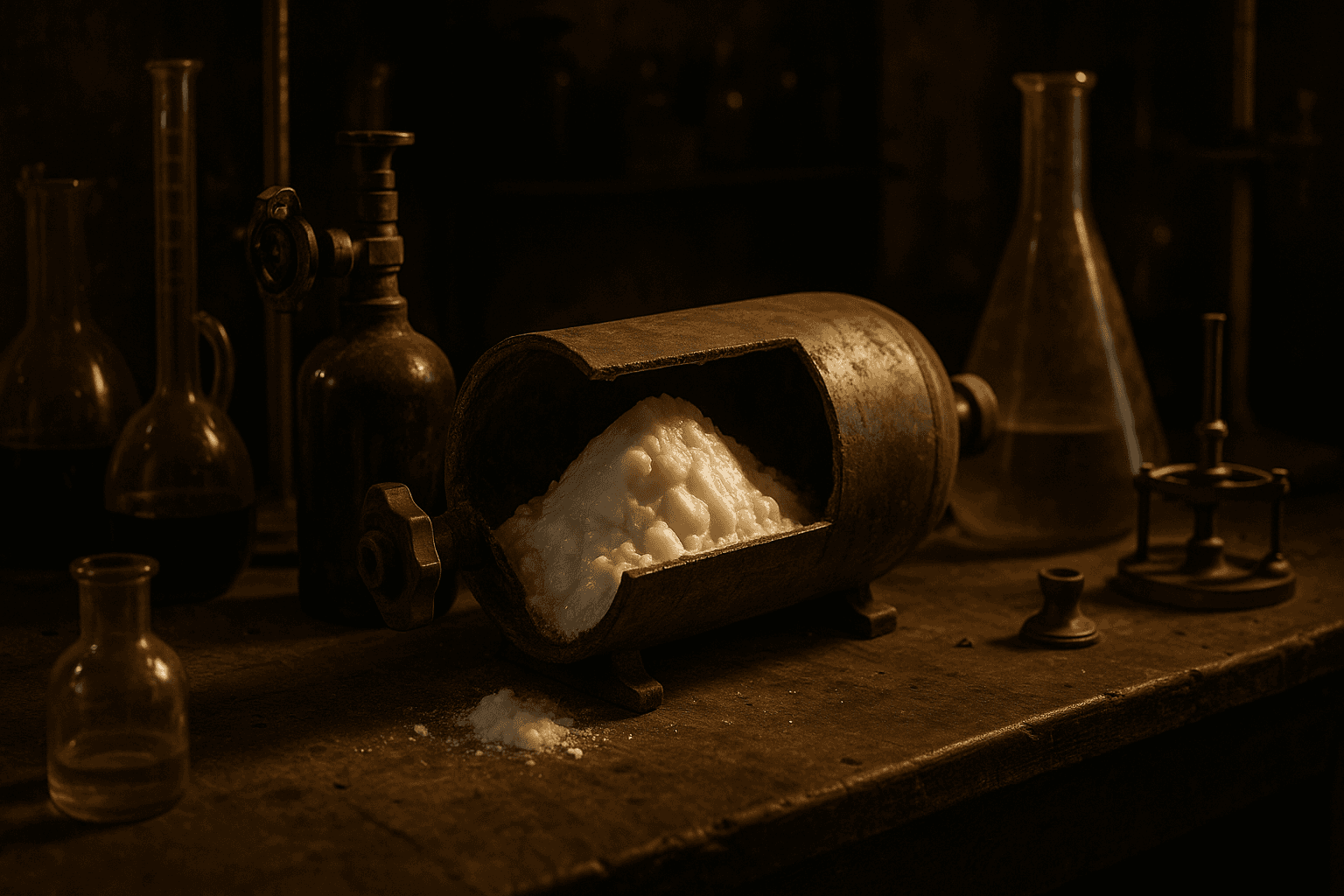
Every time a fried egg slides off the pan without leaving a trace, you're using the result of an experiment that went wrong. Teflon wasn't invented for cooking: it was born by accident in a chemistry lab, passed through the secret project that built the atomic bomb, and only decades later ended up coating frying pans around the world. It's one of those stories where a discovery is born while looking for something else entirely.
The cylinder that wouldn't empty
On the morning of April 6, 1938, a young chemist at the DuPont company named Roy Plunkett was working at the Jackson Laboratory in New Jersey. His assignment was nothing glamorous: he was looking for a new, non-toxic refrigerant gas for iceboxes, and for that he experimented with a gas called tetrafluoroethylene (TFE), which he stored compressed inside metal cylinders.
That morning, one of the cylinders released no gas when he opened the valve. Yet weighing it showed it was still as heavy as if it were full: something was inside. Intrigued, Plunkett and his assistant sawed the cylinder in half and found a white, waxy, slippery powder stuck to the walls. The gas had polymerized on its own: its molecules had joined into long chains to form a brand-new solid, polytetrafluoroethylene (PTFE). Instead of tossing out the ruined cylinder, Plunkett was curious enough to ask what the substance was. As in so many great finds, it was a textbook case of serendipity: finding something valuable while searching for something else.
The most slippery material in the world
That powder had baffling properties. It was inert to nearly every known chemical: not even the most aggressive acids attacked it. It withstood extreme temperatures without breaking down, dissolved in nothing, and, above all, was incredibly slippery. In fact, PTFE is one of the substances with the lowest coefficient of friction in existence; practically nothing sticks to it.
The reason lies in its chemistry. Each PTFE chain is a backbone of carbon atoms armored by fluorine atoms, which form with carbon one of the strongest bonds in organic chemistry. That fluorine shield is so stable and tightly packed that no other molecule can find anywhere to grip. DuPont patented the material in 1941 and registered the Teflon trademark in 1945. But by then the substance already had a secret use very far from any kitchen.
An atomic-bomb secret
During World War II, the Manhattan Project —the program that built the atomic bomb— ran into a fiendish chemical problem. To enrich uranium, engineers had to handle uranium hexafluoride, a gas so corrosive that it devoured the seals, gaskets, and valves of the pipes it flowed through. Almost no material could survive its assault.
Almost none, except DuPont's new inert plastic. PTFE, able to endure the harshest chemical, became the ideal seal for the enormous gaseous-diffusion plants at Oak Ridge, Tennessee, with their hundreds of miles of piping. The material was so strategic that its very existence stayed classified for much of the war. Teflon, which today we associate with an omelet, began its working life as a secret component of the nuclear race.
From Colette's pan to your kitchen
The leap into the kitchen wasn't made by DuPont but by a French engineer. In the early 1950s, Marc Grégoire used Teflon to coat molds and make it easier to release fiberglass fishing rods. It was his wife, Colette Grégoire, who had the decisive idea: if this substance kept things from sticking, why not apply it to her pans? She challenged him to try.
Getting the slippery plastic to adhere to hot aluminum was hard —precisely because Teflon sticks to nothing, sticking it to a pan was the challenge— but Grégoire managed it and patented the method in 1954. In 1956 the couple founded the company Tefal, a name that fuses Teflon and aluminum, with a slogan that said it all: "the pan that really doesn't stick." The success was overwhelming: by 1960 they were selling three million items a year. The nonstick pan had arrived to stay.
The other side of the miracle
Teflon seemed like a perfect material, but its story has a shadow. For decades, making PTFE required an auxiliary compound called PFOA (perfluorooctanoic acid), part of the family of perfluorinated substances now known as PFAS or "forever chemicals," because they barely break down in the environment. Research and lawsuits revealed that PFOA exposure was linked to health problems, and the industry ultimately phased it out of manufacturing from the 2010s onward.
A clarification is worth making: the already-cured PTFE coating on a modern pan is considered stable under normal use; the concern centered on the manufacturing processes and on environmental contamination, not on this morning's fried egg. In its tension between usefulness and risk, it's a story much like when lead was in almost everything: materials that solved one problem and created another we were slow to understand.
So the next time you watch an egg glide effortlessly across the pan, remember the improbable chain that made that gesture possible: a refrigerant that never came, a cylinder that wouldn't empty, a wartime secret, and the bright idea of a Frenchwoman who looked at a fishing mold and thought of dinner. Not so different, in the end, from how a melted chocolate bar gave rise to the microwave.
References
- "Roy J. Plunkett," Science History Institute: the chemist's biography and the April 6, 1938 accident at DuPont's Jackson Laboratory. sciencehistory.org
- "The Long, Strange History of Teflon," Smithsonian Magazine: from the accidental discovery to its use in the Manhattan Project and its commercial life. smithsonianmag.com
- "Marc Grégoire," Wikipedia: the French engineer, Colette's idea, and the founding of Tefal in 1956. wikipedia.org
- "The history of PFAS: From World War II to your Teflon pan," Manufacturing Dive: PFOA, the "forever chemicals," and their removal from manufacturing. manufacturingdive.com
Enjoy these stories of accidental inventions? Continue with how a microwave works and the word serendipity, or explore the whole science and technology section.
Categories
The books · born from this blog
Atahualpa con su abrigo de pelo de murciélago
y otras 49 historias verdaderas que parecen mentira
Available on Amazon
Tocar madera
Pequeña historia de las supersticiones que el mundo no ha podido soltar
Available on Amazon
100 futuros
Cien escenarios del mundo que viene con la inteligencia artificial
Available on AmazonYou may also like
Why veins look blue when your blood is red
Human blood is never blue—it is always red. So why do veins look blue under the skin? The answer lies in how light travels through your body and how you see.
The History of the Match: Fire in Your Pocket
The friction match was born by accident in 1826, poisoned thousands of factory women, and only later became the safe fire we carry in our pocket.
The nocebo effect: when expecting harm creates it
The nocebo effect is the placebo's dark twin: believing a treatment will hurt can make it hurt. Its origin, real cases and what science says.