
Atahualpa's Chess Game Is Legend; His Bat-Hair Cloak Is Not
Two stories from Atahualpa's captivity: the chess game everyone cites and a cloak woven from bat hair. Only one of them is documented.
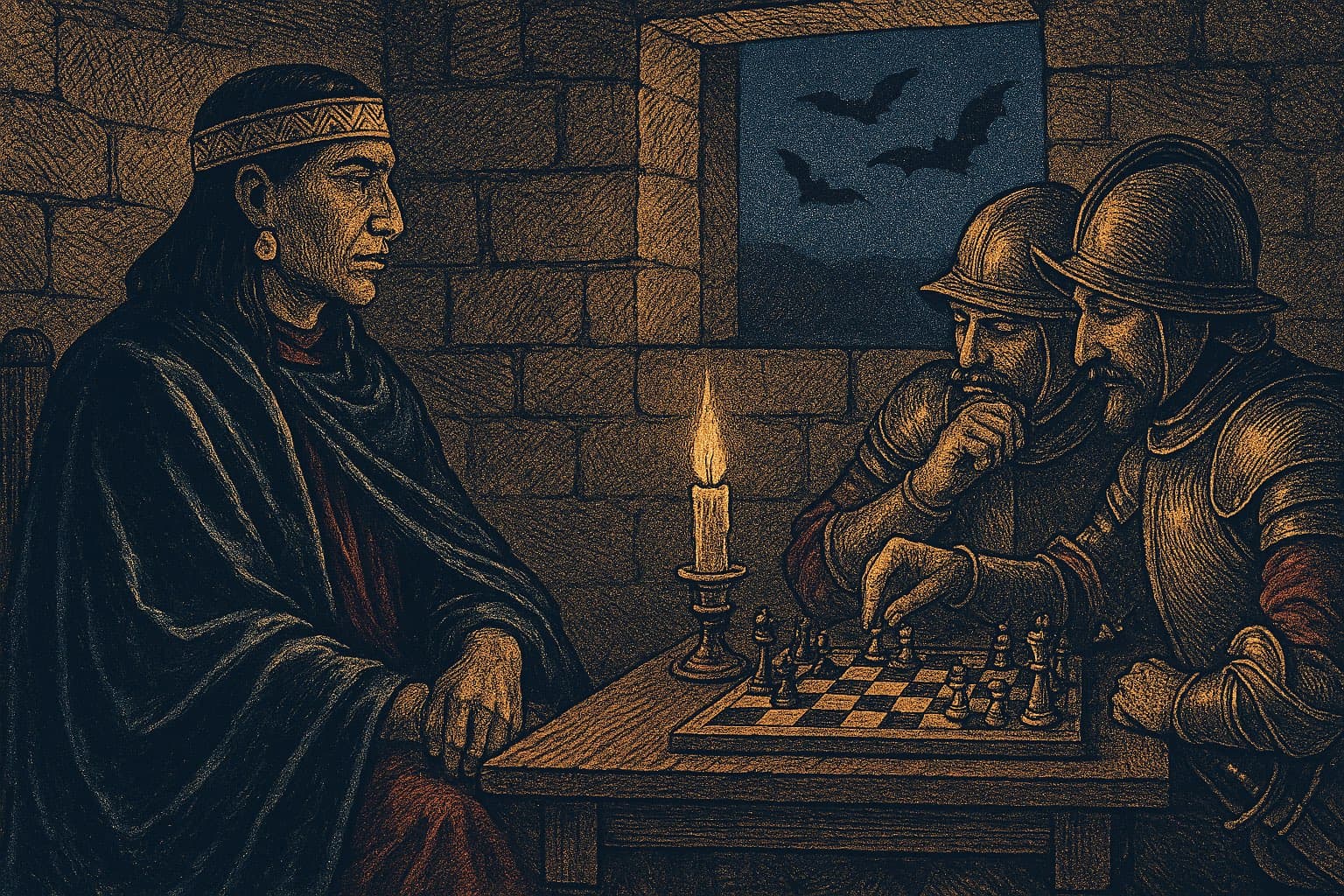
From Atahualpa's captivity in Cajamarca —the eight months between his capture in 1532 and his execution in 1533— two extraordinary stories circulate. One is cited by everyone: that of the Inca who learned chess by watching his captors play and humiliated a Spaniard with a single move. The other almost nobody knows: that of the cloak woven from bat hair, softer than silk. And here comes the twist that makes this pair perfect for this blog: the famous story is literature, and the implausible story is documented by an eyewitness. Let's take them one at a time, because both deserve it.
The chess game everyone cites
The celebrated version comes from Ricardo Palma, the great Peruvian man of letters, in “Los incas ajedrecistas” (The Chess-Playing Incas). According to Palma, Atahualpa watched in silence, evening after evening, the chess games of his jailers. One day, while Hernando de Soto was playing against the treasurer Riquelme, the Inca broke his silence to suggest a move to Soto — “the castle,” the rook — with which Soto won the game. From then on Soto played with him, giving him a knight's odds, and Atahualpa proved a more than worthy opponent. The ending is perfect tragedy: Riquelme, humiliated, would later cast one of the deciding votes in the council that condemned the Inca to death. Palma's ironic conclusion: knowing how to play chess cost Atahualpa his life.
It is a gem. The problem is that Palma wrote it at the end of the 19th century, more than 350 years after the events, in his Tradiciones peruanas — a genre that deliberately blends history, rumor and fiction, which is precisely its charm. No chronicler present at Cajamarca —not Jerez, not Estete, not Pedro Pizarro— mentions the game, the move, or Riquelme's revenge. What the chronicles do record is the plausible core: that Atahualpa learned to play chess and dice during his captivity, and that he learned everything with a speed that astonished the Spaniards. The chess-playing Inca is credible; the game with the deadly moral is, almost certainly, Palma's invention — so well told that it has spent a century sneaking into serious books as if it were history.
The cloak nobody would believe (which is true)
The second story is told by Pedro Pizarro —the conquistador's cousin, a direct witness at Cajamarca— in his Relación of 1571. One day, Atahualpa appeared wearing a dark cloak of a softness that disconcerted the Spaniard: smoother than silk to the touch. Pizarro asked him what it was made of, and the Inca's answer is one of the best lines of the entire conquest: of bat hair — from the bats that fly at night in Puerto Viejo and Tumbes, whose people hunted them and collected their hair as tribute.
Pause a moment on the logistics, which is where the astonishment lives: how many bats must one “shear” to weave an entire cloak? The garment was a practical impossibility for any mortal — and that is exactly why the Sapa Inca wore it. It was the tributary machine of the Tahuantinsuyo converted into cloth: entire coastal provinces —the coast of present-day Ecuador, as it happens— paying taxes in bat hair. And the same passage by Pedro Pizarro holds another staggering detail: the Inca's clothing was worn only once. Everything Atahualpa touched, wore or left behind —including food scraps and strands of hair— was stored in chests and ritually burned: no one could touch what the son of the Sun had touched, and nothing of his could be left within reach of witchcraft. The man who wore single-use bat cloaks was the prisoner of men who had spent months in the same shirt.
Why we believe the legend and not the chronicle
The deeper question remains, and it is an old acquaintance of this house: why does the invented story circulate as fact while the documented one sleeps in the chronicles? For the same reason as always, the one we saw with the curse of Tutankhamun: the chess legend is a perfect story — it has wit, humiliation, revenge and a moral in four acts. The reality of the cloak, by contrast, has no plot: it is merely a fact — but a fact so strange, so revealing of what the Tahuantinsuyo was, that it is worth ten tragedies. That is perhaps Cajamarca's lesson for storytellers: when the truth includes Ecuadorian bats sheared as imperial tribute and sacred single-use wardrobe, there is no need to invent anything. Palma, who was a genius, knew it — that is why he signed “traditions,” not history. We are the ones who stopped reading the fine print.
References
- Ricardo Palma, “Los incas ajedrecistas,” in Tradiciones peruanas (fourth series, 1877; collected in Tradiciones peruanas completas, Madrid, Aguilar).
- Pedro Pizarro, Relación del descubrimiento y conquista de los reinos del Perú [1571], ed. Guillermo Lohmann Villena, Lima, Pontificia Universidad Católica del Perú, 1978. archive.org
The books · born from this blog
Atahualpa con su abrigo de pelo de murciélago
y otras 49 historias verdaderas que parecen mentira
Available on Amazon
Tocar madera
Pequeña historia de las supersticiones que el mundo no ha podido soltar
Available on Amazon
100 futuros
Cien escenarios del mundo que viene con la inteligencia artificial
Available on AmazonYou may also like

Tagua: the Vegetable Ivory That Buttoned Europe
Tagua, the seed of an Ecuadorian palm, mimicked ivory and buttoned the world's clothes for decades, until cheap plastic pushed it aside almost overnight.
David Todd and his tunnel to the top of Chimborazo
In 1922 astronomer David P. Todd proposed boring a tunnel into Chimborazo all the way to the summit to build a pressurized steel observatory inside it.
Ecuador's Cacao Boom: When the Golden Bean Ruled
Between 1880 and 1920 Ecuador was the world's top cacao exporter. The «golden bean» built fortunes in Guayaquil until a silent plague brought it all down.