
Ecuador's Cacao Boom: When the Golden Bean Ruled
Between 1880 and 1920 Ecuador was the world's top cacao exporter. The «golden bean» built fortunes in Guayaquil until a silent plague brought it all down.
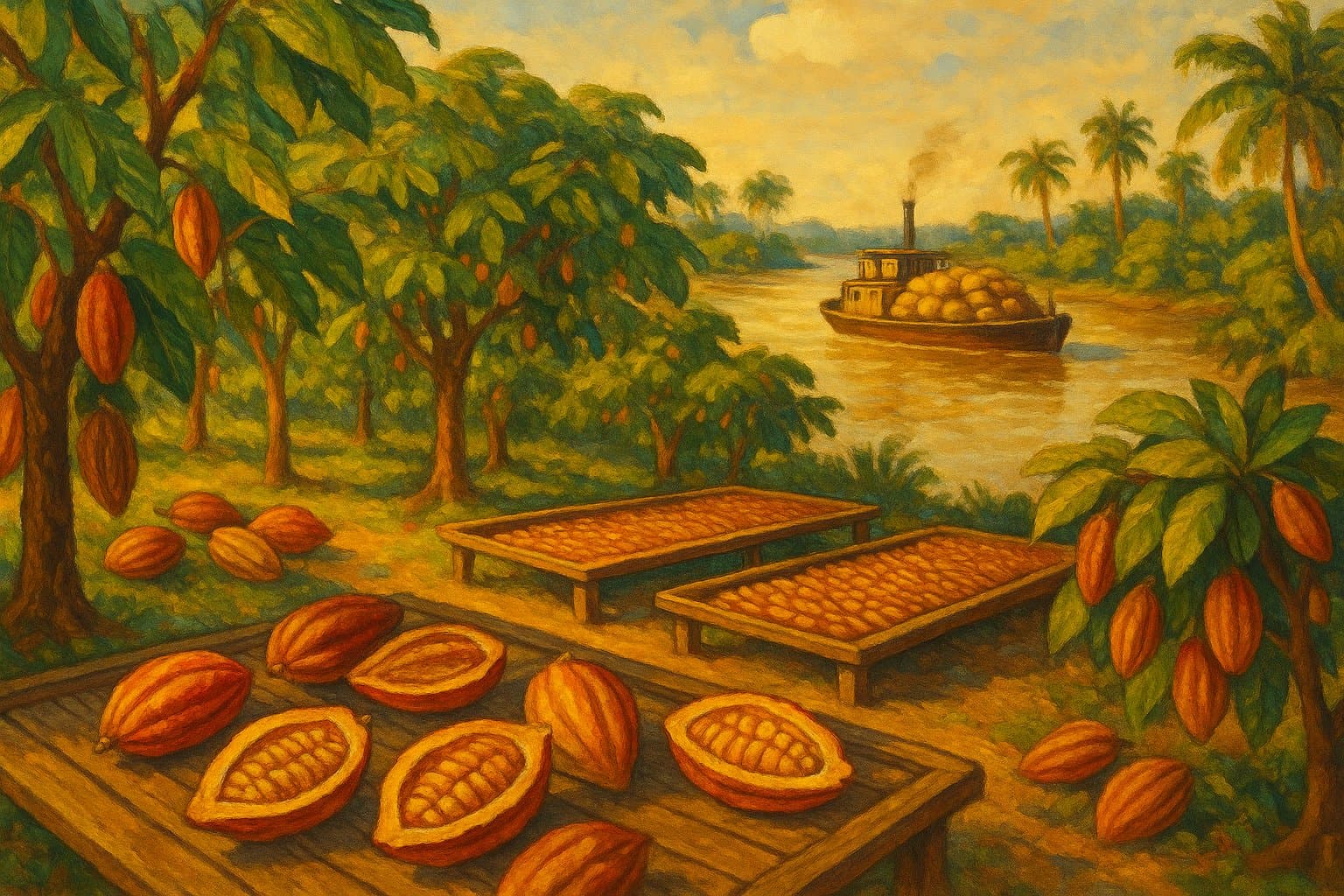
For half a century, a small South American country fed much of the planet's chocolate. Between the late nineteenth century and the first decades of the twentieth, Ecuador was the world's leading cacao exporter, and the seed that made it possible earned a nickname that says it all: the «golden bean» (pepa de oro). That cacao fever built mansions in Guayaquil, financed a revolution and sent entire families to live in Paris. And then, almost as fast as it arrived, a silent plague wiped it off the map.
An ancient seed
Cacao did not arrive in Ecuador: it came from there. Archaeological finds from the Mayo-Chinchipe culture, in the country's southern Amazon, show that the fruit was cultivated and consumed more than 5,000 years ago, making it one of the oldest known evidences of cacao domestication in the world. Long before the Aztecs whisked their bitter drink —the same one that gave birth to the word «chocolate»— the plant already had centuries of history in the Andean foothills.
From there came a native variety, Nacional cacao, famous for its floral aroma and complex flavor. Merchants sailing up the Guayas River would ask the farmers where those fragrant beans came from, and the answer was always the same: arriba, upriver. And so, almost by accident, the name European chocolatiers gave it —and still ask for— was born: «Arriba» cacao.
The boom of the «golden bean»
From 1870 onward, world demand for cacao exploded. Europe and the United States had fallen in love with sweet, solid chocolate and needed raw material by the ton. Ecuador's south-central coast, around the port of Guayaquil, answered by planting cacao groves as far as the eye could see. The takeoff figures are brutal: the country went from exporting some 172,000 quintals on average in the decade of 1861–1870 to more than 817,000 in 1911–1920, brushing one million quintals in its best years, around 1916.
At its peak, Ecuador supplied more than half of the world's fine cacao. Cacao led the nation's exports for decades and became the engine of the entire economy. It was a classic case of a fortunate monoculture, much like other raw-material fevers that enriched whole regions overnight, such as when rubber made the Amazon the richest place on Earth.
The «Gran Cacao»
All that wealth concentrated in a handful of families who owned the great estates. They were known as the «Gran Cacao»: names like Aspiazu, Seminario, Morla, Durán Ballén and Rosales who amassed staggering fortunes and political power. They were so rich that many lived between Guayaquil and Paris, educated their children in Europe and moved their capital through the Guayaquil banks they themselves controlled.
That money did not stay out of politics. The coastal agro-export oligarchy was the main financial backing of the Liberal Revolution of 1895 and its leader, General Eloy Alfaro. Cacao, quite literally, helped fund the side that transformed modern Ecuador: the railway, secularism, the civil registry. For a few decades, the golden bean didn't just move fortunes: it moved the whole country.
The collapse
The fall began with money. World War I upended markets and sank prices, and at the same time formidable competitors appeared: the African colonies, above all the Gold Coast (today's Ghana), and Brazil began flooding the market with cheaper cacao. Ecuador's share of world trade plummeted.
But the final blow was not economic but biological. Around 1916, a fungus appeared in the Balao area, «monilla» (frosty pod rot), which rotted the pod before it could be harvested. And in 1922 came something worse: «witches' broom», a disease that not only ruined the fruit but deformed and killed the whole plant. With no effective fungicides and no knowledge of how to fight them, the two plagues devastated the groves: production fell to around 30% of what it had been. The golden bean was rotting on the tree.
Crosses on the water
The cacao crash was not only a problem for landowners. When the chain of payments broke, bankruptcies, unemployment and misery followed, hitting Guayaquil hard —the city that had lived off the port and the golden bean. The tension exploded into a general strike and, on November 15, 1922, security forces fired on the workers gathered in the city center. Estimates speak of between one thousand and fifteen hundred dead, whose bodies were thrown into the Guayas River. Popular memory remembers it as the «crosses on the water» massacre.
It was the dark flip side of the fever: the same monoculture economy that had raised fortunes left thousands with nothing when the tree fell sick. As in every bubble —from the Amazon rubber boom to any single-product surge— what rises fast tends to fall just as fast, and the cost is paid by those who have the least.
The return of the golden bean
The Nacional variety was so decimated that it nearly disappeared. In 2009, Ecuador's agricultural institute INIAP analyzed the DNA of thousands of trees across the country and found that, of some 11,000 samples, only six were genetically pure Nacional cacao. The legendary aroma had almost gone extinct with the plagues.
And yet, a century later, cacao became an Ecuadorian source of pride again. Today the country produces more than 60% of the world's fine-aroma cacao, the most prized for premium chocolate, and international prices are living through a new boom. The story of the golden bean is that of a country that had the best cacao on the planet, lost it to a plague and a war, and took a hundred years to win back the throne. Few seeds have carried so much: fortune, revolution, tragedy and, in the end, a second chance.
References
- «Nacional (cocoa bean)», Wikipedia. en.wikipedia.org
- «Historia del cacao», Anecacao (National Association of Cacao Exporters). anecacao.com
- «Huelga general de noviembre de 1922», Wikipedia. es.wikipedia.org
- «La época cacaotera del Ecuador», Taller de Historia Económica. the.pazymino.com
Do you enjoy stories of economic booms and busts? Continue with the Amazon rubber fever or explore the whole history section.
The books · born from this blog
Atahualpa con su abrigo de pelo de murciélago
y otras 49 historias verdaderas que parecen mentira
Available on Amazon
Tocar madera
Pequeña historia de las supersticiones que el mundo no ha podido soltar
Available on Amazon
100 futuros
Cien escenarios del mundo que viene con la inteligencia artificial
Available on AmazonYou may also like
Why Is the Panama Hat Called Panama If It Was Born in Ecuador?
The world's most famous hat is woven in Montecristi and Cuenca, yet it bears another country's name. The story of a stylish injustice.
The 1949 Ambato Earthquake: One of Ecuador's Most Devastating Disasters
On August 5, 1949, a 6.8 quake flattened Ambato and Pelileo, killing thousands and leaving cities in ruins in one of Ecuador's deadliest disasters.
A window to Ecuador from a century ago. Photo restoration.
Restored and colorized photos open a vivid window onto Ecuador a century ago, from presidents and earthquakes to long-vanished railways.