
The Origin of the Word “Barbarian”
Where does barbarian come from? To Greek ears, foreigners who didn't speak Greek just went “bar bar”. The story of a word that changed meaning.
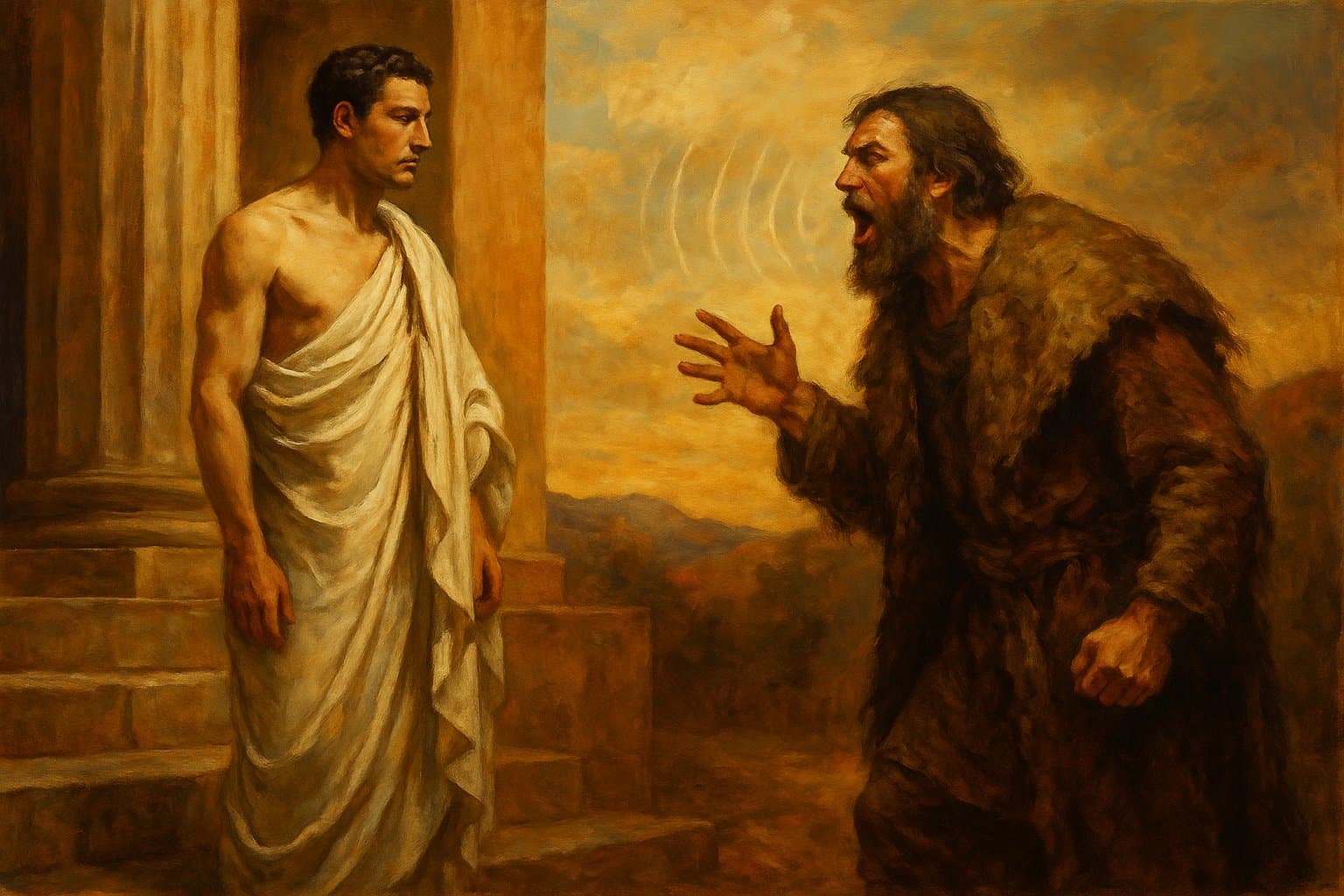
Today a barbarian is the one who destroys, who plunders, who eats with his hands and shouts at the table. Yet the word shares a single, surprisingly humble root: not a fierce people, not a battle, but a sound. To the Greek ear, anyone who didn't speak Greek said nothing intelligible — just “bar bar bar”. And from that phonetic mockery — one of the most honest etymologies there is — came one of the most well-traveled words in history.
A sound, not yet an insult
The Greek word βάρβαρος (bárbaros) is what linguists call a reduplicated onomatopoeic formation: it imitates the incomprehensible babble of the foreigner by repeating a meaningless syllable, just as we say “blah blah” today. Greek was not alone in this: Sanskrit had barbara, “stammering, babbling”, tied to the very same idea. The Greeks, for whom their own language was the measure of the civilized, heard in every foreign tongue a noise — and turned that noise into a name.
What matters is that the word carried no contempt at first. Its earliest known appearance is in Homer's Iliad, which describes the Carians —allies of Troy— as barbarophonoi, “of incomprehensible speech”. Homer doesn't call them savages or cowards; he simply notes that they didn't speak Greek. It was a linguistic label, not a moral verdict. A barbarian was, quite literally, someone whose language you couldn't understand.
The word a war changed
The turn came in the 5th century BC, with the Greco-Persian Wars. When all of Greece united against a common enemy, “barbarian” stopped meaning “the one who talks funny” and started meaning “the other”: the Persian, the non-Greek, and by extension whoever was assumed to be servile, despotic and a stranger to the freedom of the Greek cities. The word took on all the pride of the victors of Marathon and Salamis. From neutral description it became a banner of identity: us, the Greeks, against them, the barbarians. That same Greece which left us mechanisms as sophisticated as ostracism also drew the line separating the civilized from those who were not.
When the barbarians entered Rome
Rome inherited the word intact, as barbarus, and with it the habit of splitting the world between a civilized interior and a threatening exterior. To the Romans, the barbarians were the peoples beyond the frontiers: Germans, Gauls, Goths, Vandals. The irony is famous: those very “barbarians” ended up entering the Empire, first as soldiers and settlers, then as conquerors, until in AD 476 a Germanic chieftain deposed the last emperor of the West. The word Greece had coined to laugh at an accent ended up naming those who wrote the ending of Rome. From there, now fully pejorative —“savage, uncultured, cruel”— it passed into medieval Latin, into the Romance languages, and into English.
The Berbers and a final irony
The word had one more unexpected bounce. When the Arabs conquered North Africa, they took the Greek bárbaros —probably by way of Latin— and applied it to the peoples already living there: the Berbers. From that Arabic barbar came the demonym “Berber”, the name of the region (the Barbary Coast) and even the dreaded “Barbary pirates” of the Mediterranean. In other words: an entire people ended up being called, without anyone realizing it, “the ones who babble”.
And the irony is completed by what they call themselves. The Berbers do not call themselves Berbers: they say imazighen, which in their language means “free men”. While the rest of the world was baptizing them with a borrowed insult handed down from the Greeks, they kept for themselves a name that spoke of freedom. As happened with the word slave —born from the name of an entire people—, the story of “barbarian” is the story of how one language decides, out of convenience or arrogance, what everyone else is called. Sometimes the word we use without a second thought hides, in its first syllable, the noise someone once ascribed to a language they didn't care to understand.
References
- Homer, Iliad 2.867: the Carians of Nastes are described as barbarophonoi, “of barbarous / incomprehensible speech” — the term's only appearance in Homer. Trans. A. T. Murray, Perseus Digital Library. perseus.tufts.edu
- “βάρβαρος”, Wiktionary: a reduplicated onomatopoeic formation (βαρ-βαρ) imitating the unintelligible speech of the foreigner; compared with Sanskrit barbara, “stammering”. en.wiktionary.org
- “Barbarian”, Encyclopædia Britannica: original Greek use as a linguistic term for all non-Greeks, which turned pejorative after the 5th-century-BC Greco-Persian Wars. britannica.com
- “Barbary”, Online Etymology Dictionary: “Barbary” and “Berber” derive from Arabic barbar, itself from Greek bárbaros by way of Latin. etymonline.com
Enjoy the stories behind words? Continue with the origin of the word “sybarite” and the origin of the word “slave”, or browse the whole etymology series.
The books · born from this blog

Atahualpa con su abrigo de pelo de murciélago
y otras 49 historias verdaderas que parecen mentira
Available on Amazon
Tocar madera
Pequeña historia de las supersticiones que el mundo no ha podido soltar
Available on Amazon
100 futuros
Cien escenarios del mundo que viene con la inteligencia artificial
Available on AmazonYou may also like
The Origin of the Word “Quarantine”: 40 Days in Venice
Where does the word quarantine come from? From the 40 days that Venice and Ragusa forced ships to wait during the Black Death. Here is its story.
The Origin of the Word “Dollar”: a Bohemian Valley
Where does the word dollar come from? From a silver-mining valley in Bohemia and a 16th-century coin. The story of the thaler that conquered the world.
The Origin of the Word “Museum”: House of the Muses
Where does the word museum come from? From mouseion, the temple of the Greek Muses and the great center of learning in Alexandria, long before glass cases.