
Scurvy: the disease that killed more sailors than storms
Scurvy killed more sailors than battles and shipwrecks combined. Its cure was discovered, forgotten, and rediscovered over and over for centuries.
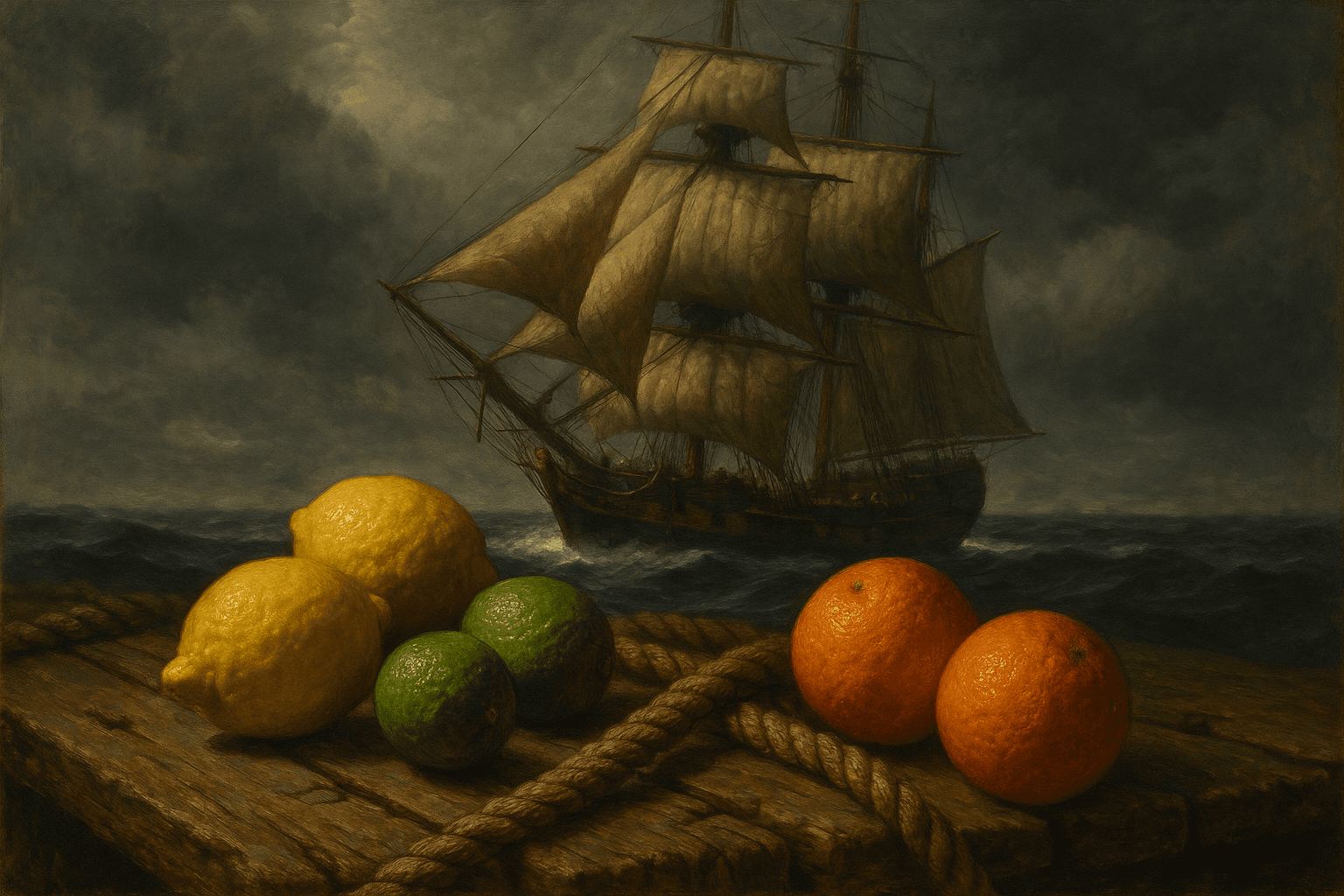
During the great age of sail, a sailor's deadliest enemy was not the storm, nor enemy fire, nor shipwreck: it was a silent disease that began with bleeding gums and ended in death on deck. Scurvy killed some two million sailors between the fifteenth and eighteenth centuries, more than all the naval battles of the era combined. And the most astonishing part is that its cure was cheap, simple, and within arm's reach the whole time: all you had to do was eat fruit.
A slow death on board
Scurvy appears when the body goes too long —sometimes as little as three months— without vitamin C. Human beings, unlike almost every other animal, cannot manufacture it: we have to get it from food. And on a sailing ship, the diet was exactly the opposite of what was needed: dry biscuit, salted meat, and no fresh fruit or vegetables for weeks or months.
Without vitamin C, the body stops producing collagen, the protein that holds tissues together. The consequences were gruesome and unmistakable: spongy, bleeding gums, teeth that loosened and fell out, old wounds that reopened, bleeding under the skin, extreme exhaustion, and finally death. Sailors described a fatigue that left them lying down, unable to move, while their bodies literally came apart at the seams from the inside.
The price of every great voyage
No long expedition was spared. When Vasco da Gama opened the route to India around Africa in 1497-1499, he lost roughly two-thirds of his crew to scurvy. On the first circumnavigation, by Magellan and Elcano, the disease decimated the men during the endless Pacific crossing. A century and a half later the story repeated itself: on Commodore George Anson's voyage around the world (1740-1744), more than half of his nearly two thousand men died, the overwhelming majority from scurvy.
These numbers lived alongside the same paradox as the rest of the medicine of the time, when the causes of disease were still not understood and the sick were isolated as a precaution, as told in the story of the word "quarantine" or that of the smallpox that changed empires. Scurvy was so constant that it was counted as a predictable cost of the voyage, like food or sails.
The first clinical trial in history
The solution came from a Scottish naval surgeon, James Lind. In 1747, aboard HMS Salisbury, he did something revolutionary: instead of theorizing, he experimented. He took twelve sailors sick with scurvy, with similar symptoms, and divided them into six pairs. He gave them all the same base diet, but added a different "remedy" to each pair: cider, vinegar, seawater, diluted sulfuric acid, a spice paste… and, to one of them, two oranges and a lemon a day.
The result was unambiguous. In just six days, the citrus pair had almost completely recovered; one was already fit to return to duty. None of the other remedies did any good. Without knowing he was founding a method, Lind had carried out one of the first controlled clinical trials in the history of medicine. He published his findings in 1753, in A Treatise of the Scurvy.
A cure the world insisted on forgetting
Here comes the most frustrating part of this story. Having the proof was not enough. The British Royal Navy took almost half a century to act: not until 1795 did it order a daily ration of lemon juice for every sailor. When it finally did, scurvy all but vanished from its ships in one stroke. The English grew so fond of the citrus that other navies began, mockingly, to call them limeys.
But the cure was lost again. Seeking to cut costs, the Navy switched from lemon to lime from its Caribbean colonies, not knowing that lime contains considerably less vitamin C. Worse still: pressing the juice, boiling it, and storing it in copper destroyed what little vitamin remained. When Robert Falcon Scott's Antarctic expedition tried to reach the South Pole in 1911, his men fell ill with scurvy once more: humanity had forgotten yet again why the remedy worked.
The culprit gets a name: vitamin C
The mystery was not fully solved until the twentieth century. In 1932, the Hungarian biochemist Albert Szent-Györgyi —alongside the parallel work of the American Charles Glen King— identified the substance that cured scurvy: the "hexuronic acid" he had isolated years earlier was, in fact, vitamin C. He renamed it ascorbic acid, from the Latin scorbutus with the privative a: literally, "anti-scurvy." In 1937 he received the Nobel Prize for that and other discoveries.
So a circle nearly four centuries wide finally closed. A disease that had decided the fate of entire expeditions —as much as navigation inventions like the compass did— turned out to stem from the lack of a molecule we now find in a single orange. Scurvy thus joins that long list of ills that science eventually dismantled, like the bark that became a malaria remedy and later gin and tonic. The most uncomfortable lesson is not that we took so long to find the cure, but how many times, having it, we chose to forget it.
References
- «Scurvy», Encyclopædia Britannica. britannica.com
- «James Lind and the first clinical trial», James Lind Library. jameslindlibrary.org
- «Albert Szent-Györgyi and the Discovery of Vitamin C», American Chemical Society. acs.org
- «Sailors' scurvy before and after James Lind — a reassessment», PubMed / Nutrition Reviews. pubmed.ncbi.nlm.nih.gov
Enjoy the stories behind science? Continue with the smallpox that changed empires or explore the whole history section.
Categories
The books · born from this blog
Atahualpa con su abrigo de pelo de murciélago
y otras 49 historias verdaderas que parecen mentira
Available on Amazon
Tocar madera
Pequeña historia de las supersticiones que el mundo no ha podido soltar
Available on Amazon
100 futuros
Cien escenarios del mundo que viene con la inteligencia artificial
Available on AmazonYou may also like
Smallpox: the disease that changed empires
Smallpox killed some 300 million people in the 20th century, helped topple empires, and became the first human disease ever fully eradicated.
The history of the stethoscope and Laennec's modesty
In 1816 a French doctor felt too awkward to press his ear to a patient's chest, so he rolled up paper — and the stethoscope was born.
Anesthesia: when surgery was pure torture
Before 1846, surgery meant sheer agony and surgeons who amputated a leg in 30 seconds. This is how anesthesia was born and transformed medicine.