
Anesthesia: when surgery was pure torture
Before 1846, surgery meant sheer agony and surgeons who amputated a leg in 30 seconds. This is how anesthesia was born and transformed medicine.
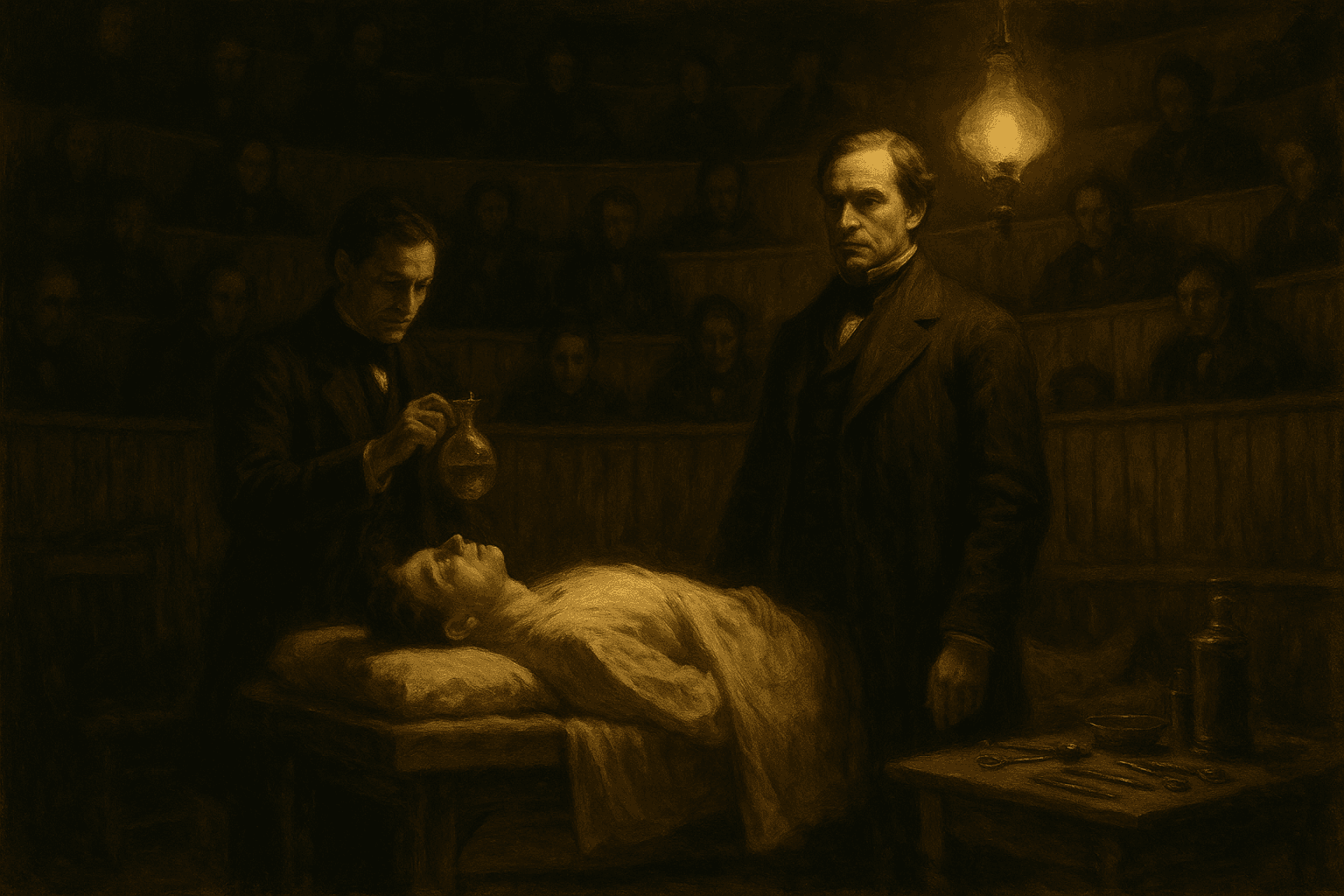
Imagine you need an operation, but anesthesia does not exist. You are wide awake, strapped to the table, with several men pinning down your arms and legs while the surgeon cuts, saws and cauterizes. Your screams fill the operating room. That is what surgery was like for almost all of human history: not a calm remedy, but a conscious torture that many patients preferred to avoid even at the cost of their lives. Everything changed one morning in 1846, when an invisible gas turned pain into silence.
When speed was everything
With nothing to numb the patient, the only mercy a surgeon could offer was speed. The shorter the ordeal, the less pain, the less blood, and the better the odds of surviving the shock. That is why, before anesthesia, the best surgeon was not the most precise one, but the fastest.
The most famous case was the Scot Robert Liston, nicknamed "the fastest knife in the West End," able to amputate a leg in just 30 seconds. Before starting he would shout to his students, stopwatch in hand: "Time me, gentlemen, time me!" One anecdote about him captures the horror of those operating rooms: during a lightning-fast amputation he supposedly also sliced off his assistant's fingers and slashed a spectator's coat. The patient and the assistant later died of infection, and the spectator, convinced he had been stabbed, dropped dead from fright. It is, according to legend, the only operation in history with a mortality rate of 300 percent. True or exaggerated, the story describes a world in which surgery was a last, desperate resort — something as brutal as it is fascinating, which also surfaces in the history of rhinoplasty, the oldest plastic surgery.
Ether Day
The problem was not a lack of substances able to stun a person. Ether and nitrous oxide — the famous "laughing gas" — had been known for decades, but they were used mainly for fun at the strange parties to inhale anesthesia of the nineteenth century, not for surgery. No one had taken the step of bringing them seriously into the operating room and proving they worked.
That step was taken by a Boston dentist, William T. G. Morton. On October 16, 1846, in the surgical amphitheater of Massachusetts General Hospital, Morton administered sulfuric ether vapor to a patient named Edward Gilbert Abbott. Before a room full of skeptical doctors, the distinguished surgeon John Collins Warren removed a tumor from the patient's neck without him screaming or writhing. When he finished, Warren turned to the audience and uttered a line that went down in history: "Gentlemen, this is no humbug."
The news traveled the world in weeks. That amphitheater has been known ever since as the Ether Dome, and October 16 became Ether Day. In fairness, a country doctor in Georgia, Crawford Long, had already operated with ether in 1842, but he did not publish his results; it was the public demonstration in Boston that changed medicine forever.
A new word for a new world
That state of insensitivity to pain needed a name. Weeks after the demonstration, the physician and writer Oliver Wendell Holmes wrote to Morton proposing to call it anesthesia, from the Greek an- ("without") and aisthesis ("sensation"): literally, "without sensation." The word caught on immediately and christened not just a procedure but an entire new branch of medicine. As so often happens, a scientific discovery brings its own vocabulary with it — much as it did with diseases that rewrote history, like smallpox, the disease that changed empires.
Chloroform and the Queen
Ether had drawbacks: it was irritating, it smelled terrible, and it was dangerously flammable near the operating room's lamps. So in 1847 the Scottish obstetrician James Young Simpson looked for an alternative. After testing various substances in his own home — with him and his colleagues passing out around the table — he hit upon chloroform, more potent and pleasanter to inhale. Simpson boldly introduced it into childbirth.
But anesthesia in labor ran into strong religious objections: some argued that the pain of childbirth was a divine command and should not be eased. The debate was settled at a stroke in 1853, when the physician John Snow administered chloroform to Queen Victoria herself during the birth of her son, Prince Leopold. If it was good enough for the Queen, it was good enough for anyone. Chloroform became respectable overnight, and in Britain it grew popular under the name "anesthesia à la reine," the Queen's anesthesia.
In just seven years, humanity had gone from holding down screaming patients to sending them peacefully to sleep. Anesthesia not only abolished an unimaginable suffering: by freeing the surgeon from the race against the clock, it let him operate slowly, carefully and deeply. Without it, today's complex operations would not exist. It was, perhaps, one of the most humane gifts that science has ever given to medicine.
References
- «The Ether Dome», Massachusetts General Hospital. massgeneral.org
- «History of Anesthesia», Wood Library-Museum of Anesthesiology. woodlibrarymuseum.org
- «Anesthesia à la Reine», McGill University — Office for Science and Society. mcgill.ca
- «Anesthetic», Encyclopædia Britannica. britannica.com
Enjoy the stories behind science? Continue with the parties for inhaling laughing gas or explore the whole history section.
Categories
The books · born from this blog
Atahualpa con su abrigo de pelo de murciélago
y otras 49 historias verdaderas que parecen mentira
Available on Amazon
Tocar madera
Pequeña historia de las supersticiones que el mundo no ha podido soltar
Available on Amazon
100 futuros
Cien escenarios del mundo que viene con la inteligencia artificial
Available on AmazonYou may also like
The history of the stethoscope and Laennec's modesty
In 1816 a French doctor felt too awkward to press his ear to a patient's chest, so he rolled up paper — and the stethoscope was born.
Scurvy: the disease that killed more sailors than storms
Scurvy killed more sailors than battles and shipwrecks combined. Its cure was discovered, forgotten, and rediscovered over and over for centuries.
Smallpox: the disease that changed empires
Smallpox killed some 300 million people in the 20th century, helped topple empires, and became the first human disease ever fully eradicated.