
Knock on Wood: The Real Origin of the Superstition
Almost everyone thinks knocking on wood comes from Celtic tree worship. But the documented trail leads to a far more recent origin: a children's game.
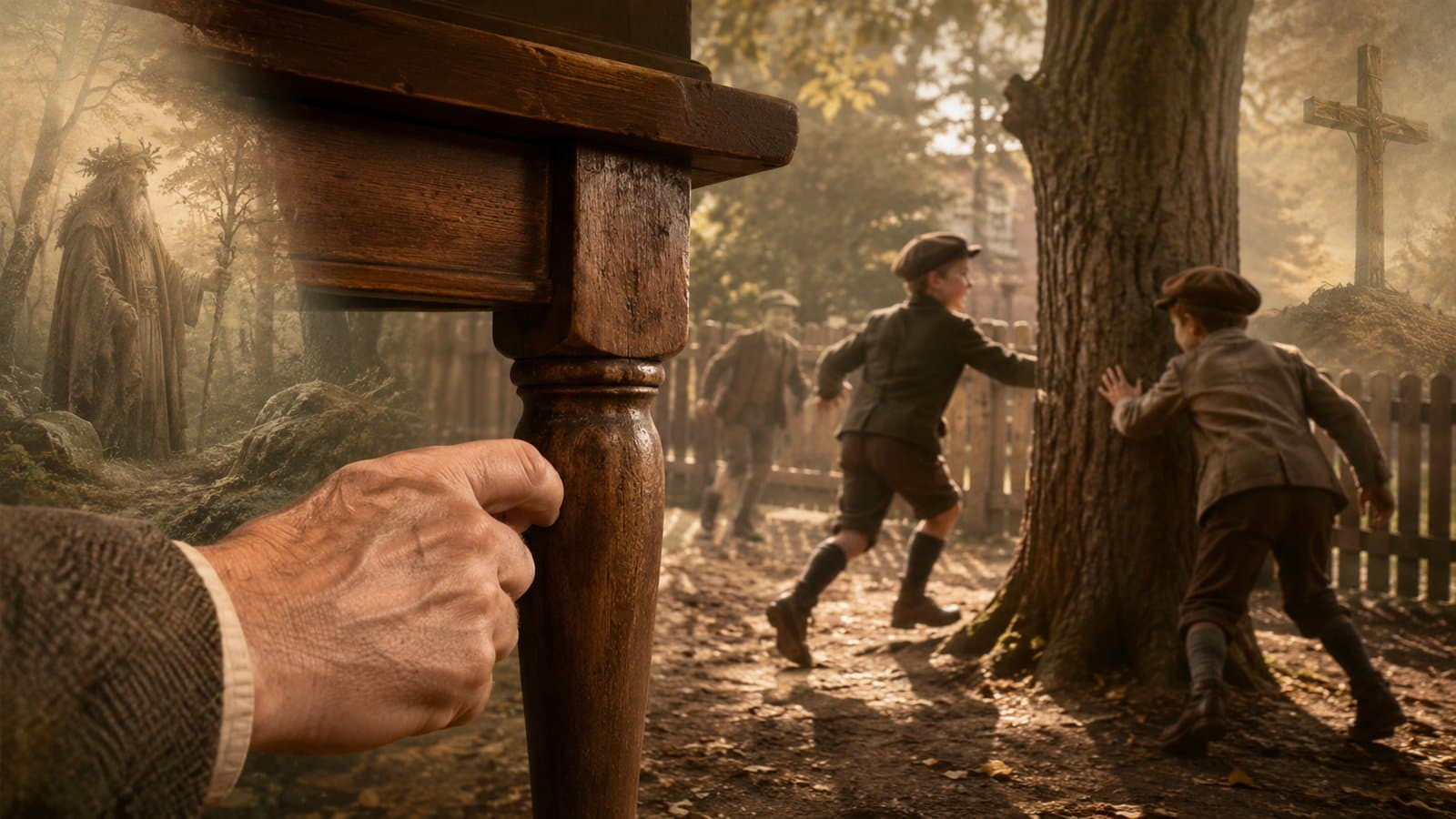
You say out loud, «I haven't been sick once this year», and the next instant your hand is groping under the table for a leg to knock on wood. It is one of the most universal gestures there is: the believer does it and so does the skeptic, almost as a reflex, so that luck won't turn against us for having tempted fate. And nearly all of us think we know where it comes from: the ancient Celts, who worshipped the spirits of the trees. It is a beautiful story. The trouble is that, once you follow the documented trail, that story falls apart and a far more recent —and far humbler— origin appears than we like to imagine.
The explanation everyone repeats: trees, spirits and the cross
The popular version has two branches, and both sound so good that they get retold at any dinner table. The first is pagan: many ancient peoples —the Celts and their druids with the oak, the Germanic tribes whose Norns wove fate beside a tree, those who revered the ash or the birch— believed that gods or kindly spirits lived inside trees. Laying a hand on the trunk was a way to ask them a favour, thank them for a good streak, or ward off misfortune.
The second branch is Christian: knocking on wood would mean touching, symbolically, the wood of Christ's cross. The idea fits the medieval relic trade, when half of Europe claimed to own a splinter of the «True Cross». Under this reading, the gesture would be a tactile prayer, a way of clinging to divine protection.
Both explanations share the same charm: they hand us an ancient, almost sacred lineage for an everyday act. That is why they are quoted everywhere. And that is exactly why we should be suspicious of them.
The problem: there is no documentary trace
The awkward detail is that neither of those theories has any evidence connecting the ancient cult to the modern gesture. There is no druidic text, no medieval sermon, no chronicle that says «people touch wood to summon the spirit of the oak» or «to honour the cross». They are reconstructions made backwards: someone observed the custom, found it a noble ancestor and took it as fact. It is the same mechanism by which we accept stories that never happened, like the famous mass panic over Orson Welles's «War of the Worlds», a legend that survives precisely because it is too neat to resist.
There is also a chronological clue that gives the trick away. If knocking on wood were a rite thousands of years old, we would expect to find it in writing very early. But it doesn't appear. According to the Oxford English Dictionary, the British expression touch wood used as a superstition is not documented in print until the end of the 19th century (around 1898), and its American cousin knock on wood is later still, already into the 20th century. For a druidic inheritance, it reaches the books suspiciously late.
The real trail: a children's game
The reliable trail was followed by the British folklorists Jacqueline Simpson and Steve Roud, authors of Oxford's Dictionary of English Folklore. The earliest known appearance of «touching wood» as a gesture of protection is not in a Celtic grimoire, but in a children's chasing game mentioned in a book of ballads in the Cumberland dialect published by R. Anderson in 1805.
The game was called Tiggy Touchwood (a variant of tag): the child being chased was safe, immune, as long as they were touching wood —a door, a fence, a tree—. Touching wood meant, quite literally, reaching safe ground. In his book The Lore of the Playground (2010), Roud argues that this is the origin: «Given that the game was concerned with 'protection', and was well known to adults as well as children, it is almost certainly the origin of our modern superstitious practice of saying, 'Touch wood'». About the romantic theory he is blunt: the claim that the gesture goes back to when we believed in tree spirits, he says, «is complete nonsense».
The story turns out to be much less epic, but more believable: we did not inherit a sacred druidic rite —we turned the rules of a playground game into a grown-up superstition. The original meaning —touch wood = be safe— stayed intact; only the danger changed, ceasing to be a playmate at your heels and becoming bad luck instead.
Touch wood, touch iron: the world's versions
The way the gesture is reshaped by each culture is another sign that it does not come from a single ancient source, but spreads and adapts. British English says touch wood; American English says knock on wood, with the hand in a fist. In Spanish we say «toco madera» and we immediately hunt for something real —imitation veneer or plastic doesn't count—.
Beyond that, the variants multiply: in Brazil people knock on wood three times (bater na madeira), in Turkey they give two quick taps (tahtaya vurmak), often pulling on the earlobe as well, and in Italy, curiously, you don't touch wood but iron: tocca ferro. The object changes, but the logic is always the same: a physical contact that works as insurance against misfortune.
Why do we still do it, even when we don't believe?
Here is the most interesting part: the gesture works even when we know it's absurd. And it «works» in a measurable sense. In 2014, the psychologists Yan Zhang, Jane Risen and Christine Hosey published in the Journal of Experimental Psychology: General a study of five experiments in which people «tempted fate» and then performed an action: some knocked on wood or threw a ball away from themselves; others, toward themselves. Those who made an avoidant movement —knocking downward, pushing the wood, throwing the ball away— afterwards judged the foretold misfortune to be less likely.
The key, they concluded, is not the wood or any magic: it is the act of pushing away, of shoving bad luck away from the body. That motion makes the mind form a less vivid image of the dreaded disaster and, with it, lowers anxiety. Knocking on wood is, at bottom, a one-second piece of therapy: it hands us back a sense of control just after we've provoked chance with our own mouth.
A young gesture dressed up as an ancient one
So the next time you touch the table leg, remember that you are probably not summoning any druid or the cross, but repeating the rules of a 19th-century children's game to which someone, later, invented a thousand-year-old pedigree. It is not the only custom whose real origin turned out to differ from the one everyone repeated: it happens too with words that carry ancient fears, like «soroche» and the stone once blamed for altitude sickness, or with stories whose birth was very different from their legend, like that of Stockholm syndrome. The truth is almost always less magical than the myth; but, looked at closely, it tends to be even more curious.
References
- Steve Roud, The Lore of the Playground: One Hundred Years of Children's Games, Rhymes and Traditions, Random House, 2010.
- Jacqueline Simpson and Steve Roud, A Dictionary of English Folklore, Oxford University Press, 2000, s. v. «touch wood».
- Oxford English Dictionary, s. v. «touch wood» and «knock on wood» (earliest citations, late 19th and early 20th century).
- R. Anderson, Ballads in the Cumberland Dialect, 1805 (earliest known reference to the game Tiggy Touchwood, cited in Simpson and Roud).
- Yan Zhang, Jane L. Risen and Christine Hosey, «Reversing One's Fortune by Pushing Away Bad Luck», Journal of Experimental Psychology: General, vol. 143, no. 3, 2014. pubmed.ncbi.nlm.nih.gov
Do you enjoy stories that take apart what we took for granted? Continue with the «War of the Worlds» panic that never happened or explore more curiosities.
Categories
The books · born from this blog

Atahualpa con su abrigo de pelo de murciélago
y otras 49 historias verdaderas que parecen mentira
Available on Amazon
Tocar madera
Pequeña historia de las supersticiones que el mundo no ha podido soltar
Available on Amazon
100 futuros
Cien escenarios del mundo que viene con la inteligencia artificial
Available on AmazonYou may also like
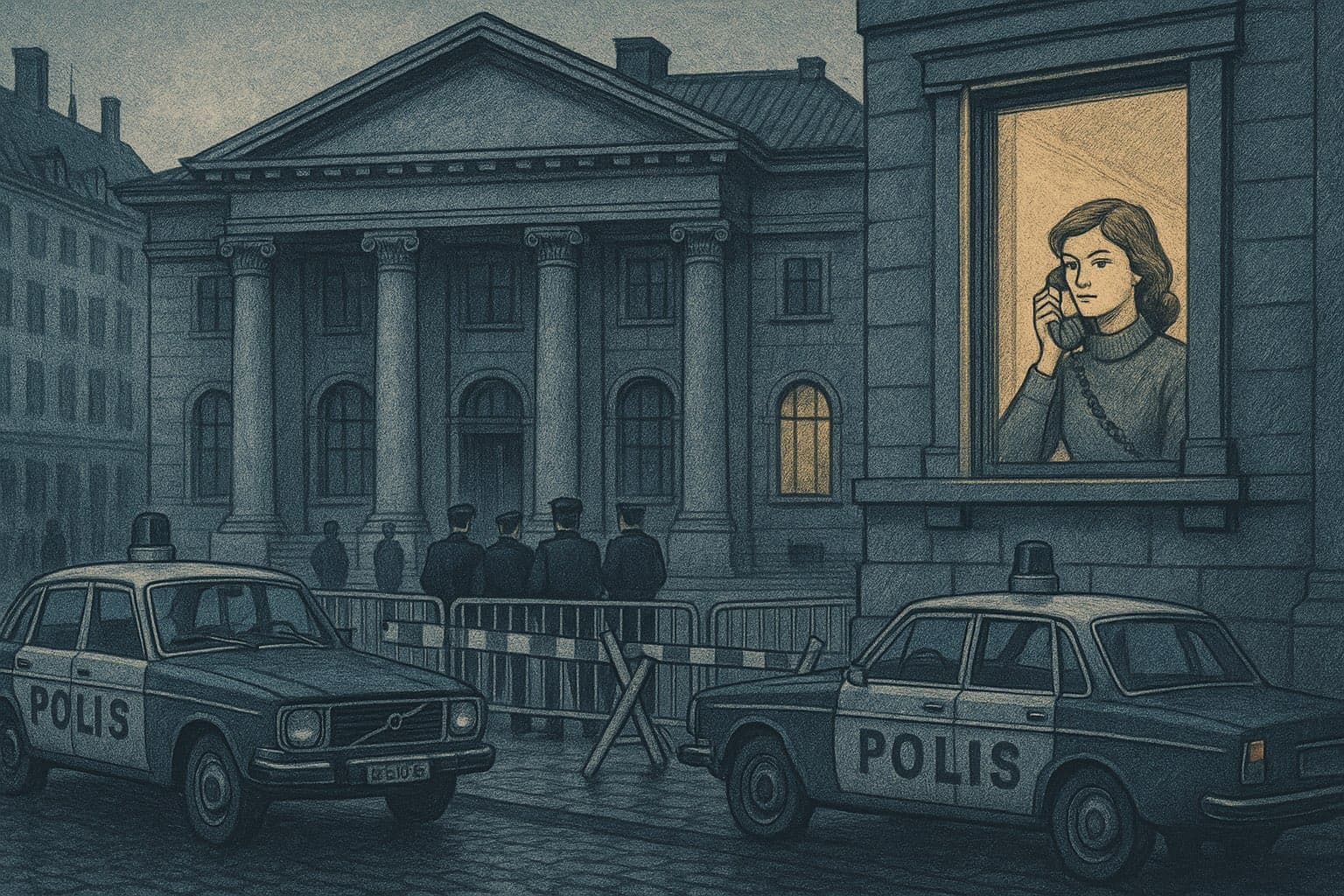
Stockholm Syndrome Was Born to Silence a Hostage
The famous syndrome didn't come from a study: the police's own psychiatrist coined it to discredit a hostage who criticized him. It isn't in the DSM.
What “Bizarro” Really Means in Spanish (Not Bizarre)
For centuries, the Spanish word “bizarro” meant brave and gallant. How a false friend stole a word's meaning — and how the dictionary surrendered.
The Fifth Sleep: when we slept in two shifts
For centuries we did not sleep eight hours straight, but in two sleeps with a waking hour in between. The history of segmented sleep, from Cervantes to science.