
The Origin of the Word “Soroche”
Soroche, the altitude sickness of the Andes, owes its name not to the air but to a mineral: for centuries its vapours were blamed for sickening travellers.
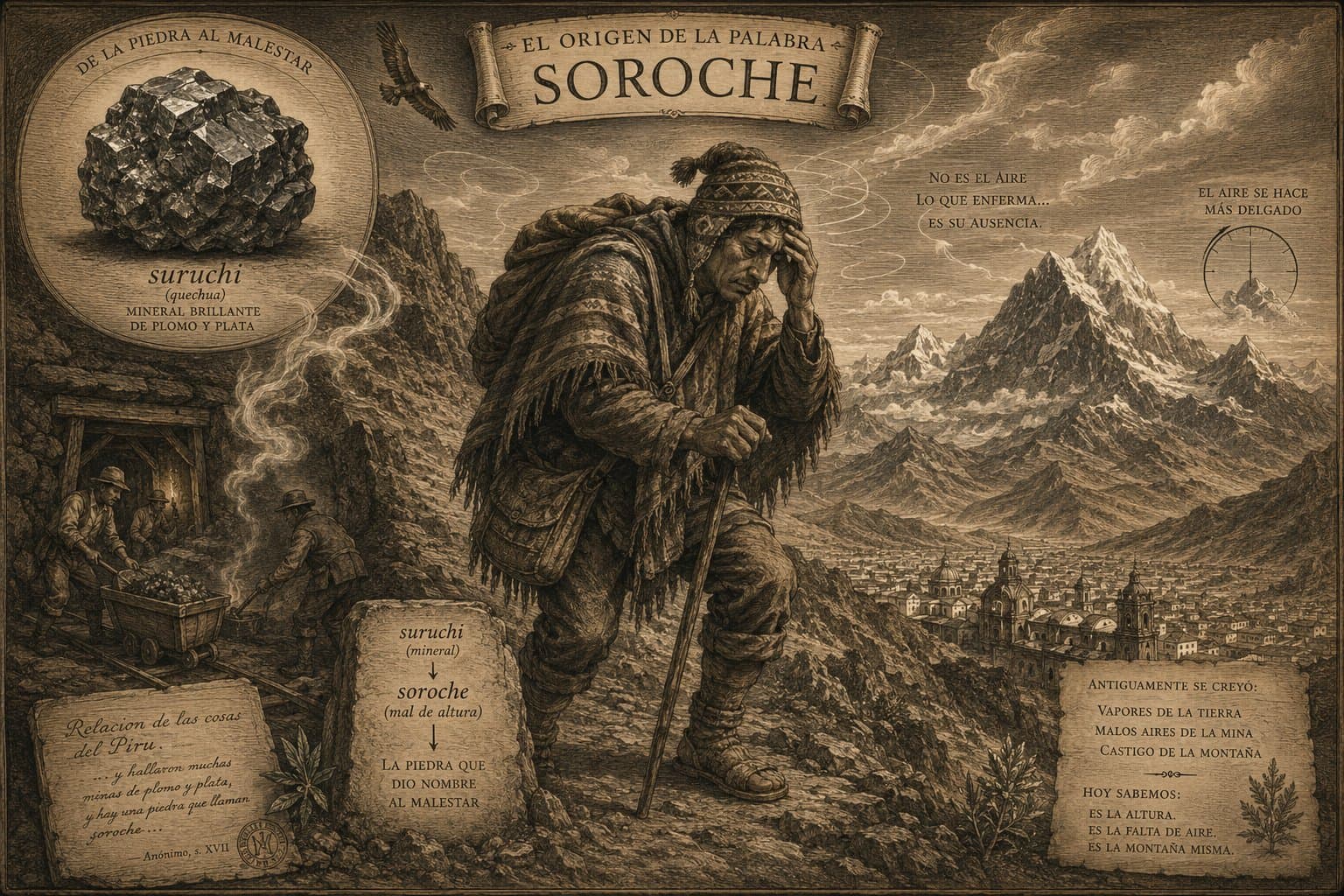
Anyone who has climbed up to Quito, La Paz or Cusco without acclimatizing knows soroche: the headache squeezing the temples, the short breath, the nausea and that strange exhaustion that comes just from standing. The curious thing is that the word we use throughout the Andes to name altitude sickness has nothing to do with the air or the mountains. It speaks of a stone. And behind that name lies a medical mistake that lasted for centuries.
A Quechua word for an Andean malaise
«Soroche» comes from Quechua, probably from suruchi, and like so many Quechua loanwords —just like the chuchaqui, the Ecuadorian hangover— it embedded itself in the region's Spanish without asking permission. Today an Ecuadorian, a Bolivian, a Peruvian or a Chilean understand it equally, while a Spaniard or a Mexican would probably need it explained.
But the fascinating detail is that, originally, soroche did not name the illness. It named a mineral.
The stone that gave the sickness its name
In the mining vocabulary of the colonial Andes, soroche was a metallic mineral —generally a shiny lead sulphide, what we would now call galena, sometimes confused with other ores from the silver veins. The mountains that left travellers dizzy were often the very ones that held silver and lead in their bowels, and in whose mines thousands of people laboured.
From that coincidence was born a theory as logical as it was wrong: if you felt unwell climbing those peaks, it must be the fault of the emanations of the metal. The vapours of soroche, that mineral hidden in the rock, were thought to poison the air and break down the body of anyone who came near. The illness ended up taking the name of the mineral it was blamed on: it came to be called, simply, soroche.
The real culprit was the air (or the lack of it)
Today we know the stone is innocent. Altitude sickness is caused by no metallic vapour, but by something far simpler and invisible: a lack of oxygen. The higher you go, the thinner the air; each breath holds fewer oxygen molecules, and the body —until it acclimatizes by making more red blood cells— protests with headache, fatigue and nausea. It is pure physics, not mineral chemistry.
But the name was already in place, and names are rarely corrected when science changes its mind. We still say «I got soroche» as naturally as we blame a stone that never had anything to do with it. It is the same phenomenon by which we drag along words whose literal meaning no one remembers anymore, as when we discover that «pelucón» didn't mean what we think today either.
A fossil of the fear of the mountain
So the next time soroche ruins your arrival in a high-altitude city, remember that you are pronouncing a small linguistic fossil: the memory of an age when the Andes were climbed with dread, and the mountains were believed to hide a mineral poison capable of felling the strongest. The cure, by the way, is still the oldest one: climb slowly, drink water, and give the body time to learn to breathe a thinner air.
References
- Real Academia Española, Diccionario de la lengua española, s. v. «soroche» (from Quechua suruchi). dle.rae.es
- Diego González Holguín, Vocabulario de la lengua general de todo el Perú llamada lengua qquichua o del Inca, Lima, 1608.
- Asociación de Academias de la Lengua Española, Diccionario de americanismos, 2010, s. v. «soroche».
Do you enjoy the stories behind words? Continue with the origin of «chuchaqui» or explore the whole etymology series.
The books · born from this blog

Atahualpa con su abrigo de pelo de murciélago
y otras 49 historias verdaderas que parecen mentira
Available on Amazon
Tocar madera
Pequeña historia de las supersticiones que el mundo no ha podido soltar
Available on Amazon
100 futuros
Cien escenarios del mundo que viene con la inteligencia artificial
Available on AmazonYou may also like

The Origin of the Word “Quarantine”: 40 Days in Venice
Where does the word quarantine come from? From the 40 days that Venice and Ragusa forced ships to wait during the Black Death. Here is its story.

The Origin of the Word “Dollar”: a Bohemian Valley
Where does the word dollar come from? From a silver-mining valley in Bohemia and a 16th-century coin. The story of the thaler that conquered the world.
The Origin of the Word “Museum”: House of the Muses
Where does the word museum come from? From mouseion, the temple of the Greek Muses and the great center of learning in Alexandria, long before glass cases.