
Tires before rubber: the hard history of bumpy travel
Before the air-filled tire, travel meant wooden wheels with iron rims that jolted every bone. This is the story of rubber, from Goodyear to Michelin.
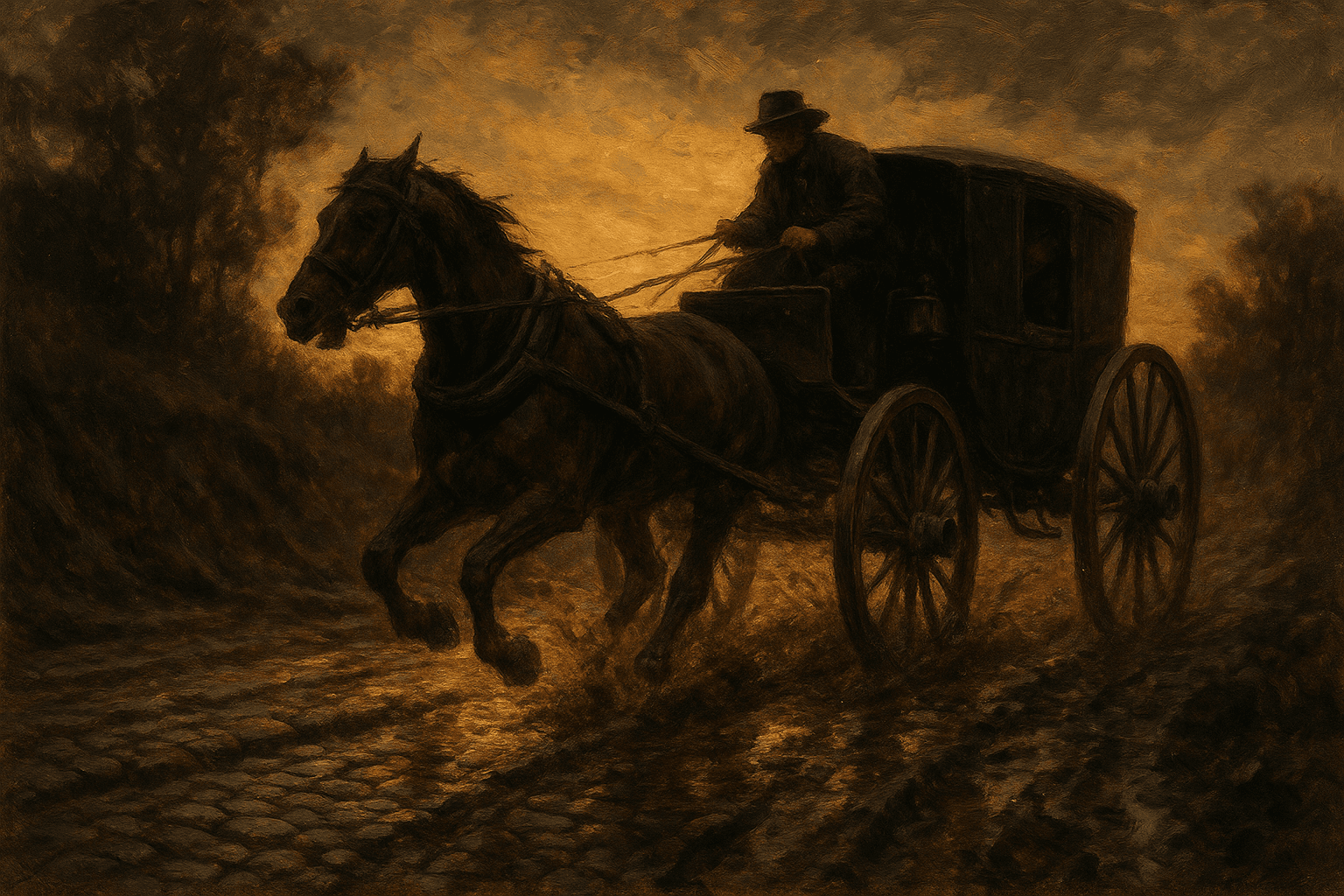
Today we take for granted that wheels are filled with air and that a car ride is comfortable. But for most of history, traveling on wheels was a punishment for the body: every stone, every pothole and every rut in the road went straight up through the wheel and into the passenger's bones. The pneumatic tire —that band of rubber filled with air that now cushions the world— is a surprisingly recent invention, and the story of how we got there is full of dead ends, brilliant ideas born too soon, and a veterinarian who wanted his son to stop suffering on a bicycle.
The wheel dressed in iron
The earliest wheels were solid wood, and over the centuries they grew lighter: a central hub, spokes and an outer rim built from several curved pieces. The problem was durability, and the blacksmith supplied the answer. Around the wood a iron band was fitted: heated until red-hot so it expanded, slipped over the wheel and then cooled suddenly with water so that, as it shrank, the metal squeezed every piece together and held them like a steel belt.
That, in fact, is where the word comes from. The English tyre (or tire) is related to attire, «clothing»: the band was literally the «dress» the wheel wore. That iron hoop was tough and lasted for years, but it had one brutal flaw: it absorbed absolutely nothing. Over the uneven, muddy, poorly maintained roads of the time, a wooden wheel with an iron rim transmitted every jolt, every vibration and an infernal metallic rattle straight into the carriage.
Cushioning without air
For centuries, the only way to soften the ride was not in the wheel but between the wheel and the passenger. Carriage builders hung the cabin from leather straps and, later, from big steel leaf springs that acted as suspension. It was an expensive luxury: a well-sprung carriage marked the difference between a bearable trip and hours of torture. If the refined travel of that era interests you, see the story of Cigarrón and his carriage, a curious chapter in that culture of riding on wooden wheels.
The other great obstacle was the dream material: rubber. Natural gum, tapped from the American rubber tree, promised softness, but it was useless for travel. In summer it turned sticky and foul-smelling; in winter it went hard and brittle as a cracker. No one was going to make wheels out of something that melted in the heat and cracked in the cold.
Goodyear's accident
That wall fell in 1839 thanks to an obsessive, penniless American named Charles Goodyear. He had spent years trying to stabilize rubber when, as the legend goes, he accidentally dropped a mixture of gum and sulfur onto a hot stove. Instead of melting into a sticky puddle, the material transformed: it came out firm, elastic and resistant to both heat and cold. He had discovered vulcanization, the process that finally made rubber practical.
Vulcanization was the missing ingredient. With a rubber that survived summer and winter without spoiling, bands of gum could suddenly be made for wheels. The first step was the solid rubber tire: a simple ring of hard rubber mounted on the wheel. It was a real improvement over iron —less noise, a bit less of a jolt— but it was still hard and heavy. It cushioned, but it did not forgive.
The invention that came too soon
The brilliant idea arrived before the world was ready for it. In 1845, a young Scottish engineer named Robert William Thomson patented what he called the «aerial wheel»: a band of rubber tubes filled with compressed air, wrapped in leather and mounted on the wheel. It was, in essence, the modern pneumatic tire, invented almost half a century early. And it worked: trials showed it rolled more smoothly and quietly.
And yet it failed. In 1845 there were no popular bicycles and no automobiles; the only possible customers were heavy horse-drawn carriages, for which making those delicate rubber tubes by hand was hugely expensive and impractical. Thomson's invention simply had no market. The patent was shelved and the brilliant «aerial wheel» was forgotten for decades, like so many other inventions that arrived before the world knew what to do with them.
The vet, his son and a bicycle
The air-filled tire had to be reinvented from scratch. In 1888, in Belfast, a Scottish veterinarian named John Boyd Dunlop watched his young son pedal a solid-wheeled tricycle over the cobblestones, complaining about how uncomfortable and slow it was. Dunlop came up with a homemade fix: he wrapped the wheels in rubber tubes inflated with air and covered them with a rubberized canvas. The result was so clear that it impressed the inventor himself: the air-filled wheel rolled faster, bounced better and soaked up the shocks of the pavement.
Dunlop patented his tire in December 1888 and set up the company that would carry his name. It arrived at the perfect moment: the world was in the grip of the bicycle craze, and the pneumatic tire turned a brutal machine into a fast, comfortable one. Curiously, years later his patent was voided when it was discovered that Thomson had beaten him to it by almost half a century. But by then the business was already rolling on its own: the difference was made not by whoever had the idea first, but by whoever arrived when the world finally needed it.
From pedal to engine
The leap from pedal to engine still remained. It came in 1895 from two French brothers, André and Édouard Michelin, who fitted pneumatic tires to an automobile —a car nicknamed L'Éclair, «the lightning»— to run the Paris–Bordeaux–Paris race. The car punctured again and again and finished near the back, but it had proven something enormous: a motor vehicle could also float on air instead of hammering the ground on solid gum. Within a few years the inflatable tire became inseparable from the automobile, just as the age of the first cars, including the electric ones that competed to conquer the street, was getting underway.
So, in barely half a century, travel stopped being a punishment for the bones. The pneumatic tire is one of those invisible inventions that redesigned everyday life almost without anyone noticing, like the history of the elevator that made vertical cities possible. Next time a car or bike ride feels smooth, remember that for thousands of years every stone in the road was felt in the body: it took an accident with sulfur, a forgotten invention and a father tired of watching his son suffer for the world to finally learn to roll on air.
References
- «John Boyd Dunlop», Encyclopædia Britannica. britannica.com
- «Dunlop's pneumatic tyre», Deutsches Patent- und Markenamt (DPMA). dpma.de
- «Charles Goodyear», Encyclopædia Britannica. britannica.com
- «Robert William Thomson», Wikipedia. en.wikipedia.org
Do you enjoy stories of the inventions that changed everyday life? Continue with the first electric cars or explore the whole history section.
Categories
The books · born from this blog

Atahualpa con su abrigo de pelo de murciélago
y otras 49 historias verdaderas que parecen mentira
Available on Amazon
Tocar madera
Pequeña historia de las supersticiones que el mundo no ha podido soltar
Available on Amazon
100 futuros
Cien escenarios del mundo que viene con la inteligencia artificial
Available on AmazonYou may also like

Rubber Before Goodyear: The Gum That Melted
Before vulcanization, rubber was a gum that melted in summer and cracked in winter. From the Maya to Goodyear, here's how it was finally tamed.

The Maya and Aztecs Made Paper Before Columbus
Centuries before Columbus, the Maya and Aztecs were making bark paper: amate, the skin of the codices the conquistadors would later burn.
The history of the stethoscope and Laennec's modesty
In 1816 a French doctor felt too awkward to press his ear to a patient's chest, so he rolled up paper — and the stethoscope was born.