
Why Is the Panama Hat Called Panama If It Was Born in Ecuador?
The world's most famous hat is woven in Montecristi and Cuenca, yet it bears another country's name. The story of a stylish injustice.
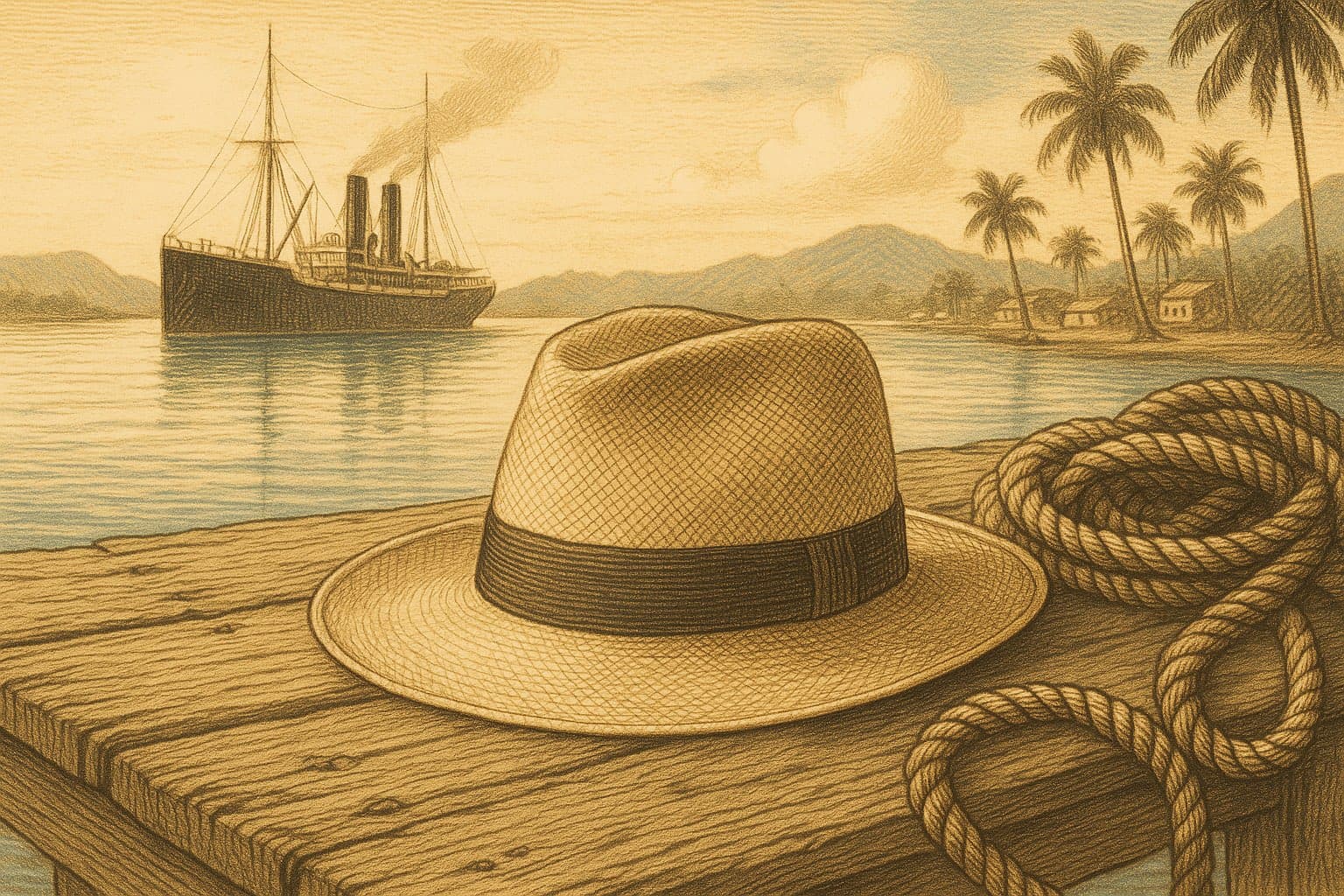
It is probably the most elegant geographical misunderstanding in the world. The Panama hat —the fine straw one with the black band worn by Bogart, Hemingway and half of Hollywood— has nothing Panamanian about it: it has been woven for centuries in Ecuador, from toquilla straw, in the villages of Manabí and the workshops of Azuay. And yet the entire planet calls it by another country's name. As an Ecuadorian, I confess the subject stings a little. As a storyteller, I admit the explanation is excellent.
First, the Ecuadorian part: toquilla straw
The raw material is a trunkless palm that grows on the Ecuadorian coast, Carludovica palmata, known as toquilla straw. Coastal weavers were making headwear from it long before Ecuador existed as a country —some trace the tradition back to Manabí's pre-Columbian cultures—, and by colonial times the towns of Jipijapa and Montecristi were synonymous with fine hats: in fact, for much of the 19th century the hat was known as a “jipijapa”. A true Montecristi superfino is woven only at dawn or dusk, when the humidity keeps the fiber from snapping; a single hat can take months of work, and the finest roll up so obediently that legend says they can pass through a ring.
The most successful labeling error in history
So why “Panama”? Logistics. In the 19th century, Panama was the great transit station of the Americas: everything crossing between the Atlantic and the Pacific passed through the isthmus. Manabí merchants —among them Manuel Alfaro, of whom more in a moment— shipped their hats to Panama, where travelers from all over the world bought them. And when the California Gold Rush exploded in 1849, tens of thousands of fortune-seekers crossed the isthmus on their way to San Francisco and carried off the hat they had bought along the way. Where's your hat from? “Panama.” The product was christened after its point of sale, not its origin — as if Colombian coffee were called “Miami coffee” because the ship made a stopover there.
The finishing blow came in November 1906, when president Theodore Roosevelt visited the works of the Panama Canal and let himself be photographed aboard a steam shovel wearing a toquilla straw hat. The photo went around the world, and the name went with it. Against a picture of the president of the United States, no rebranding campaign stands a chance.
The hat that funded a revolution
And here is the chapter almost nobody tells outside Ecuador. That Manuel Alfaro who exported hats from Montecristi built a considerable fortune on the hat trade. His son, Eloy Alfaro, used a good part of that money to finance something more ambitious than a business: the Liberal Revolution that transformed Ecuador at the end of the 19th century. In other words: the hat the world credits to Panama was not only born Ecuadorian — it also helped pay for one of the most important revolutions in our history. The “Old Fighter” was, among other things, a son of the hat.
Justice, halfway
In December 2012, UNESCO declared the traditional weaving of the Ecuadorian toquilla straw hat Intangible Cultural Heritage of Humanity — with the word “Ecuadorian” in the official title, for the record. The weavers of Montecristi and the workshops of Cuenca still produce the finest examples on the planet, and connoisseurs now ask for “a Montecristi” rather than “a Panama”. But the general public keeps using the wrong name, and will probably keep doing so for decades: as we saw with the word “gringo”, once a label settles into the language, no decree can move it. Two consolations remain: every authentic hat says “Made in Ecuador” on the sweatband — and we, at least, know the full story.
References
- UNESCO, Traditional weaving of the Ecuadorian toquilla straw hat, Representative List of the Intangible Cultural Heritage of Humanity, inscribed 2012 (Ecuador), no. 00729. ich.unesco.org
- Underwood & Underwood, 'President Roosevelt running an American steam-shovel at Culebra Cut, Panama Canal,' photograph, Nov. 1906, Library of Congress, LC-DIG-stereo-1s02353. loc.gov
- 'Panama hat,' Encyclopædia Britannica. britannica.com
- 'Alfaro Delgado, José Eloy (1842-1912),' Encyclopedia of Latin American History and Culture. encyclopedia.com
Enjoy the stories behind words? Continue with whether “travel” really comes from a torture device and the real myth behind the word “narcissist”, or browse the whole etymology series.
The books · born from this blog
Atahualpa con su abrigo de pelo de murciélago
y otras 49 historias verdaderas que parecen mentira
Available on Amazon
Tocar madera
Pequeña historia de las supersticiones que el mundo no ha podido soltar
Available on Amazon
100 futuros
Cien escenarios del mundo que viene con la inteligencia artificial
Available on AmazonYou may also like
The Origin of the Word “Soroche”
Soroche, the altitude sickness of the Andes, owes its name not to the air but to a mineral: for centuries its vapours were blamed for sickening travellers.
The Origin of the Word “Robot”: Born in a Czech Play
Where does the word robot come from? Czech writer Karel Čapek coined it in 1920 from robota, forced labor; and the idea was actually his brother Josef's.
Cipher and zero: two words born from the same void
«Cipher» and «zero» come from the same Arabic word, sifr, meaning «empty». How one void gave us two words that today seem like opposites.