
The Vacuum Pump That Made Modern Science Possible
Otto von Guericke's vacuum pump proved air has weight with horses that couldn't pull two hemispheres apart. How the modern vacuum was born.
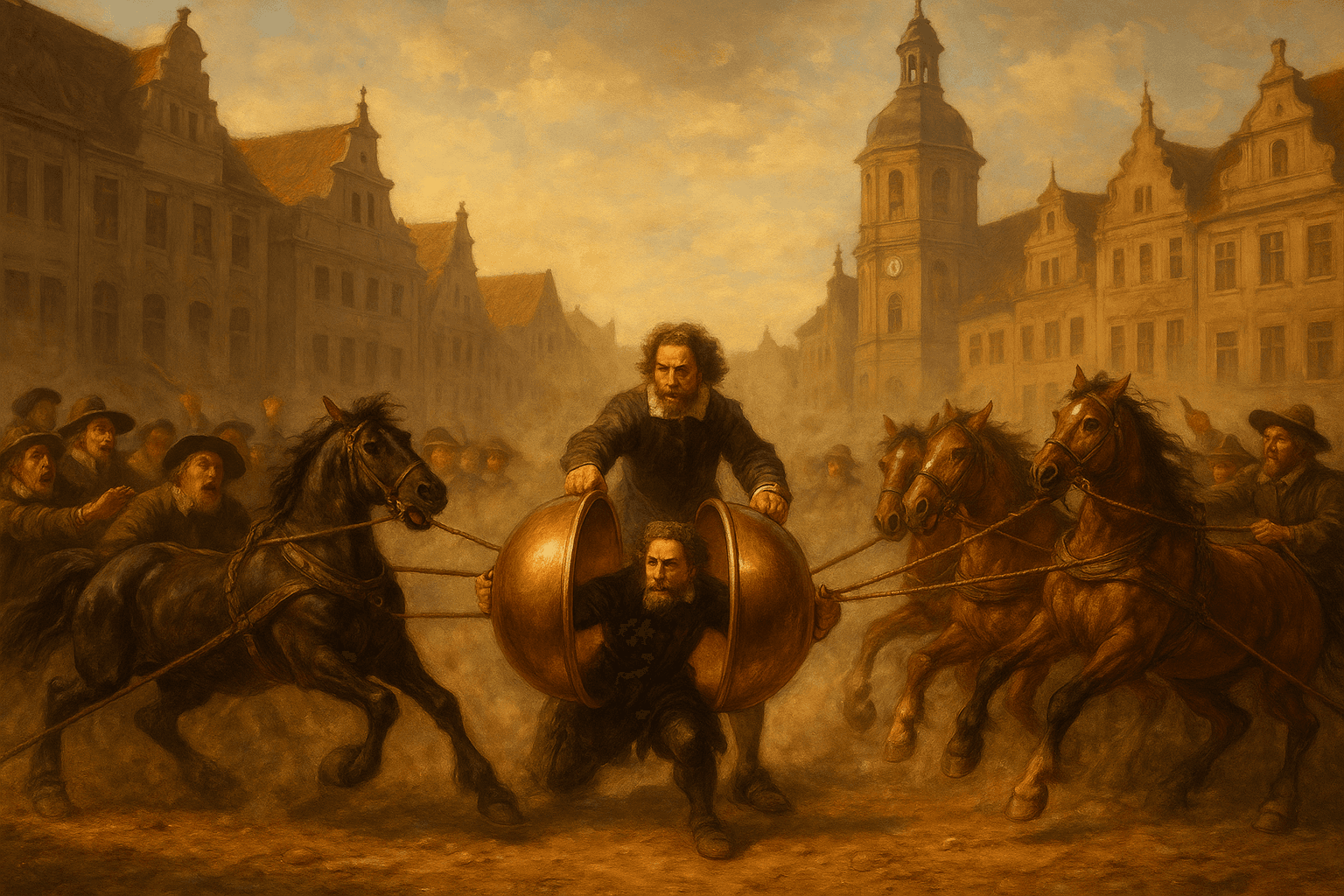
On 8 May 1654, in the German city of Regensburg, two teams of eight horses each pulled with all their might in opposite directions. Between them, held together by nothing but air—or rather, by its absence—were two copper hemispheres. The sixteen animals sweated, strained and failed to pull them apart. Emperor Ferdinand III watched in astonishment. There was no glue, no screws, no chains: only the vacuum that a former mayor had created inside the sphere with a machine of his own invention. The vacuum pump had just turned a philosophical idea into a spectacle no one could deny.
Nature's fear of emptiness
For nearly two thousand years, Western science believed a vacuum could not exist. The blame lay with Aristotle, who had declared that nature "abhors a vacuum": wherever a gap opened up, air or water would rush in at once to fill it before allowing nothingness to exist. Scholars repeated it in Latin like a creed: horror vacui, the horror of the void. The universe, they said, was full to its last corner.
The idea worked as an explanation for almost everything. Why does water climb up a straw when you suck on it? Because nature rushes to fill the vacuum your mouth makes. Why is it hard to pull two wet plates apart? Same reason. No one suspected that behind all these phenomena was something far simpler and far harder to imagine: the invisible weight of the air surrounding us.
Torricelli and the first artificial nothing
The first crack in the dogma was opened by a pupil of Galileo. The Medici engineers had run into a practical problem: suction pumps could not raise water from wells beyond about ten metres, no matter how hard they tried. If nature abhorred a vacuum, why did it give up at exactly that height? In 1643, Evangelista Torricelli found the answer. He filled a glass tube sealed at one end with mercury, covered it, turned it upside down into a basin and uncovered it. The mercury dropped… but not all the way: it stopped at a column about 76 centimetres high, leaving an empty space above.
That gap at the top of the tube was the first nothingness made by a human being. And Torricelli's explanation was revolutionary: the column was not held up because nature "pulled" on it, but because the weight of the entire atmosphere pressed down on the mercury in the basin. "We live submerged at the bottom of an ocean of air," he wrote. There was no horror of the void: there was atmospheric pressure. The instrument he had just invented, the barometer, has a story of its own; what matters here is that Torricelli had proved the vacuum was not only possible but was right there, sitting above a pool of mercury, waiting to be studied.
The mayor who milked the air
The man who turned that laboratory curiosity into an unforgettable experiment was an unlikely figure: Otto von Guericke, mayor of the city of Magdeburg, amateur engineer and man obsessed with the idea of the vacuum. Around 1650 he built the first air pump in history: a brass syringe with a piston and valves, much like a water pump, but designed to draw air out of a sealed vessel rather than push liquid in. Pumped again and again, the machine slowly emptied a copper globe until an almost perfect vacuum remained inside.
With that tool, Von Guericke began to play with the invisible. He discovered that inside a vacuum a candle went out, that a bell sounded fainter and fainter until it fell silent, and that birds and small animals could not survive. Air, that something we never see, turned out to be essential for fire, for sound and for life. Like the Flemish physician who years earlier had christened the invisible airs with the word "gas", Von Guericke was mapping a substance that until then had been taken for granted.
The horses of Magdeburg
But Von Guericke knew that no argument convinces like a good show. He had two copper hemispheres made that fit together into a hollow sphere about 35 centimetres across, their rims smeared with grease to seal perfectly. He joined the halves, connected his pump and drew out the air. Nothing held them from outside; inside, nothing at all. And yet the pressure of the atmosphere squeezed them against each other with an enormous force.
In the demonstration before Emperor Ferdinand III, eight horses on each side pulled without managing to part them. There was no trick: the same ocean of air Torricelli had described was crushing the hemispheres together with more force than sixteen horses combined. All it took was opening a valve and letting the air back in for the halves to fall apart on their own, almost with contempt. The Magdeburg hemispheres became the most famous experiment of the century and an image still repeated in any physics class today.
Boyle, Hooke and the pump that founded a science
The news crossed Europe and reached England, where a young and immensely wealthy aristocrat read it with fascination. Robert Boyle asked his brilliant assistant Robert Hooke to improve Von Guericke's design, and by 1659 they had a more precise air pump, with a large glass vessel—the "receiver"—into which you could place anything and watch what happened when the air was removed. Between the spring and autumn of that year they carried out dozens of experiments and published them in 1660 in a book with an endless title, usually shortened to New Experiments Physico-Mechanical, Touching the Spring of the Air.
Out of those trials came one of the first quantitative laws of modern physics: Boyle's law, which relates the pressure of a gas to the volume it occupies. But beyond that particular finding, the air pump became the emblem of a new way of doing science. It was no longer about reasoning like Aristotle from an armchair, but about building an apparatus, controlling the conditions and letting the experiment speak. The newly founded Royal Society made that expensive, temperamental machine its symbol, and with it was born much of the method we still use, as revolutionary in its day as the instruments that changed navigation.
The vacuum that holds up the modern world
That brass syringe from Magdeburg left an enormous lineage. Two centuries later, without vacuum pumps able to remove almost all the air from a glass bulb, it would have been impossible to build the incandescent light bulb: the filament would burn out in an instant if any oxygen remained around it. The same principle made possible the vacuum tubes that gave life to the first radios, televisions and computers, before the transistor retired them.
Today the vacuum pump is a silent worker of technology. Without it, vaccines and foods could not be freeze-dried—that cold drying that preserves without cooking—the silicon chips in your pocket could not be made, etched layer by layer in vacuum chambers, and the great particle accelerators would not work, where particles must travel through tubes emptier than outer space. It all started with a stubborn mayor, sixteen horses and the then-heretical idea that nothingness not only exists: it can be manufactured, measured and put to work.
References
- "Otto von Guericke," Encyclopædia Britannica. britannica.com
- "Magdeburg hemispheres," Wikipedia. en.wikipedia.org
- "Torricelli's experiment," Wikipedia. en.wikipedia.org
- "The History of the Vacuum," KNF. knf.com
Do you enjoy the inventions that changed the world while no one was looking? Continue with the war of the currents or explore the whole Science & Technology section.
Categories
The books · born from this blog

Atahualpa con su abrigo de pelo de murciélago
y otras 49 historias verdaderas que parecen mentira
Available on Amazon
Tocar madera
Pequeña historia de las supersticiones que el mundo no ha podido soltar
Available on Amazon
100 futuros
Cien escenarios del mundo que viene con la inteligencia artificial
Available on AmazonYou may also like
Morse Code: How It Works and Why It Saved Lives
Morse code turns letters into dots and dashes that travel down a wire or a flash of light. Here is how it works, where it came from and why it is still used.
The Telegraph: The Victorian Internet
The telegraph shrank weeks of mail into minutes of cable. How Morse, Cooke and a wire under the Atlantic built the Victorian internet and shrank the world.

The nocebo effect: when expecting harm creates it
The nocebo effect is the placebo's dark twin: believing a treatment will hurt can make it hurt. Its origin, real cases and what science says.