
The War of the Currents: Edison vs. Tesla
In the late 19th century Edison, Tesla and Westinghouse fought the war of the currents to decide whether the world would run on direct or alternating current.
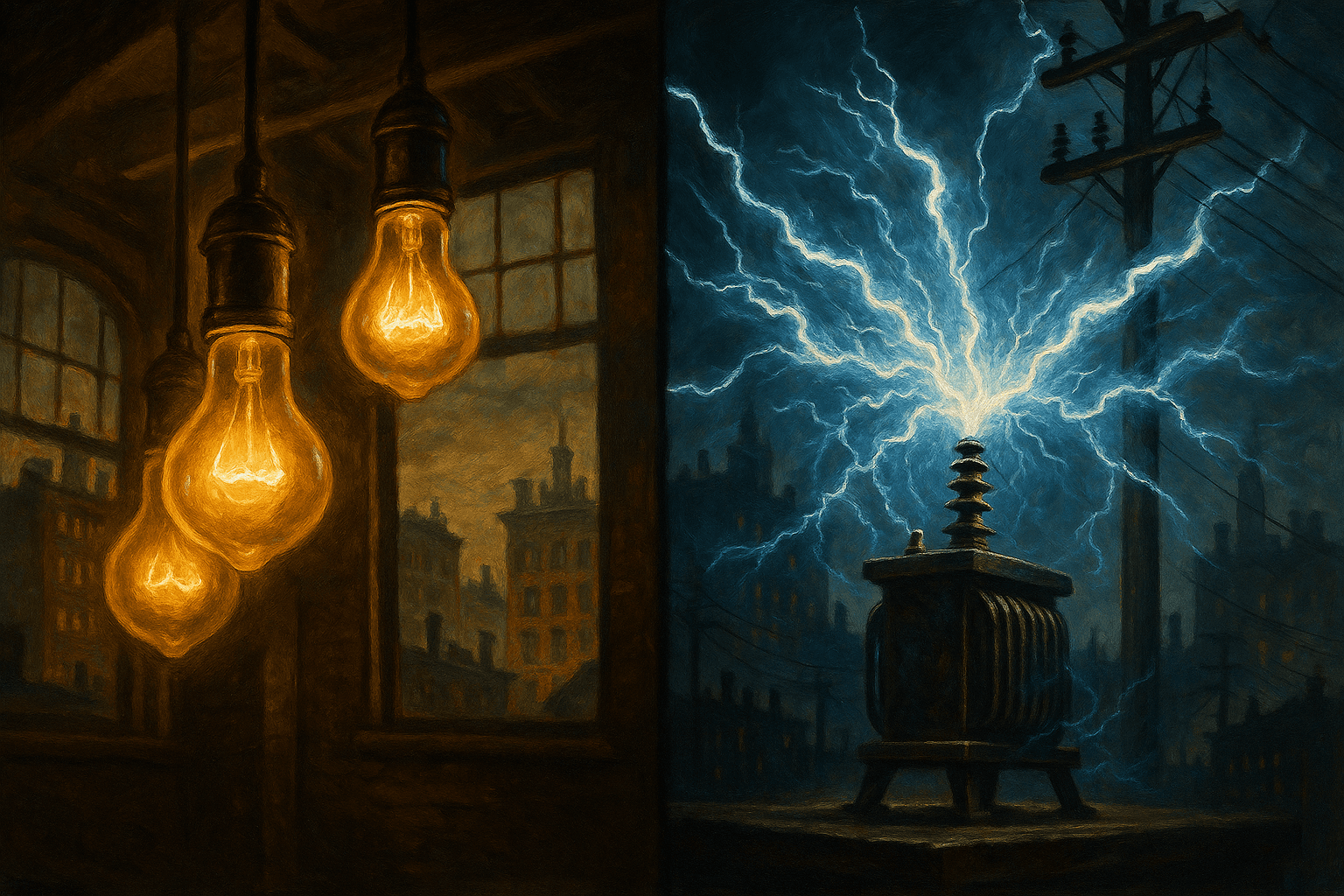
In the late 19th century, electricity promised to change the world, but nobody yet knew how to distribute it. The question looked technical and dull —direct current or alternating current— but behind it lay vast fortunes, lucrative patents, and enormous egos. What we now call the war of the currents pitted three of the biggest names in American engineering against one another: Thomas Edison, Nikola Tesla, and George Westinghouse. And it ended, like almost every technological war, not with the best speech but with the best business deal.
Edison and direct current
In 1882, Thomas Edison opened the Pearl Street Station in New York, the first commercial power plant in history. It fed direct current (DC) to the incandescent lamps he had perfected, and for the first time an entire Manhattan district was lit from a central source. It was a spectacular triumph, and Edison had patented almost everything: the bulbs, the generators, the meters. Every connected home earned him money.
The trouble with direct current was physical, and there was no arguing with it. At the low voltages Edison used, electricity lost strength quickly in the wires: it could not be transmitted much beyond a mile or so before the voltage drop made it useless. To electrify a large city you would have to dot it with power stations every few blocks, tangled together by thick copper cables. It worked for the heart of a metropolis, but it could never carry light to the rest of the country.
Tesla, Westinghouse, and alternating current
The solution came with alternating current (AC), which instead of always flowing in the same direction reverses many times per second (60 in the United States, 50 in Europe). Its great advantage is that its voltage can be raised and lowered with a simple device that has no moving parts: the transformer. Stepped up to thousands of volts, energy travels down thin lines over great distances with minimal loss; a transformer then steps it back down to a safe level just before it enters people's homes.
The Serbian engineer Nikola Tesla, who had briefly worked for Edison before leaving him in 1885, patented a complete polyphase alternating-current system, including the induction motor that made that current useful for driving machinery. In 1888 he sold his patents to the industrialist George Westinghouse, whose company had become Edison's great rival. Suddenly the battle stopped being between ideas and became a fight between two companies willing to do whatever it took.
The campaign of fear
Edison did not want to lose the royalties from his direct-current patents, so instead of improving his own technology he chose to attack his rival's where it hurt most: fear. He launched a campaign to convince the public that alternating current, with its high voltages, was inherently deadly. He secretly funded a man named Harold Brown, who staged public demonstrations in which he electrocuted dogs, cats, and even horses with alternating current to show how dangerous it was.
The campaign reached its most sinister extreme with the electric chair. The state of New York was seeking a «more humane» method of execution than hanging, and Edison's circle pushed for it to run on alternating current, so that the current would be forever linked to death. On 6 August 1890, at Auburn Prison, William Kemmler became the first person executed in an electric chair. The execution was long and horrifying. Edison's allies even tried to popularize the verb «to be Westinghoused» as a synonym for being electrocuted to death. Westinghouse, outraged, went so far as to pay $100,000 to fund Kemmler's appeal to the Supreme Court.
The elephant Edison did not kill
Here it is worth clearing up one of the most repeated myths in this story. It is often told that Edison electrocuted Topsy, a circus elephant, at Coney Island in 1903 to demonstrate the dangers of alternating current. The scene exists —there is a film titled Electrocuting an Elephant shot by Edison's company— but the reality is more nuanced.
Topsy was put down in 1903 by decision of the owners of Luna Park, not Edison, and the war of the currents had already ended ten years earlier. There is no evidence that Edison ordered or witnessed the execution; his name stuck to the episode only because his company filmed the scene. It is a good reminder that technological stories, told a thousand times, tend to become both cleaner and crueler than they really were.
Chicago 1893: the finishing blow
The war was won not by an experiment but by a bid. In 1893 Chicago hosted the World's Columbian Exposition, and whoever lit it before millions of visitors would have the best showcase imaginable. General Electric —heir to Edison's companies— offered to electrify the fair with direct current for $554,000. Westinghouse submitted an alternating-current bid for just $399,000 and won the contract.
The result was dazzling, quite literally: nearly 200,000 lamps turned the exposition into a «White City» that left the public awestruck. Millions saw with their own eyes that alternating current not only worked, but was spectacular and safe. It was the best advertising Westinghouse could have dreamed of, and the worst nightmare for the campaign of fear.
Niagara: the future starts to flow
The decisive blow came from water. That same year, 1893, the Niagara Falls Power Company awarded Westinghouse —who had licensed Tesla's polyphase motor— the contract to harness the power of Niagara Falls. The plant was switched on 26 August 1895, and on 16 November 1896 the alternating current generated at Niagara lit up the city of Buffalo, more than twenty miles away. No direct-current station could have transmitted power so far.
That transmission line is regarded as the unofficial end of the war of the currents. Alternating current became the standard for carrying energy from hydroelectric plants to cities, and it remains so today in the wall sockets of almost the entire planet.
Who really won?
In the long run, alternating current won for the transmission of energy, and that is what reaches the outlets in your home. But the story took an ironic turn: almost everything you plug into those outlets runs internally on direct current. Phones, computers, LEDs, solar panels, and electric cars —heirs of those first automobiles of the late 19th century— depend on batteries that only understand direct current. That is why every charger contains a small transformer and rectifier that converts the AC from the wall into the DC the device needs.
Even the ultra-high-voltage lines that span continents now use high-voltage direct current, because at that scale it becomes more efficient again. In a way, Edison was not entirely wrong; he simply arrived a century before technology proved him partly right. Tesla, for his part, died broke and forgotten in 1943, still dreaming of transmitting energy through the air without wires. The war of the currents was won not by the purest genius, but by whoever managed to pair the best idea with the best business.
References
- «The War of the Currents: AC vs. DC Power», U.S. Department of Energy: official summary of the dispute, the Pearl Street Station (1882), and the physical reason DC could not travel far. energy.gov
- «How Edison, Tesla and Westinghouse Battled to Electrify America», HISTORY: Tesla's 1888 patent sale to Westinghouse, Edison's campaign, the 1893 Exposition, and Niagara. history.com
- «War of the currents», Wikipedia: detailed timeline, the electric chair, the execution of William Kemmler (1890), and the term «Westinghoused». en.wikipedia.org
- «Myth Buster: Topsy the Elephant», Thomas Edison Papers, Rutgers University: why Edison neither ordered nor witnessed the killing of Topsy the elephant in 1903. edison.rutgers.edu
Enjoy the stories behind technology? Continue with the history of lithium and the first electric cars, or explore the whole science and technology section.
Categories
The books · born from this blog
Atahualpa con su abrigo de pelo de murciélago
y otras 49 historias verdaderas que parecen mentira
Available on Amazon
Tocar madera
Pequeña historia de las supersticiones que el mundo no ha podido soltar
Available on Amazon
100 futuros
Cien escenarios del mundo que viene con la inteligencia artificial
Available on AmazonYou may also like

Porcelain: the Chinese secret Europe tried to steal
For centuries Europe paid fortunes for Chinese porcelain without knowing how it was made. This is the story of a hundred-year industrial espionage.
The History of Glass: The Material That Changed the World
Glass went from Egyptian luxury to everyday object thanks to Roman glassblowers, and later gave science its telescope and microscope.
Gunpowder Before Cannons: Alchemy, Fire and War
Chinese alchemists chasing eternal life invented gunpowder by accident. Before cannons came fireworks, fire lances and centuries of fire medicine.