
The History of the Compass: From Lodestone to GPS
The history of the compass, from the Chinese lodestone that pointed south to the GPS in your phone: how we learned to find our way without the sky.
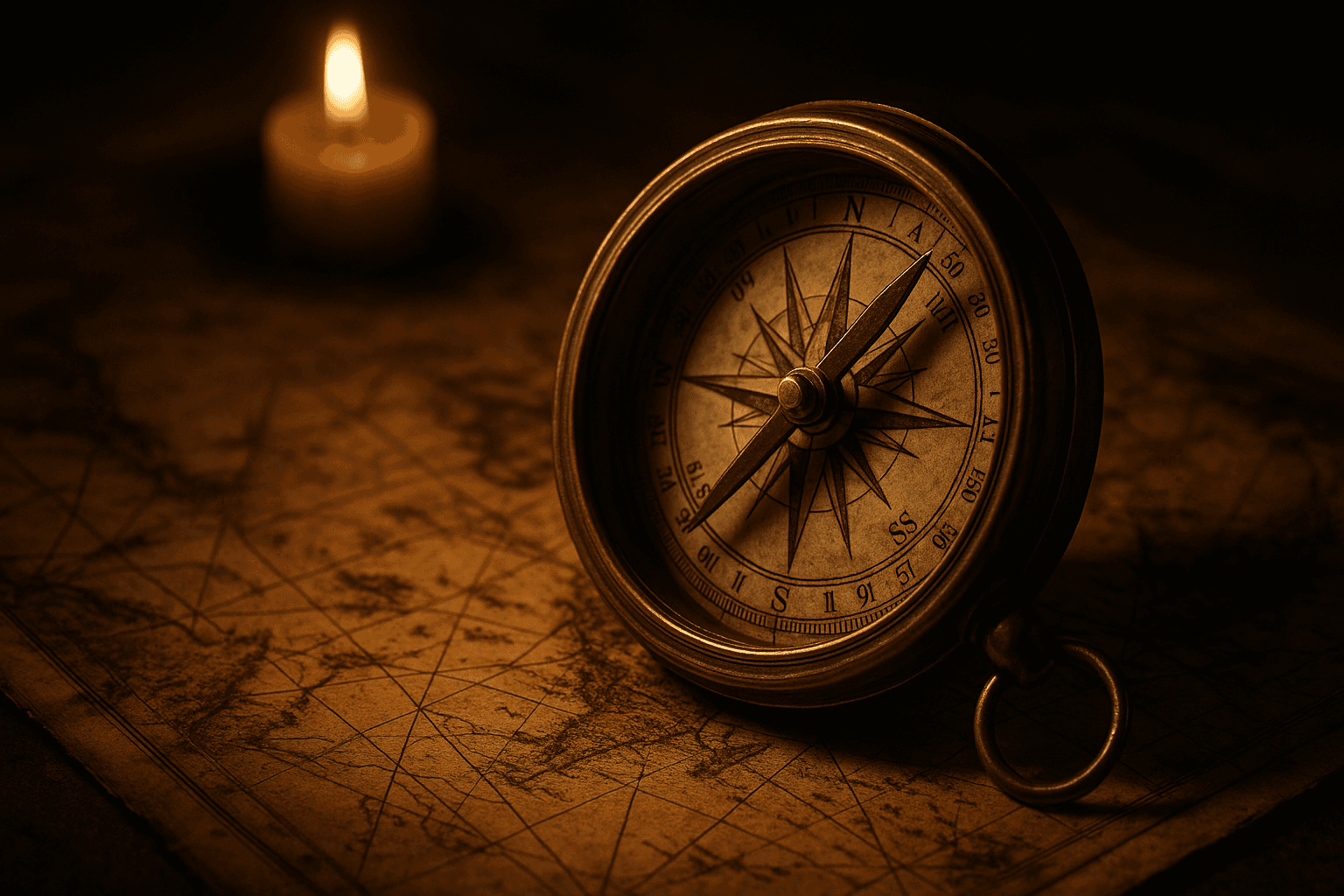
You are lost in the middle of the sea, no coast in sight and the sky sealed off by clouds. No sun, no stars, nothing to tell you which way is north. For thousands of years, that was almost a death sentence: with no landmarks, a ship could only go in circles and pray. And then someone discovered that a certain dark stone, if left to spin freely, always pointed the same way. The compass did not invent north, but for the first time it let us find it with our eyes closed. This is its story: the story of the invention that changed the way we get lost.
The stone that pointed by itself
It all began with a stone. Magnetite is an iron mineral that, in its naturally magnetized form, attracts metal and —most astonishing of all— orients itself if you let it turn. The ancients called it lodestone, literally «leading stone». Nobody understood why it did this; it looked like magic. But it worked, and for centuries that was enough.
The first to make use of it were the Chinese. Around the 2nd century BCE, during the Han dynasty, they carved spoons of magnetite that spun on a polished bronze plate until they came to rest pointing south. That device, the sinan («the south governor»), was not for navigation: it was used in divination and feng shui, to align houses and tombs with the invisible forces of the earth. History's first compass was really an instrument for talking to fate.
From the future to the south: the magnetized needle
The stone spoon was heavy, awkward and only worked on a perfectly smooth surface. The decisive leap came when someone discovered that the whole stone was not needed: it was enough to rub an iron needle against the magnetite for the needle to become magnetized and, hung from a thread or floated on water, to point north and south too.
The first to describe this trick clearly was the scholar Shen Kuo, one of those universal geniuses that 11th-century China produced now and then. In his work Dream Pool Essays (1088) he explained how to magnetize a needle and mount it so it could turn freely. And he noticed something that ran centuries ahead of Europe: the needle did not point exactly at geographic south, but slightly off. Without knowing it, Shen Kuo had discovered magnetic declination, the little lie that every compass tells and that we still have to correct for today.
The compass takes to the sea
The most important step was still missing: putting it on a ship. The first written mention of the compass being used for navigation appears in Pingzhou Table Talks, by the official Zhu Yu, around 1119. He recounts that pilots, when night or fog hid the stars, consulted «the needle that points south». At last a ship could hold its course without seeing the sky.
From China, the idea travelled along the trade routes to the Mediterranean. Around 1190, the English monk Alexander Neckam became the first European to describe a magnetized needle guiding sailors in the English Channel. And in 1269, the Frenchman Pierre de Maricourt —Petrus Peregrinus— wrote the first serious treatise on magnetism, the Epistola de magnete, describing a compass mounted on a pivot, turning dry inside a graduated box. The compass as we picture it today had been born. The earliest European models floated the needle in a bowl of water; soon it was set on a point —the «dry» compass— and a compass rose was added beneath it, with the thirty-two headings every sailor had to know by heart.
Why the needle lies a little
The compass has a built-in flaw: it does not point to the geographic North Pole, the fixed point where the Earth's axis passes, but to the magnetic north pole, which is somewhere else and, to make matters worse, keeps moving. The planet behaves like an enormous magnet, and its magnetic poles do not coincide with the geographic ones. The gap between the two is magnetic declination, and it varies by where you are and what year it is: the magnetic north pole has spent decades drifting from the Canadian Arctic toward Siberia at a brisk pace.
Christopher Columbus saw it for himself in the mid-Atlantic in 1492, uneasily noticing that his compass kept shifting relative to the pole star. It was not the compass failing, but the Earth turning out stranger than it seemed. That is why, on a map, finding your way properly means correcting that deviation by hand —something that, for other reasons of geometry, also complicates the routes that planes follow.
From the gyrocompass to the chip in your pocket
The steel ship brought a new problem: an iron hull deflects the needle and makes the magnetic compass unreliable. The solution arrived in 1908, when the German Hermann Anschütz-Kaempfe —who dreamed of crossing the Pole under the ice by submarine— unveiled the first practical gyrocompass: a gyroscope that, instead of chasing magnetism, points to true north through the pure physics of rotation, indifferent to the steel around it. Three years later, the American Elmer Sperry patented a version that was easier to manufacture, and the two ended up in a lawsuit so technical that even Albert Einstein was called as an expert witness. The gyrocompass still guides today's great ships and, in its day, submarines like Isaac Peral's.
And yet the age-old compass has not disappeared: you carry it in your pocket. Inside your phone sits a magnetometer, a tiny chip that measures the Earth's magnetic field just like that old needle and tells the map app which way you are facing. Combined with GPS, it does what no ancient sailor would have believed possible: not just knowing where north is, but exactly where you are. It is, like other invisible technologies we use without thinking, a very old trick hidden inside a new object. From the stone spoon to the silicon chip, we still rely on the same discovery from more than two thousand years ago: the one that turns a stone into a promise —never to be completely lost again.
A little box that became a word
One last curiosity remains: the name. In Spanish the compass is not called «compás» but brújula, and the word comes neither from north nor from the needle, but from the box. Italian sailors kept the needle in a small boxwood case they called bussola, from Latin buxida and, before that, Greek pyxis, «little box». Passing into Spanish, the word warped and gained an «r» until it became brújula. The English compass, by contrast, comes from «to measure by tracing a circle», after the compass rose. Two languages that, in naming the same object, fixed on different things: one on the box that protected it, the other on the circle that explained it.
References
- «History of the compass», Wikipedia. en.wikipedia.org
- «Shen Kuo», Wikipedia. en.wikipedia.org
- «Compass», New World Encyclopedia. newworldencyclopedia.org
- «Gyrocompass», Encyclopædia Britannica. britannica.com
Do you enjoy inventions that changed the world while nobody was watching? Continue with the war of the currents or explore the whole Science & Tech section.
Categories
The books · born from this blog

Atahualpa con su abrigo de pelo de murciélago
y otras 49 historias verdaderas que parecen mentira
Available on Amazon
Tocar madera
Pequeña historia de las supersticiones que el mundo no ha podido soltar
Available on Amazon
100 futuros
Cien escenarios del mundo que viene con la inteligencia artificial
Available on AmazonYou may also like

The History of the Match: Fire in Your Pocket
The friction match was born by accident in 1826, poisoned thousands of factory women, and only later became the safe fire we carry in our pocket.
The History of Ethernet: How an Office Learned to Share
In 1973, at Xerox PARC, an engineer wired an office's computers to a laser printer. That was the birth of Ethernet, the network we still use today.
The History of the Floppy Disk and the Save Icon
The floppy disk held 80 KB in 1971 and survives today as the «save» icon many young people never touched. This is the full history of the floppy disk.