
Maecenas Was Not a Word: He Was a Man
Behind every patron of the arts stands a real man: Gaius Maecenas, Augustus' millionaire friend who paid poets — and changed history doing it.
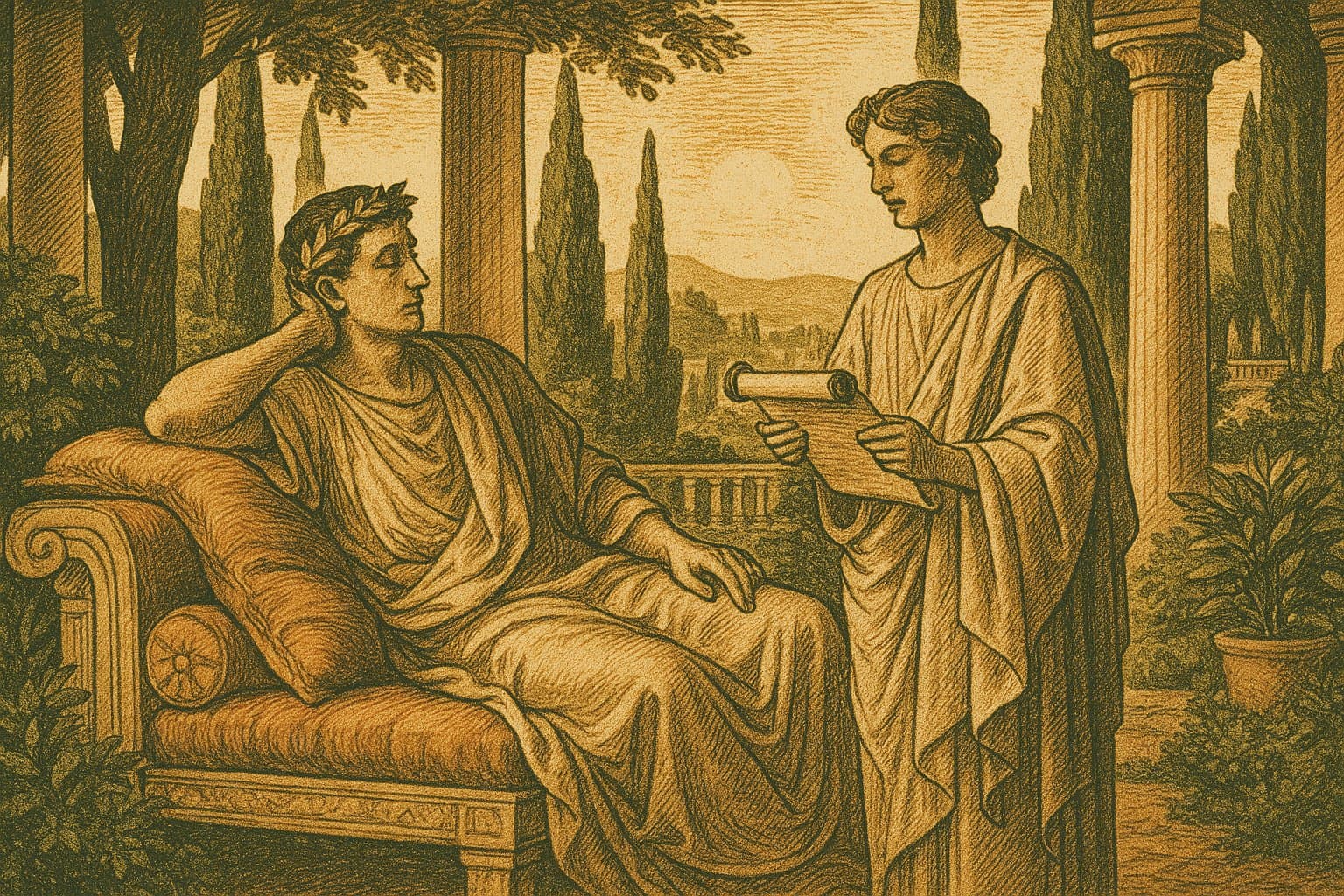
When a bank sponsors a symphony orchestra or a millionaire funds a museum, the Romance languages say he acts as a mecenas — a Maecenas. The word sounds like technical jargon from some ministry of culture. But no: maecenas, like sybarite, is one of those words that used to be somebody. It was once spelled with a capital letter and walked the streets of Rome two thousand years ago: Gaius Maecenas, the richest and most useful friend of the emperor Augustus.
The man who refused every title
Maecenas was an aristocrat of Etruscan origin —he boasted of descending from kings— and one of the two most trusted men of Octavian, the future Augustus, during the civil wars that buried the Republic. While the general Agrippa won the battles, Maecenas won the negotiations: he wove alliances, arranged political marriages, smothered conspiracies and governed Rome whenever the boss was away on campaign. And here is the first of his oddities: though he could have been senator, consul, anything he wished, he never accepted public office. He preferred to remain, formally, a simple knight — no title, operating from his gardens. Real power without the org chart.
The gardens, by the way, deserve their own line: he bought an entire hill of the Esquiline that had been a paupers' cemetery and turned it into Rome's first great gardens, with terraces, a heated swimming pool —said to be the city's first— and a tower from which, decades later, Nero would watch Rome burn. Seneca, who never forgave him his lifestyle, portrayed him as an incurable softie who strolled about with his tunic loose: a sybarite, any Roman would have said.
The best investment in Roman history
But if Maecenas ended up in the dictionary, it was not for his swimming pools — it was for his payroll. He gathered around himself a circle of poets to whom he gave something extremely rare in any era: money, protection, and the freedom to write. He sheltered Virgil when the poet's family lands were confiscated; the Georgics are dedicated to him. To Horace —the son of a freed slave who had, moreover, fought on the losing side of the civil war— he gave a farm in the Sabine hills that solved his life entirely; Horace repaid him with a friendship of a kind no longer manufactured, and with verses that name him in their very first line: “Maecenas, descended of kings...”.
Pure kindness? Not quite, and that is the interesting part. Those poets wrote the works that gave a soul to Augustus' new regime: Virgil's Aeneid made the emperor heir to the heroes of Troy; Horace's odes celebrated the new age of peace. Maecenas invented something we recognize instantly today: investment in image. His genius was understanding that a good poem outlasts a thousand speeches — two thousand years later we are still reading Augustus' propaganda, and it strikes us as sublime literature, because it is.
From proper name to universal trade
Maecenas died in 8 BC, leaving his fortune to Augustus along with the most quoted line of his life, written in one of his letters: “Remember Horace as you remember me.” The poet died a few months later and was buried beside his friend's tomb on the Esquiline. By then his name had already begun its journey toward the lowercase: the Romans themselves lamented not having “a Maecenas” to fund their Virgils. From there it passed into the languages of Europe —mécène in French, mecenate in Italian, mecenas in Spanish— and into the word for arts patronage itself, which today appears even in tax legislation. Not bad for a man who refused to be so much as a senator: his colleagues with the resounding titles are forgotten, and he became a common noun in a dozen languages. In the end, the finest work he ever funded was his own name.
References
- Horace, Odes 1.1.1: "Maecenas atavis edite regibus". Latin text at Perseus Digital Library. perseus.tufts.edu
- Seneca, Epistulae morales ad Lucilium 114.4–8, trans. R. M. Gummere, Loeb Classical Library 77, Harvard University Press, 1925. en.wikisource.org
- Suetonius, Life of Horace (De poetis): "Horati Flacci ut mei esto memor"; Horace buried near Maecenas's tomb on the Esquiline. Trans. J. C. Rolfe, Loeb Classical Library 38; text at LacusCurtius (University of Chicago). penelope.uchicago.edu
- Real Academia Española and ASALE, "mecenas", Diccionario de la lengua española, 23rd ed. (online version). dle.rae.es
Enjoy the stories behind words? Continue with why the Panama hat is called Panama if it was born in Ecuador and whether “travel” really comes from a torture device, or browse the whole etymology series.
The books · born from this blog
Atahualpa con su abrigo de pelo de murciélago
y otras 49 historias verdaderas que parecen mentira
Available on Amazon
Tocar madera
Pequeña historia de las supersticiones que el mundo no ha podido soltar
Available on Amazon
100 futuros
Cien escenarios del mundo que viene con la inteligencia artificial
Available on AmazonYou may also like

Placebo: the Latin word that means «I shall please»
«Placebo» means «I shall please» in Latin and began as a medieval funeral chant. Here is how it jumped from the church to medicine and its famous effect.
The Origin of the Word “Quarantine”: 40 Days in Venice
Where does the word quarantine come from? From the 40 days that Venice and Ragusa forced ships to wait during the Black Death. Here is its story.

The Origin of the Word “Dollar”: a Bohemian Valley
Where does the word dollar come from? From a silver-mining valley in Bohemia and a 16th-century coin. The story of the thaler that conquered the world.