
The History of Ethernet: How an Office Learned to Share
In 1973, at Xerox PARC, an engineer wired an office's computers to a laser printer. That was the birth of Ethernet, the network we still use today.
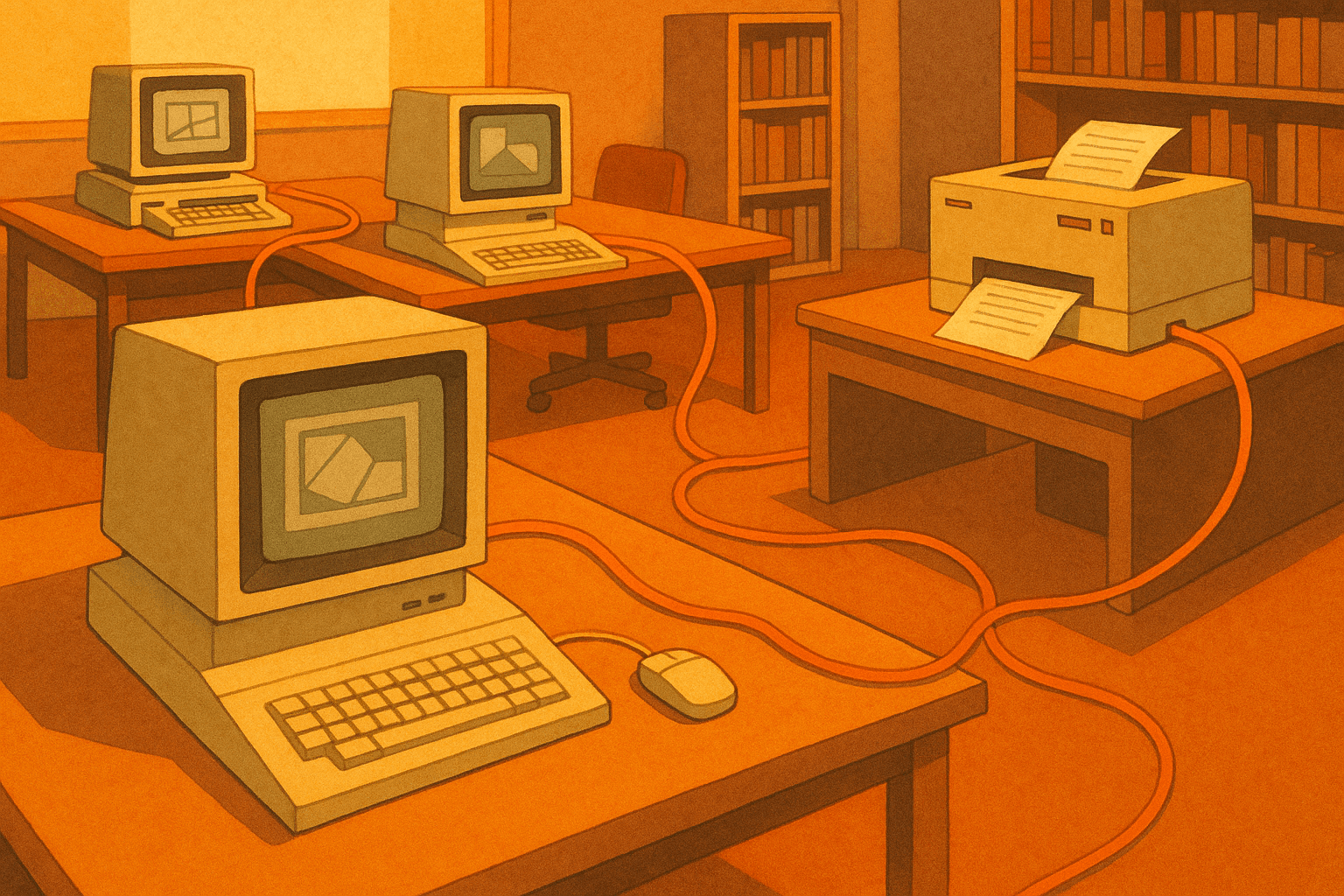
Every time you plug a network cable into the wall or connect a console over Wi-Fi, you are using an idea born more than half a century ago to solve a very concrete office problem: how to get a whole roomful of computers to share one absurdly expensive printer. That idea is called Ethernet, and its story begins one day in May 1973, in a California lab, with an engineer, a typewriter, and a laser printer that ran too fast for the network of the day.
The problem: a laser printer with nothing to feed it
In the early 1970s, Xerox's Palo Alto Research Center (Xerox PARC) was probably the most advanced place on Earth for personal computing. It was where the Alto had been built —one of the first computers with a graphical screen and a mouse— and where EARS, the first laser printer in history, had been born, able to print a page per second at 500 dots per inch.
The problem was almost absurdly simple: PARC had dozens of Alto computers scattered around the building and a single one of those spectacular printers. To make use of it, all those machines had to send it data —and a lot of data: feeding that printer required moving on the order of 25 million bits per second. The networks of the era, designed for slow text terminals, weren't remotely close. Something new was needed: fast, and not dependent on a central computer acting as a traffic cop.
Robert Metcalfe, ALOHAnet, and a radio in Hawaii
The task fell to a young engineer named Robert Metcalfe, who had come from working on ARPANET —the network that, years earlier, had carried the first message in internet history. Looking for inspiration, Metcalfe turned to a system that seemed very different: ALOHAnet, a network at the University of Hawaii that connected the islands by radio.
The brilliance of ALOHAnet was its nerve. Instead of carefully coordinating who spoke and when, it let any station transmit whenever it liked. If two messages collided in the air, they were simply retransmitted later, after waiting a random amount of time. Metcalfe realized that same idea —let everyone talk, and resolve the crashes when they happen— could move from radio waves onto a cable, and run vastly faster.
May 22, 1973: the name «Ethernet» is born
On May 22, 1973, Metcalfe wrote an internal memo —typed on an IBM Selectric typewriter— describing a «broadcast communication network» to connect the Altos inside a building. In that document he christened the system with a name that would stick for good: Ethernet.
The name was a learned joke. In the 19th century, physicists believed light traveled through an invisible medium that filled the entire universe, which they called the «luminiferous ether». That ether turned out not to exist, but Metcalfe revived the word to name the «medium» through which data would travel. And it was a visionary choice: by talking about an abstract «ether» rather than a specific cable, he left the door open for Ethernet to later run over coaxial cable, twisted pair, optical fiber, and even radio waves.
Everyone talks, and when they collide, they wait
The technical heart of Ethernet is a method with an intimidating name, CSMA/CD, but a very human logic. Picture a meeting with no moderator: before speaking, each person listens to check whether someone else is already talking (that's the «carrier-sense multiple access»). If the channel is free, they speak. If by chance two start at once, both notice the clash (the «collision detection»), fall silent, and wait a random instant before trying again.
Together with David Boggs, co-inventor of Ethernet, Metcalfe built a network at PARC that joined about a hundred nodes over a coaxial cable. That first Ethernet ran at 2.94 megabits per second: roughly 10,000 times faster than the terminal networks it replaced, and finally enough to keep the voracious laser printer fed. The office, at last, knew how to share its data.
From a lab to a global standard
Xerox could have kept the invention to itself, but Metcalfe understood that a network is only valuable if many people use it. In 1980, three giants —Digital Equipment Corporation (DEC), Intel, and Xerox— jointly published the «DIX» specification for a 10 Mbps Ethernet, opening the design to the whole industry. Soon after, in 1983, the IEEE turned it into an official standard, the famous IEEE 802.3, which to this day defines how wired networks talk.
Metcalfe himself left Xerox and founded 3Com to sell Ethernet cards, and in time he formulated the celebrated «Metcalfe's law»: the value of a network grows with the square of the number of connected users. The missing piece that would carry Ethernet into every office arrived in 1990 with 10BASE-T, which allowed the use of simple twisted-pair cable and telephone-like connectors, instead of the rigid, expensive coaxial cable.
Why Ethernet won (and keeps winning)
For years Ethernet competed with other, theoretically more elegant network technologies, such as Token Ring. It won for the same reasons so many things win in technology: it was simpler, cheaper, and good enough. And above all, it was flexible: that idea of an abstract «ether» let the same family of standards go from 3 to 10, then to 100, to 1,000, and today to hundreds of thousands of megabits per second, without changing its essential logic.
Even Wi-Fi is, at bottom, a close relative: from that Hawaiian radio network it inherits the idea of sharing a medium and managing collisions. If that other branch of the story interests you, it's worth learning what the word Wi-Fi actually stands for, or how the modem made the internet screech through the telephone. They are all variations on the same question Metcalfe answered in 1973: how to make several machines share a conversation without stepping on each other. Half a century later, we still use his answer every time we casually say, «just plug it into the network cable».
References
- «Milestones: Ethernet Local Area Network (LAN), 1973–1985», Engineering and Technology History Wiki (ETHW). ethw.org
- «Responding to a Challenge with a World-Changing Invention», Internet Hall of Fame. internethalloffame.org
- Metcalfe, Robert M.; Boggs, David R. «Ethernet: Distributed Packet Switching for Local Computer Networks», Communications of the ACM, 1976. dl.acm.org
- «Ethernet», Wikipedia. en.wikipedia.org
Do you enjoy these stories about the origins of technology? Continue with the first message ever sent over the internet or explore the whole science & tech section.
Categories
The books · born from this blog
Atahualpa con su abrigo de pelo de murciélago
y otras 49 historias verdaderas que parecen mentira
Available on Amazon
Tocar madera
Pequeña historia de las supersticiones que el mundo no ha podido soltar
Available on Amazon
100 futuros
Cien escenarios del mundo que viene con la inteligencia artificial
Available on AmazonYou may also like
The History of the Match: Fire in Your Pocket
The friction match was born by accident in 1826, poisoned thousands of factory women, and only later became the safe fire we carry in our pocket.
The History of the Floppy Disk and the Save Icon
The floppy disk held 80 KB in 1971 and survives today as the «save» icon many young people never touched. This is the full history of the floppy disk.
The History of the Elevator and the Vertical City
The history of the elevator: from Elisha Otis's 1854 safety brake to the invention that made skyscrapers and the modern vertical city possible.