
The First Submarine Was Built Centuries Before You Think
Before Isaac Peral's electric submarine came centuries of trying: Drebbel under the Thames, the Turtle of 1776 and the deadly Hunley of 1864.
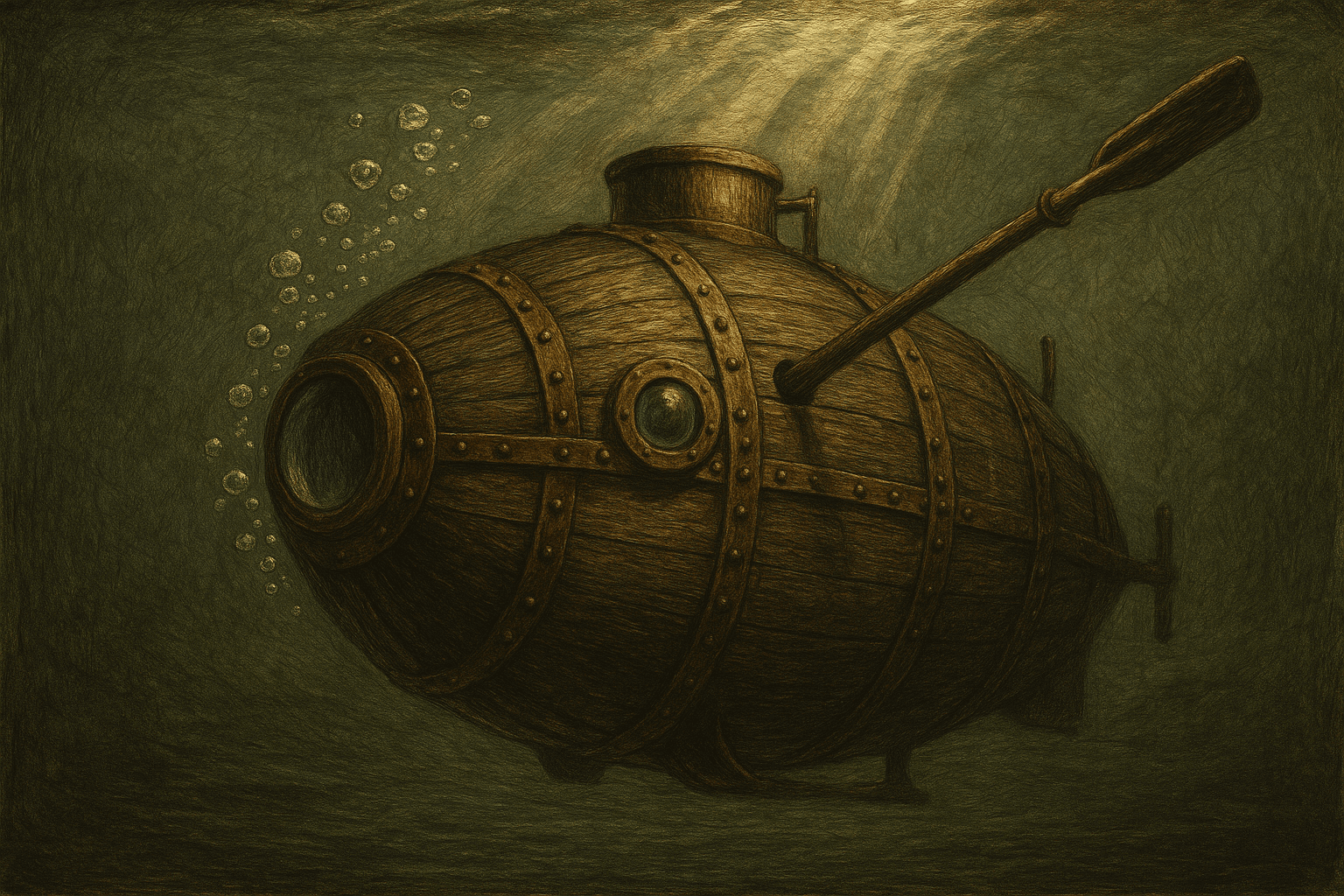
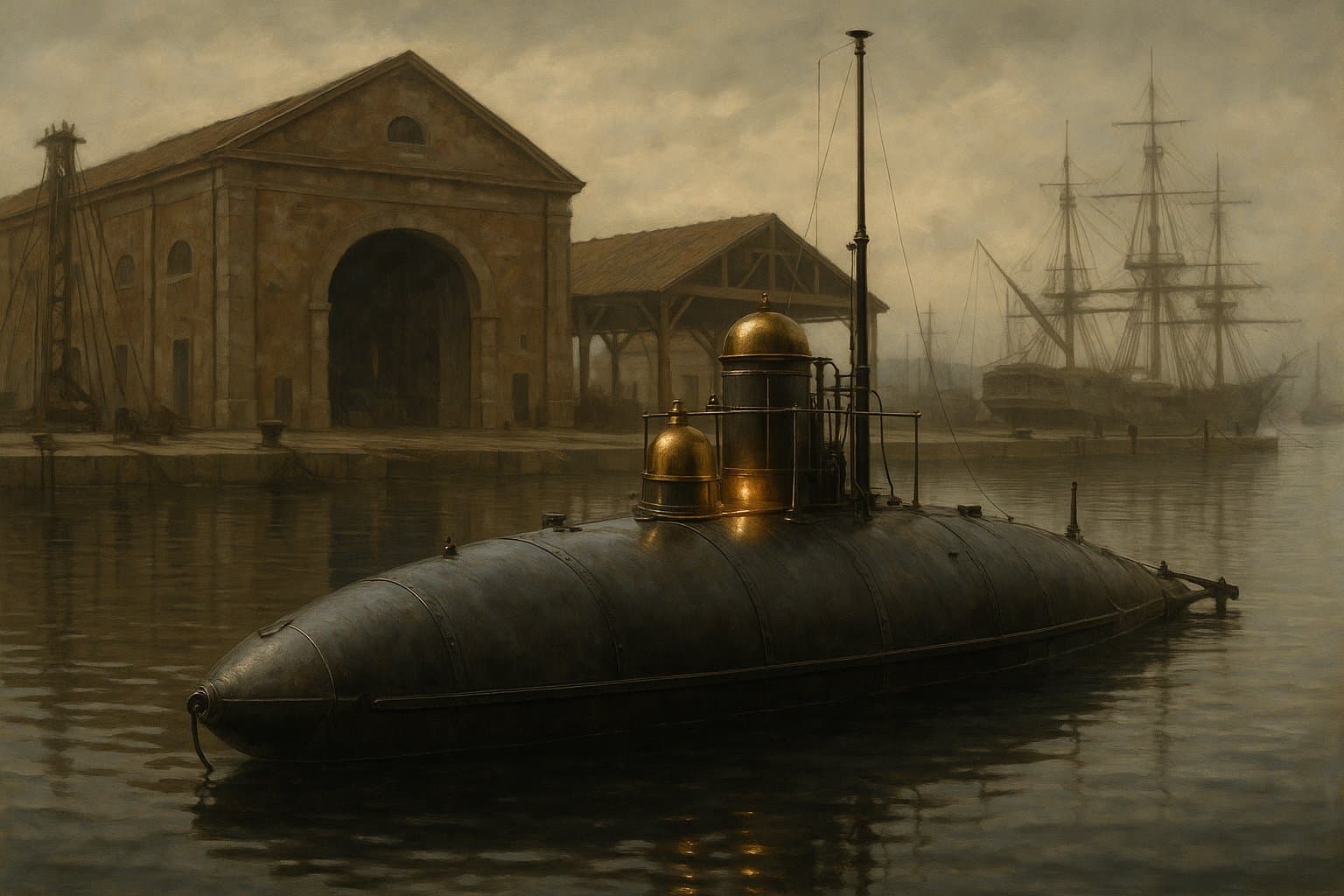
When people picture the first submarine in history, they usually imagine something sleek and modern. But the idea of sailing underwater is far older than the electric boats of the late 1800s, such as Isaac Peral's electric submarine of 1888. Long before any engine could make a submarine truly practical, there were nearly three centuries of stubborn inventors, impossible blueprints and brave —or reckless— men who climbed into boxes of wood and copper to sink on purpose. This is the story of those first submarines.
The blueprint no one dared to build (1578)
The first written description of a boat that could submerge came not from a shipwright but from an English mathematician, William Bourne. In his 1578 book Inventions or Devises, Bourne imagined a wooden vessel wrapped in leather that could sink by shrinking its own volume: movable walls squeezed inward by hand-turned screws, pushing out water to rise again.
It was, in essence, the principle behind every submarine that followed: controlling buoyancy. The catch is that Bourne never built it. His submarine lived only on paper, like so many brilliant ideas that arrive before the technology is ready to hold them up.
Drebbel: the submarine that carried a king (1620)
The leap from paper to water was made by a Dutchman in the service of the English court, Cornelis Drebbel. Between 1620 and 1624 he built, tested and improved as many as three submarines on the River Thames, in the heart of London. He started from Bourne's idea: a wooden hull covered in greased leather to make it watertight, moved by oars that passed through sealed joints in the sides.
To dive, he used skins or bladders filled with water as ballast and emptied to surface again. Air, according to the accounts, came in through tubes with floats that kept one end above the water. The largest model could carry some sixteen rowers and passengers, stay under for several hours at four or five meters deep, and travel the stretch from Westminster to Greenwich beneath the surface.
The most repeated legend says that King James I of England himself climbed aboard one of these craft and rode for a while under the Thames, which would make him the first monarch in history to travel submerged. Thousands of Londoners watched from the banks. And yet the Admiralty never took interest: a submarine that worked, but for which no one had yet found a war.
The Turtle: the first underwater weapon (1776)
It took a century and a half for the submarine to become a weapon, and it happened across the Atlantic. In the middle of the American War of Independence, a Yale student named David Bushnell built the Turtle, an egg-shaped wooden shell just over two meters long, designed for a single crewman.
The operator dived by filling a ballast tank with a foot pump, moved by hand-cranking a propeller —one of the first ever used for propulsion— and rose by pumping the water back out. Its mission was as daring as the machine: to slip beneath an enemy ship, screw a charge of gunpowder onto its hull, and pull away before it blew.
On the night of September 7, 1776, Sergeant Ezra Lee piloted the Turtle in New York Harbor to attack HMS Eagle, the flagship of Admiral Richard Howe. He failed to fix the charge —apparently he could not bore through the hull— and had to retreat. The attack failed, but it went down in history as the first use of a submarine in combat.
Fulton's Nautilus: the first "practical" submarine (1800)
The next to try was another American, Robert Fulton, later far more famous for his steamboats. Living in Napoleon's France, between 1800 and 1801 he built the Nautilus: a hull of copper plates over iron ribs, about six and a half meters long, with a folding mast and sail for surface travel and a hand-cranked propeller for moving submerged.
The Nautilus dove to around seven meters, stayed underwater with several crewmen, and even managed to sink a target ship during its trials. Many consider it the first genuinely practical submarine. But, exactly as would happen to Peral decades later, neither France nor Britain would fund it: the weapon seemed too dirty, too ungentlemanly for the navies of the age.
The Hunley: the first to sink a warship (1864)
The first to claim a real victim was a Confederate submarine during the American Civil War: the H. L. Hunley. Powered by hand by an eight-man crew turning a crankshaft, it carried an explosive charge mounted on a long pole at the bow, the so-called spar torpedo.
On the night of February 17, 1864, in Charleston Harbor, the Hunley drove its charge into the hull of the USS Housatonic and sank it: the first time a submarine ever sent a warship to the bottom. It was a bitter victory. The Hunley had already gone down twice in trials, killing its crews —including Horace Hunley himself, who gave it its name— and that night it did not come back either: it sank with its eight men shortly after the attack.
And then came electricity
All these submarines shared the same Achilles' heel: they depended on human arms turning cranks, or on a sail at the surface. They were slow, exhausting and had a ridiculous range. What was missing was a silent power source that worked underwater without burning the crew's air, and that piece did not arrive until the late 19th century, when electricity began to move the world and batteries made a truly submerged motor possible.
That is where Isaac Peral comes in, and where this prehistory of madmen underwater ends. Without Bourne, Drebbel, Bushnell, Fulton and the tragic Hunley —and without the advances in handling air and vacuum— there would have been no electric submarine for Spain to hold in its hands and let slip away. The first submarine in history was not a single machine: it was a chain of failed attempts that, one after another, taught humanity how to breathe underwater.
References
- Encyclopædia Britannica, "Cornelis Jacobszoon Drebbel" and "Nautilus (submarine)."
- Naval History and Heritage Command (U.S. Navy), "Submarine Turtle: Naval Documents."
- American Battlefield Trust, "Bushnell's Turtle: A Revolutionary Submarine."
- History.com, "9 Groundbreaking Early Submarines."
Enjoy stories of inventions ahead of their time? Continue with Isaac Peral's electric submarine or explore the whole science of the past series.
Categories
The books · born from this blog
Atahualpa con su abrigo de pelo de murciélago
y otras 49 historias verdaderas que parecen mentira
Available on Amazon
Tocar madera
Pequeña historia de las supersticiones que el mundo no ha podido soltar
Available on Amazon
100 futuros
Cien escenarios del mundo que viene con la inteligencia artificial
Available on AmazonYou may also like
The Airplane Before the Wrights: Who Almost Won
Before the Wright brothers flew in 1903, pioneers nearly got there first: Cayley, Lilienthal, Ader and Santos-Dumont. This is their untold story.
Edison's Phonograph: The First Machine That Talked
In 1877 Thomas Edison built the phonograph, the first machine that could record the human voice and play it back. A machine had finally spoken aloud.
Isaac Peral's 1888 Electric Submarine (and Its Sad End)
In 1888, Isaac Peral built an electric submarine that sailed underwater and fired torpedoes, yet Spain buried this future in paperwork.