
The Barometer and the Storm: How We Weigh the Air
The barometer was born to prove that air has weight and ended up predicting storms. The story of Torricelli, Pascal and FitzRoy against bad weather.
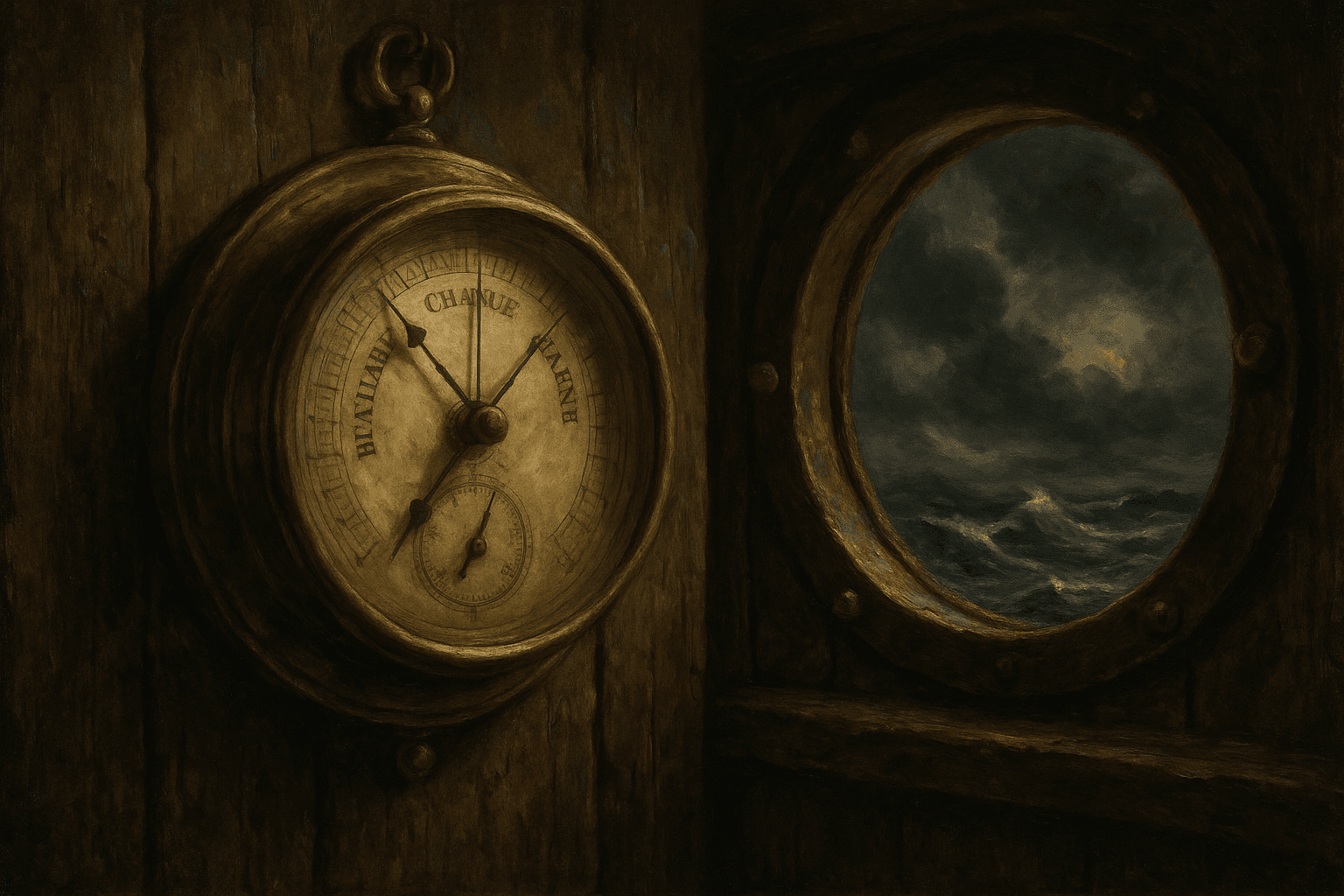
For centuries a sailor had only the sky, the wind and the ache in his joints to guess whether a storm was coming. Today an instrument the size of a watch can warn that bad weather is on the way before the first cloud appears. That instrument is the barometer, and its history is the story of how humanity learned to weigh something it did not even believe had any weight: the air we breathe. It was not invented to predict the weather, but to settle a two-thousand-year-old philosophical argument. That it also ended up saving lives at sea was an unexpected bonus.
An ocean of air over our heads
Until the seventeenth century, Western science was convinced that air weighed nothing. Aristotle had taught that nature "abhors a vacuum" — the famous horror vacui — and that idea explained almost everything: water rises up a straw because nature rushes to fill the gap, not because anything pushes it. The trouble was that the explanation failed exactly where it mattered. The engineers of the Grand Duke of Tuscany discovered, to their frustration, that their suction pumps could not lift water from wells beyond about ten meters. If nature abhorred a vacuum so fiercely, why did it always give up at that precise height?
The answer came in 1643 from Evangelista Torricelli, a pupil of Galileo. He filled a glass tube closed at one end with mercury, sealed it, turned it upside down into a basin also containing mercury, and unsealed it. The mercury fell, but not all the way: it stopped at a column about 76 centimeters high, leaving an empty space above it. Torricelli realized that the column was not held up because nature "pulled" on it, but because the weight of the entire atmosphere pressed down on the mercury in the basin. "We live submerged at the bottom of an ocean of air," he wrote, in a sentence that is still the best description of our situation. He had just invented the barometer and, in passing, the first nothingness ever manufactured by a human being.
Pascal sends the barometer up a mountain
The idea was beautiful, but it needed a proof beyond any doubt. If it really was the weight of the air holding up the mercury, then climbing a mountain — where less atmosphere sits overhead — the column should drop. In France, Blaise Pascal designed the decisive experiment, though he did not carry it out himself: he asked his brother-in-law Florin Périer to climb the Puy de Dôme, a 1,465-meter volcano in the Auvergne region, carrying a mercury tube more than a meter long.
On 19 September 1648, Périer measured the column at the foot of the mountain: about 26 inches. He left a second barometer below, watched by a witness, to make sure it did not change on its own. Then he climbed to the summit and measured again: the column had fallen more than three inches. The air did indeed weigh less higher up. The experiment demonstrated for the first time that atmospheric pressure decreases with altitude — the same principle used today by aircraft altimeters and one reason why measuring exact vertical position is so hard. And something more important for our story: it proved that the barometer does not show a fixed number. It rises and falls. And that restlessness of the mercury would turn out to be a message.
The mercury that stirs before the storm
People soon noticed a curious coincidence: when the barometer's mercury dropped sharply, bad weather usually followed; when it rose and stayed high, the skies cleared. The reason is that storms form in areas of low pressure, where warm, moist air rises and cools; the barometer, by measuring that pressure, becomes an informant on the state of the atmosphere. A rapid fall of the needle means that a low-pressure system — and with it wind and rain — is approaching fast.
As early as 1660, legend has it, Otto von Guericke — the same German mayor of the horses and the hemispheres — predicted a storm when he saw his huge water barometer plummet, and warned the townspeople of Magdeburg before it broke. The instrument thus went from cabinet curiosity to practical tool. Ships began carrying it aboard, and on land the wall barometer became a household object with its classic brass dial and engraved labels: "Rain," "Change," "Fair." What was still missing was someone to turn that scattered wisdom into an organized service.
FitzRoy: from shipwreck to forecast
That man was Robert FitzRoy, the captain who had taken Charles Darwin around the world aboard the Beagle. In 1854 the British government put him in charge of a small meteorological office within the Board of Trade. FitzRoy was obsessed with an idea that was then almost heretical: that the weather could be anticipated. For the verb describing that prediction he coined a word we now use without thinking: forecast.
The turning point came in 1859, when a hurricane sank the steam clipper Royal Charter off the coast of Wales and hundreds of people died. FitzRoy was convinced the tragedy could have been avoided if someone had read the falling barometer in time. He pressed the government and, on 5 February 1861, issued the first storm warning in history: he telegraphed ports to hoist signal cones when bad weather approached. That same year, on 1 August, he published in The Times the world's first newspaper weather forecast. Public meteorology was born — as revolutionary for sailors as the instruments that once changed navigation had been in their day.
A barometer for every fisherman
FitzRoy knew that his telegraph warning service could not reach the small fishing harbors. So he designed a cheap, sturdy barometer, easy to read, and got it installed in dozens of coastal villages. So that even the least literate sailor could understand it, he engraved simple rules and even little rhymes into the wood: if the needle fell fast, better not put to sea. Those "FitzRoy barometers" — many funded almost out of his own pocket, to the point of ruining him — saved countless lives and are still collectors' items today.
By then the instrument had already changed shape. In 1844, the Frenchman Lucien Vidi had invented the aneroid barometer, which does away with mercury: it uses a small sealed metal capsule, almost empty of air, that compresses or expands with pressure, moving a needle through a set of levers and springs. With no dangerous liquid and no meter-long tubes, the barometer could finally fit in a pocket, on the wall of a house, or in an aircraft cockpit.
The air we are still weighing
Today almost no one glances at a brass dial to know whether it will rain, but the barometer has not vanished: it has multiplied and shrunk. Your phone probably has one. Modern smartphones carry a tiny barometric sensor — a microchip that measures pressure — that helps the GPS work out which floor of a building you are on and feeds weather apps with real-time data. Millions of these sensors scattered around the world now form an observation network Torricelli could never have imagined.
The great models that predict hurricanes days in advance still start from the same figure that obsessed FitzRoy: how much the air weighs at each point and where that invisible mass is moving. From Torricelli's mercury tube to the chip in your pocket, the history of the barometer is the story of one simple, profound idea: that nothingness has weight, that this weight changes, and that learning to measure it allowed us, for the first time, to see the storm coming.
References
- "Robert FitzRoy and the early Met Office," Met Office. metoffice.gov.uk
- "Barometer," Encyclopædia Britannica. britannica.com
- "Blaise Pascal, Florin Périer, and the Puy de Dôme experiment," Backreaction. backreaction.blogspot.com
- "The History of Atmospheric Discovery," UCAR Center for Science Education. scied.ucar.edu
Fascinated by how we learned to measure the invisible? Continue with the vacuum pump that made modern science possible or explore the whole Science & Technology section.
Categories
The books · born from this blog
Atahualpa con su abrigo de pelo de murciélago
y otras 49 historias verdaderas que parecen mentira
Available on Amazon
Tocar madera
Pequeña historia de las supersticiones que el mundo no ha podido soltar
Available on Amazon
100 futuros
Cien escenarios del mundo que viene con la inteligencia artificial
Available on AmazonYou may also like
Morse Code: How It Works and Why It Saved Lives
Morse code turns letters into dots and dashes that travel down a wire or a flash of light. Here is how it works, where it came from and why it is still used.
The Telegraph: The Victorian Internet
The telegraph shrank weeks of mail into minutes of cable. How Morse, Cooke and a wire under the Atlantic built the Victorian internet and shrank the world.
The nocebo effect: when expecting harm creates it
The nocebo effect is the placebo's dark twin: believing a treatment will hurt can make it hurt. Its origin, real cases and what science says.