
How the First Cameras Worked: Dark Room to Kodak
From Ibn al-Haytham's camera obscura to Niépce's first photo and the 1888 Kodak: how the earliest photographic cameras actually worked and evolved.
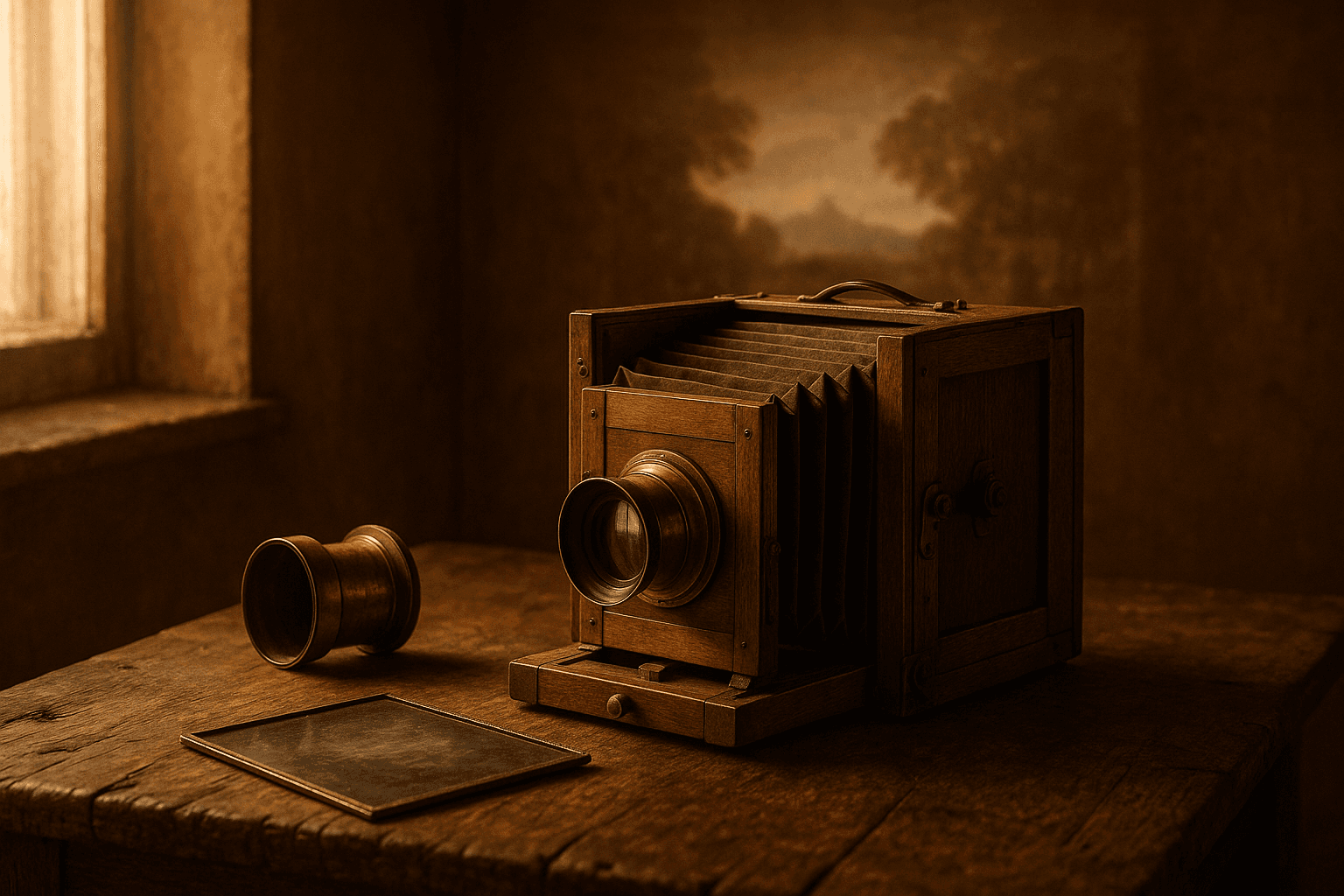
Today you pull out your phone, tap the screen, and in a fraction of a second you have a perfect image. It is hard to imagine that, for centuries, «taking a picture» was a problem that seemed impossible to solve. The optical part —projecting the world inside a box— had been figured out almost a thousand years earlier. What was missing was far harder: catching that light and making it hold still. This is the story of how the first photographic cameras worked, from a darkened room to the little box that put photography in anyone's hands.
The camera that existed a thousand years before the photo
The camera existed long before photography. The camera obscura —Latin for «dark room»— is a simple optical phenomenon: if you make a small hole in one wall of a completely dark room, the light coming in projects onto the opposite wall an image of the outside world, sharp but upside down and reversed. No lens is needed; the hole alone is enough.
The first to study it systematically was the Arab scholar Ibn al-Haytham (Alhazen), born in Basra around 965. In his Book of Optics, written around 1027, he described how to build an enclosed room with a single opening to prove that light travels in straight lines and to understand how vision works. His method —testing theories through experiments— resembles the modern scientific method so closely that Ibn al-Haytham is considered one of its pioneers, and his treatise, translated into Latin, shaped later European science. Just as happened with the word algorithm, much of the foundation of Western science passed first through the Arab world.
During the Renaissance, painters such as Leonardo used it as an aid for drawing in perspective, and in time a lens was added to the hole so the image would be brighter and sharper. The camera obscura shrank: from a room to a portable box with a ground-glass screen where the artist traced what he saw. It was, in essence, already a photographic camera… but with no film. The image was there, alive and perfect, and it vanished the instant you covered the hole.
The real problem: making the light stay
That was the wall entire generations crashed into. It was known that certain silver salts darkened in light, but no one could stop the process: the image that appeared kept blackening until it disappeared entirely the moment it was viewed in full daylight. The challenge of photography was never forming the image, but fixing it.
The first to succeed was the Frenchman Nicéphore Niépce. Around 1826 or 1827, he placed inside a camera obscura a pewter plate coated with Bitumen of Judea, a kind of asphalt that hardens when exposed to light. He pointed the camera out the window of his estate at Le Gras and waited. And waited: the exposure lasted several hours —estimated at about eight, or even more— so long that in the resulting image the sun appears to light the walls on both sides of the courtyard at once. The result, View from the Window at Le Gras, is the oldest surviving photograph: the first time an image of the real world was recorded permanently without anyone's hand drawing it.
The daguerreotype: the first camera you could buy
Niépce's process was far too slow to portray a person. His partner, Louis Daguerre, kept experimenting and in 1839 unveiled the daguerreotype: a silvered copper plate, sensitized with iodine vapor, that produced an image of astonishing sharpness, almost like a mirror. The camera was still a wooden box with a lens, but now the exposure had dropped to minutes instead of hours.
1839 is taken as the year photography was born, and the daguerreotype was the first camera manufactured and sold commercially. It had two flaws: each plate was a unique image, impossible to reproduce, and sitting for one was still an ordeal of stillness —which is precisely why nobody smiled in old photographs. Even so, within a few years daguerreotype portrait studios multiplied across Europe and America.
The negative: one photo, many copies
While Daguerre triumphed in France, the Englishman William Fox Talbot solved the other great problem. His process, the calotype (patented in 1841), did not produce a direct positive image but a negative on paper: bright areas came out dark and vice versa. The advantage was enormous, because from that negative you could make as many positive copies as you wanted. This gave rise to the negative-positive principle that would dominate photography for a century and a half, until the arrival of digital.
The next leap came in 1851, when Frederick Scott Archer invented the wet collodion process: a glass plate was coated with a sticky solution, sensitized in silver nitrate, and —here was the awkward catch— it had to be exposed and developed before it dried, within a matter of minutes. The photographer had to carry a portable laboratory everywhere: a dark tent, jars of chemicals, and glass plates. It combined the best of both worlds —the sharpness of the daguerreotype and the copies of the calotype— but turned every photo into a small chemical expedition.
The black box: what was really inside
Beyond the chemistry, all these cameras shared the same anatomy, inherited from the camera obscura. At the front, a lens that focused the light. A diaphragm that regulated how much light passed through, like the pupil of the eye. A bellows or a wooden body that let you adjust the distance to the back to focus. And at the back, the sensitive material: the plate of metal, glass, or paper where light left its mark. The shutter —the mechanism that opens and closes the light path for an exact time— was at first as simple as removing and replacing the lens cap by hand; with exposures of several seconds, that precision was enough.
All the later evolution consisted of making each of those steps faster and more automatic. It was a progress as slow and collective as that of other inventions we use today without thinking: no one invented «the camera» overnight; each generation solved one piece of the puzzle.
1888: the camera for everyone
The final step that turned photography into a mass hobby was taken by the American George Eastman. In 1888 he launched the first Kodak camera: a simple black box, with no settings to touch, pre-loaded at the factory with a flexible roll of film for 100 pictures. The user just aimed and pressed a button. When the roll was finished, they mailed the entire camera to the factory in Rochester, where the photos were developed, the film reloaded, and everything returned by post.
The slogan summed it all up: «You press the button, we do the rest.» For the first time, taking a photo required no knowledge of chemistry or optics: Eastman had separated the act of taking a picture from that of developing it, and with that he put the camera in anyone's hands. From Ibn al-Haytham's dark room to that pocket-sized box, almost nine hundred years had passed; from the Kodak roll to the sensor in your phone, little more than a century. But the principle is exactly the one that scholar from Basra discovered: a box, a hole, and light coming in to draw the world. It is worth remembering the next time you visit a museum and stop in front of one of those first, impossible photographs.
References
- «View from the Window at Le Gras», Wikipedia. en.wikipedia.org
- «Alhazen Builds the First Camera Obscura», History of Information. historyofinformation.com
- «You Press the Button, We Do the Rest», Wikipedia. en.wikipedia.org
- «Photographic Processes Video Series & Glossary», George Eastman Museum. eastman.org
Do you enjoy inventions that changed the world while nobody was watching? Continue with the war of the currents or explore the whole Science & Tech section.
Categories
The books · born from this blog
Atahualpa con su abrigo de pelo de murciélago
y otras 49 historias verdaderas que parecen mentira
Available on Amazon
Tocar madera
Pequeña historia de las supersticiones que el mundo no ha podido soltar
Available on Amazon
100 futuros
Cien escenarios del mundo que viene con la inteligencia artificial
Available on AmazonYou may also like
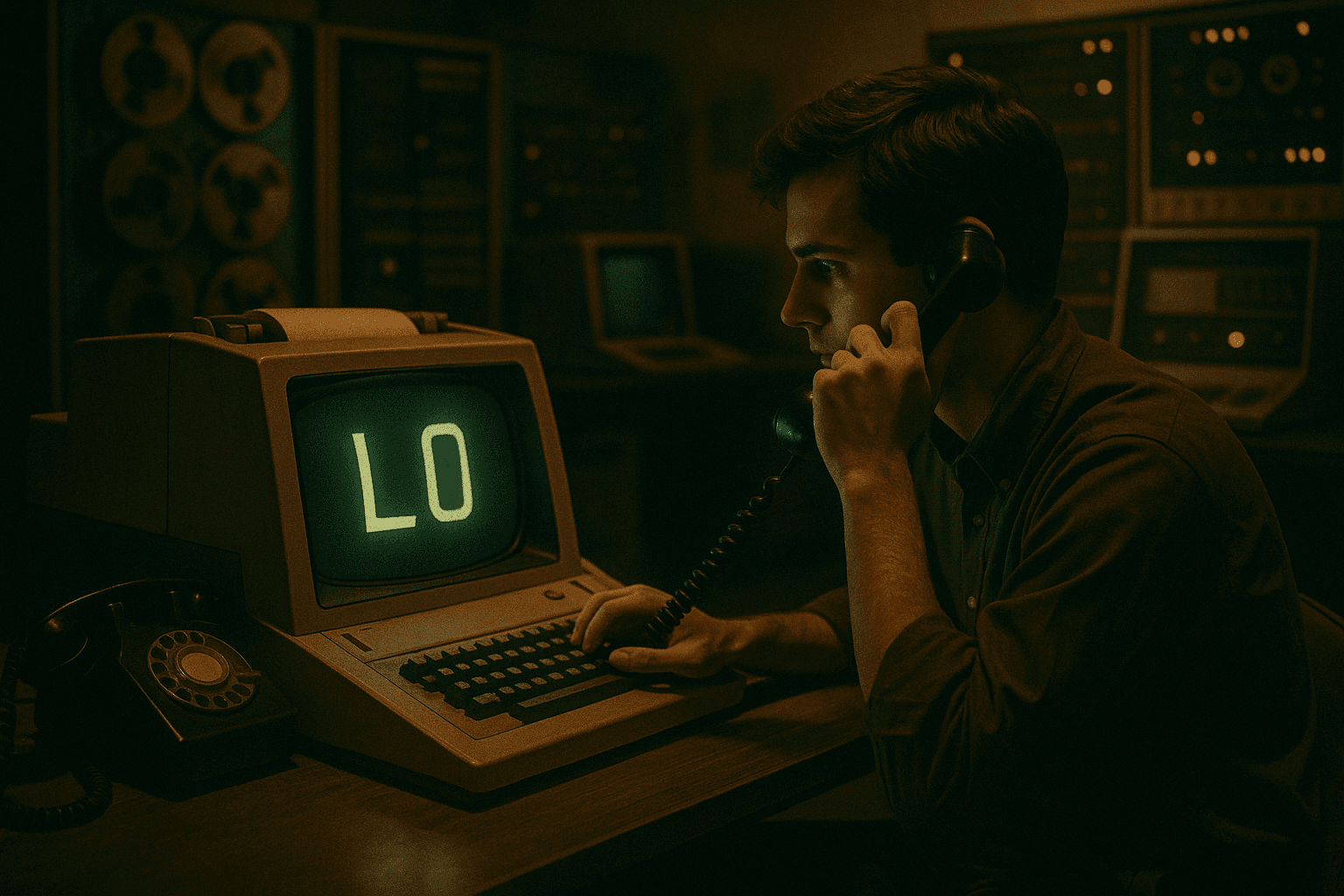
The First Message Ever Sent Over the Internet Was 'LO'
On October 29, 1969, the first message in internet history was meant to be 'login', but the network crashed after just two letters: 'LO'.
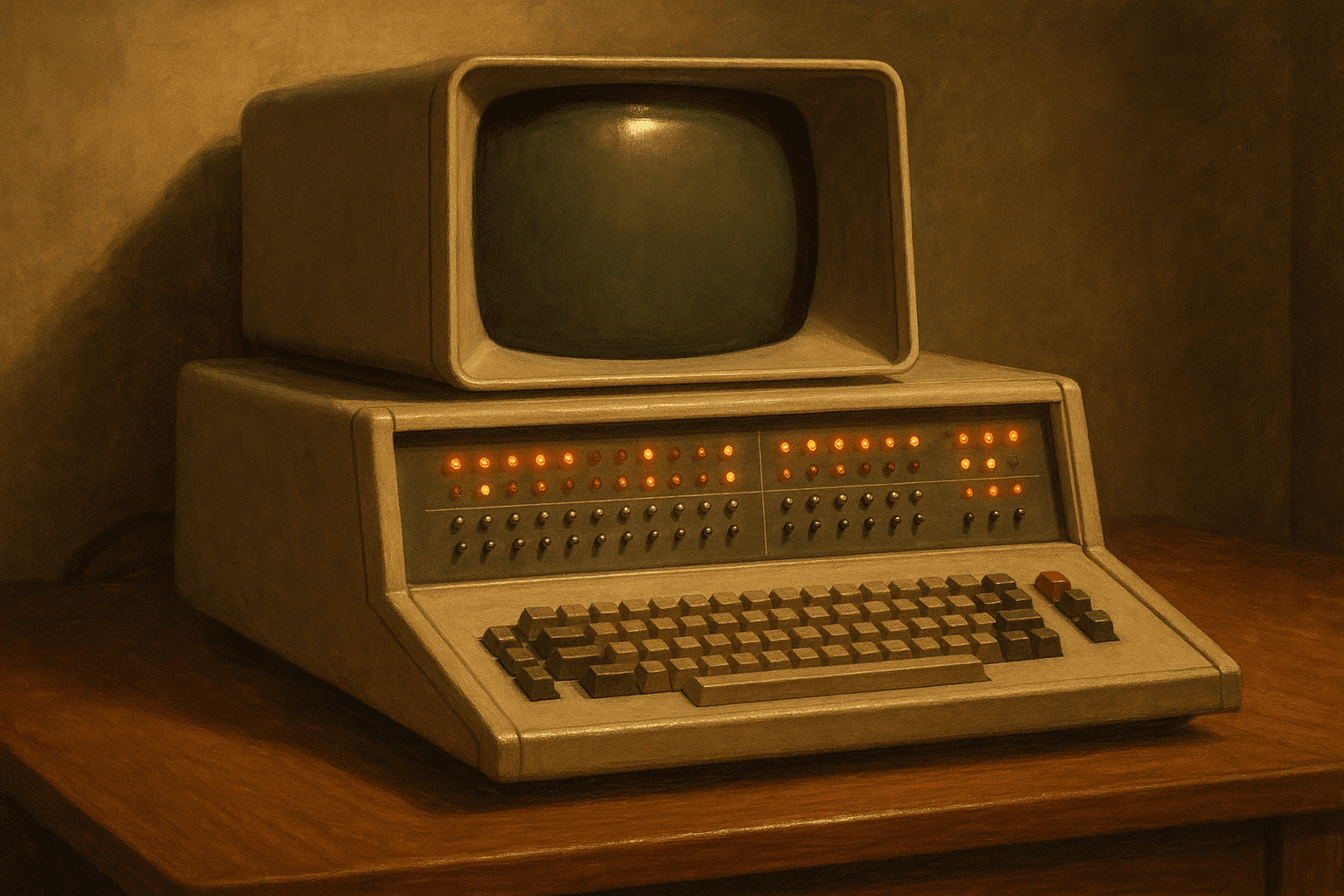
The First Personal Computer Wasn't the One You Think
Almost everyone credits the 1975 Altair as the first personal computer, but several came earlier: from Olivetti in 1965 to the Kenbak-1 in 1971.

The first computer virus was called Brain
In 1986, two brothers in Lahore wrote Brain, the first PC virus. It destroyed nothing: it guarded their software and left their name, address and phone.