
Lithium: From Medicine to the Battery of the Modern World
Lithium went from miracle cure and soft drink to mood stabilizer and battery of the modern world. This is the story of the lightest metal, from medicine to power.
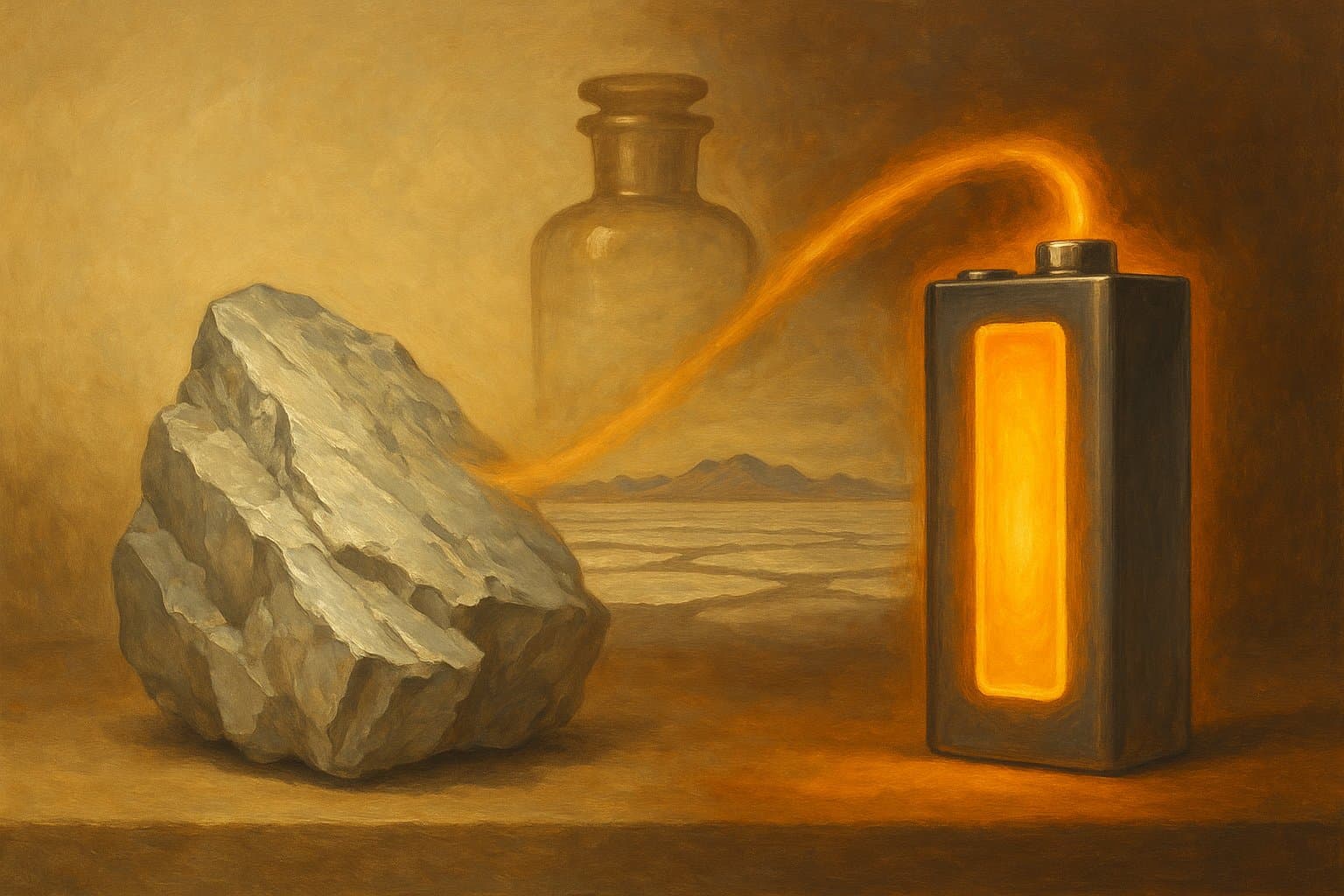
Lithium is in almost every pocket today: it keeps your phone, your laptop and electric cars alive. But before it powered the digital world, this metal lived a long and strange life: it was a spa medicinal water, the ingredient of a famous soft drink and, above all, the first drug able to calm mania. The history of lithium is the story of a substance that changed jobs several times before becoming the heart of our batteries.
A metal born from a stone
Lithium was discovered in 1817 in Stockholm. The young Swedish chemist Johan August Arfwedson, working in the laboratory of the celebrated Jöns Jacob Berzelius, was analyzing a mineral called petalite from a Swedish island when he found an unknown element in it. He could not isolate the pure metal —that would take more years and require electrolysis— but it was clear he had stumbled onto something new.
The name came from Berzelius, and it holds a small irony. He called it lithium, from the Greek lithos, «stone». Its chemical relatives, sodium and potassium, had been discovered from plant ashes and other organic sources; lithium, by contrast, turned up inside a rock. So the lightest metal in the periodic table —so light it floats on both water and oil— was forever baptized with the word «stone».
The age of the miracle cure
In the mid-nineteenth century, doctors believed that uric acid was the secret cause of half the world's ailments: gout, rheumatism, kidney stones, even melancholy. And it was found that lithium salts dissolved uric acid rather well in the laboratory. The conclusion —too hasty— seemed obvious: if lithium dissolves uric acid in a glass, it will do the same inside the body.
So the craze for «lithia water» was born. Spas and bottlers sold water with traces of the metal as a universal remedy against gout, diabetes, asthma, nerves and almost any imaginable illness. It was the same era when all sorts of miracle remedies were sold with no basis whatsoever; if that world amuses you, see when we brushed our teeth with radioactive paste. The awkward detail is that most of those waters barely contained enough lithium to have any real effect.
The star of the fad arrived late: in 1929, in the United States, a soft drink launched under the baroque name «Bib-Label Lithiated Lemon-Lime Soda», which really did contain lithium citrate and was even sold as a hangover cure. It soon shortened its name to something far more memorable: 7Up. The lithium was removed from the formula by 1948 at the latest, when the United States banned the metal in soft drinks. It is the same pattern as the malaria cure that ended up as gin and tonic: a medical compound that ends up disguised as a refreshing drink.
The psychiatrist, the guinea pigs and the calm
Lithium's true medical role was discovered, almost by accident, by an Australian psychiatrist named John Cade in 1949. Cade suspected that mania might be caused by some toxic substance in patients' urine, and to study it he injected that urine into guinea pigs. To dissolve the uric acid he used a lithium salt, and noticed something unexpected: lithium, on its own, made the guinea pigs strangely calm and docile.
After testing the compound on himself to make sure it was safe, Cade gave it to a group of patients with mania. The results were astonishing: people who had been agitated for years grew calm and recovered a normal life. He published it that same year in the Medical Journal of Australia, in a now-historic paper. The first mood stabilizer of modern psychiatry had been born.
Recognition, however, took decades. In that very year of 1949, several heart patients had died from using lithium chloride as a table-salt substitute, and that left the metal with a bad reputation. Only when doctors learned to control the dose with blood tests did lithium earn its place; in the United States it was not approved until 1970. Even today, a century and a half after those miracle waters, it remains one of the most effective treatments against bipolar disorder.
The leap to the battery
Lithium's second life began in the 1970s, when chemists looked again at its greatest physical virtue: it is the lightest metal and one of the most eager to release electrons, exactly what you need to store a lot of energy in very little weight. In 1976, Stanley Whittingham, working for the oil company Exxon, built the first rechargeable lithium battery. It worked, but it used pure lithium metal and had an ugly tendency to catch fire.
The solution came in pieces. In 1980, John Goodenough discovered that a lithium cobalt oxide could double the voltage. In 1985, the Japanese chemist Akira Yoshino eliminated the dangerous metallic lithium and designed a battery based only on lithium ions shuttling from one electrode to the other: far safer. In 1991, Sony manufactured the first commercial lithium-ion battery, and from there the world changed: cameras, phones, laptops and, finally, the electric cars that had already existed a century earlier and now at last had a battery worthy of them. In 2019, Whittingham, Goodenough and Yoshino received the Nobel Prize in Chemistry for that invention.
The «white gold» of the 21st century
Today lithium is worth so much that it is called «white gold», and a large share of it lies under Latin American ground. The so-called «lithium triangle» —the salt flats of Bolivia, Chile and Argentina— holds an enormous portion of the world's reserves of the metal, hidden in brines beneath high-altitude deserts. The race to extract it cleanly and fairly is one of the great economic and environmental debates of the region.
It is a curious ending for the story of an element that began trapped in a Swedish stone, passed through spas and soft drinks, calmed the minds of desperate patients and ended up moving the entire world. Few substances have changed jobs so many times: from miracle water to psychiatry, and from there to the pocket of every person on the planet.
References
- «Lithium», Encyclopædia Britannica. britannica.com
- «John Cade», Wikipedia. en.wikipedia.org
- The Nobel Prize in Chemistry 2019. NobelPrize.org. nobelprize.org
- «Lithia water», Wikipedia. en.wikipedia.org
Do you enjoy stories of the science that reshaped everyday life? Continue with the first electric cars or explore the whole history section.
Categories
The books · born from this blog
Atahualpa con su abrigo de pelo de murciélago
y otras 49 historias verdaderas que parecen mentira
Available on Amazon
Tocar madera
Pequeña historia de las supersticiones que el mundo no ha podido soltar
Available on Amazon
100 futuros
Cien escenarios del mundo que viene con la inteligencia artificial
Available on AmazonYou may also like
The History of Glass: The Material That Changed the World
Glass went from Egyptian luxury to everyday object thanks to Roman glassblowers, and later gave science its telescope and microscope.
Porcelain: the Chinese secret Europe tried to steal
For centuries Europe paid fortunes for Chinese porcelain without knowing how it was made. This is the story of a hundred-year industrial espionage.
Gunpowder Before Cannons: Alchemy, Fire and War
Chinese alchemists chasing eternal life invented gunpowder by accident. Before cannons came fireworks, fire lances and centuries of fire medicine.