
Ecuador's Año Viejo: The Myth and the Real History
Everyone repeats that Ecuador's Año Viejo burning began in an 1895 epidemic. The historical evidence tells a different and more curious story.
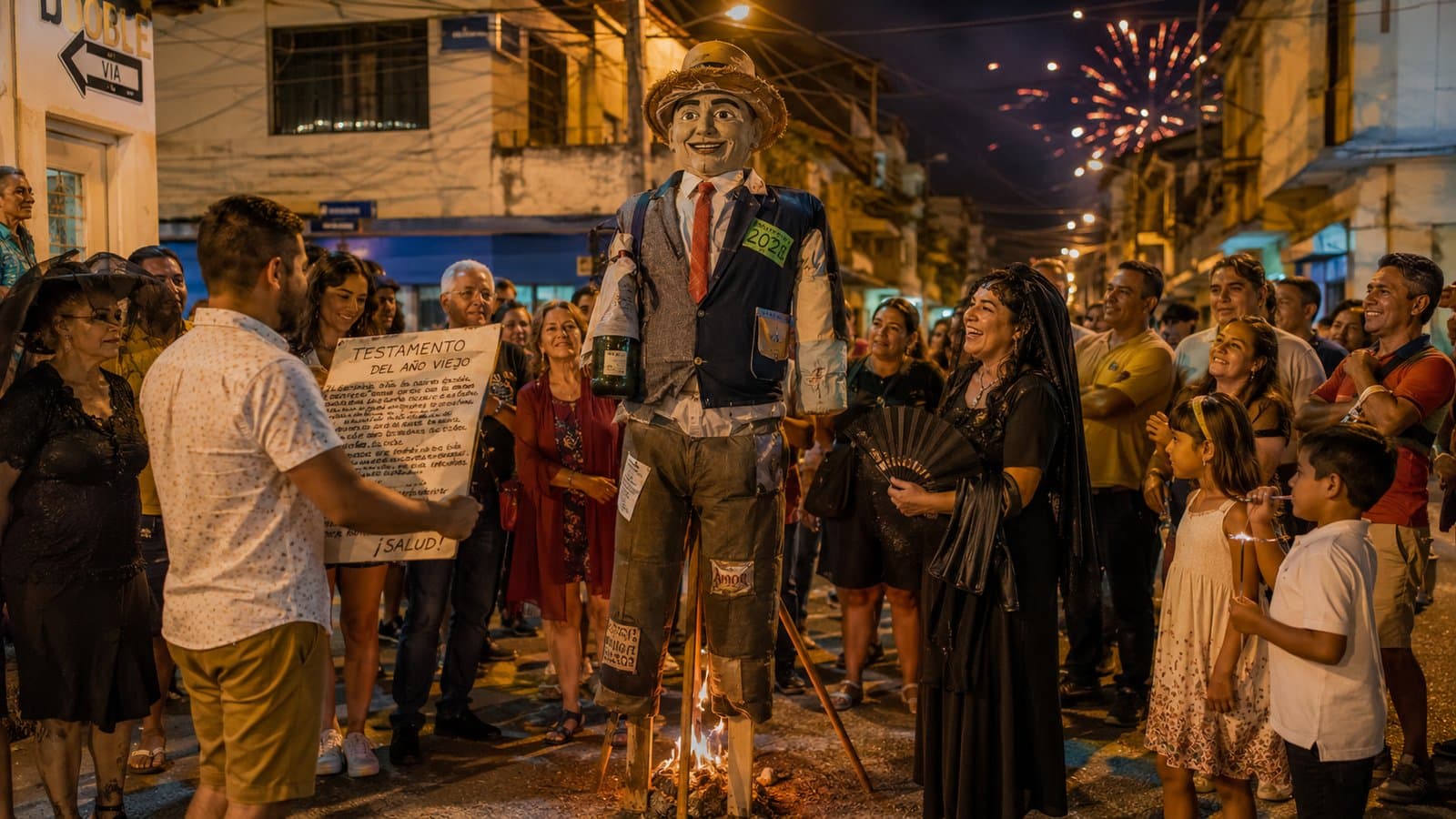
Few images sum up the end of the year in Ecuador like a whole family, well past midnight, watching a dummy of sawdust and old clothes burn in the middle of the street. This is the burning of the Año Viejo (the «Old Year»): an effigy representing the twelve months now leaving —or the politician, footballer or trending figure who marked them— set alight amid firecrackers to leave the bad behind. Almost everyone repeats the same explanation of its origin: that the custom was born in Guayaquil during a yellow fever epidemic in 1895. It is a tidy story. The trouble is that, when historians went to the archives, they found something quite different.
What gets burned every December 31st
The star is the monigote —the «old year» itself—, traditionally stuffed with sawdust, wood shavings, straw, paper and clothes no one wears anymore. They used to be modest, human-sized figures; today, especially in Guayaquil, they coexist with cardboard giants depicting caricatures, strongmen and superheroes, sold in the streets from Christmas on. At the stroke of midnight on December 31st it is set on fire, often with firecrackers hidden inside, in a mix of catharsis and spectacle.
But the Año Viejo does not travel alone. It is accompanied by the testamento, a humorous will that the deceased «year» leaves in writing and that someone reads aloud, handing out inheritances, reproaches and jabs at neighbours and authorities. And it is mourned by the viudas («widows»): men dressed as women, in exaggerated mourning, who dance and beg «a little charity for the widower» from passing cars. Three elements —the dummy, the will and the widow— that, as we will see, were not born at the same time.
The yellow fever legend
The most widespread version —repeated everywhere from tourism websites to family dinners— goes like this: in 1895, faced with a yellow fever outbreak in Guayaquil, the authorities supposedly recommended burning dummies stuffed with the clothes of relatives killed by the plague, as a hygiene measure. That sanitary burning would later have taken on symbolism —the purifying fire, the departing year— until it became a festival.
It is an appealing explanation because it ties everything together: the disease, the fear, the liberating fire. But it is exactly the kind of account worth distrusting: too clean, too perfect. It happens with many stories we accept without checking, like the supposed mass panic over «War of the Worlds», which is also repeated because it sounds better than the truth.
What the archives say
The person who went to check was the Guayaquil historian Ángel Emilio Hidalgo, author of the study Los Años Viejos (2007), based on 19th-century Guayaquil newspapers, travellers' accounts and oral tradition. His conclusion about the remote origin of the festival is honest and deflating: «everything remains in the realm of speculation and legend». For the 1895 epidemic as a birth certificate, there is no documentary proof.
What there is, is a verifiable date. The earliest written reference to the burning of a year-end effigy in Ecuador was left by the Italian naturalist Enrico Festa, who described the Guayaquil of December 31st, 1897: streets full of masked, raucous people carrying a «fantoche» —made of wood shavings, sawdust, straw and old clothes— in a singular procession that parodied a funeral, until they burned it at midnight «with bursts of firecrackers, salvos and the pealing of bells». In other words: by 1897 the custom was already formed and had its full theatrical shape. Hidalgo notes that an earlier yellow fever outbreak, the one in 1842 —not 1895—, may have reinforced the symbolism of fire as purification, but warns that not even that can be stated conclusively.
An inheritance that crossed the Atlantic
If it wasn't the plague, where did it come from? The clue lies in the very scene Festa described: a parodic funeral procession ending with an effigy in flames. That structure —burying and burning a figure to close a cycle— is not Ecuadorian, but old Iberian and Catholic heritage. The clearest antecedent is the burning of Judas, the dummy that during Holy Week is set alight or «executed» in towns across Spain and all of Spanish America.
Some chroniclers pulled at that thread. Modesto Chávez Franco, in his Crónicas del Guayaquil antiguo (1930), linked the custom to traditions brought by Spanish missionaries; decades later, an influence from Valencia's Las Fallas —where huge dummies are also burned— arriving with immigrants was even proposed. Neither hypothesis has archival backing, so they remain conjecture; but both point to the same thing: an old European gesture of burning effigies that, transplanted to 19th-century Guayaquil, was reinvented as a farewell to the year. It is the same bustling Guayaquil that peeks out in the footage of old Guayaquil.
The effigy as a political weapon
From very early on, the Año Viejo was also a political outlet. It is said —recorded by Rodrigo Chávez González in 1961— that as far back as 1871 some young men in Guayaquil built an effigy resembling President Gabriel García Moreno to burn it, and that the authorities arrested them: a sign that power soon grasped the subversive edge of the custom.
That edge sharpened in the mid-20th century, when unions, neighbourhoods and, later, the famous effigy contest of the newspaper El Universo turned the Año Viejo into a space of explicit social criticism. Burning the ruler of the moment, the corrupt official or the ridiculous figure of the year is, in a country of long political instability, a cheap and cathartic way to settle scores. The effigy says out loud what many keep quiet the other 364 days.
Widows, wills and the morning after
The other two characters arrived later. The satirical testamentos —that mocking last will of the dying year— were added as a popular literary piece, read aloud on every corner. And the viudas appear in the press only from the mid-20th century: men dressed in black who pretend to mourn the «deceased» and, along the way, collect coins. What began as an accompaniment to the procession ended up being, in many neighbourhoods, the star act of the night.
By the dawn of January 1st only ashes remain on the asphalt and, for many, a mighty chuchaqui (Ecuadorian hangover). But the rite has already done its job: the same one as many year-end superstitions, which is to give us the sense of being able to close something with our own hands. Burning a dummy does not change the calendar, but it does let us believe the bad year went up with the smoke. And that, far more than yellow fever, is probably the real reason we still do it.
References
- Ángel Emilio Hidalgo, Los Años Viejos, Guayaquil, 2007 (research on 19th-century press, travellers' accounts and oral tradition).
- Enrico Festa, Nel Darien e nell'Ecuador. Diario di viaggio di un naturalista, Turin, 1909 (description of December 31st, 1897 in Guayaquil).
- Modesto Chávez Franco, Crónicas del Guayaquil antiguo, Guayaquil, 1930 (antecedent of the burning of Judas).
- EcuadorChequea, «Origen de la quema del Año Viejo en Ecuador: historia, mitos y evidencias». ecuadorchequea.com
- Primicias, «La primera referencia a la quema de un monigote en Ecuador incluye un cortejo fúnebre con enmascarados». primicias.ec
Do you enjoy the stories behind our customs? Continue with the origin of the word «chuchaqui» or explore more about Ecuador.
Categories
The books · born from this blog
Atahualpa con su abrigo de pelo de murciélago
y otras 49 historias verdaderas que parecen mentira
Available on Amazon
Tocar madera
Pequeña historia de las supersticiones que el mundo no ha podido soltar
Available on Amazon
100 futuros
Cien escenarios del mundo que viene con la inteligencia artificial
Available on AmazonYou may also like

The Story Behind the Name of Isla de la Plata and the Treasure It Still Hides
Why is it called Isla de la Plata? A real pirate's chronicle reveals the truth behind the name, once Drake's Island, and the treasure it may still hide.
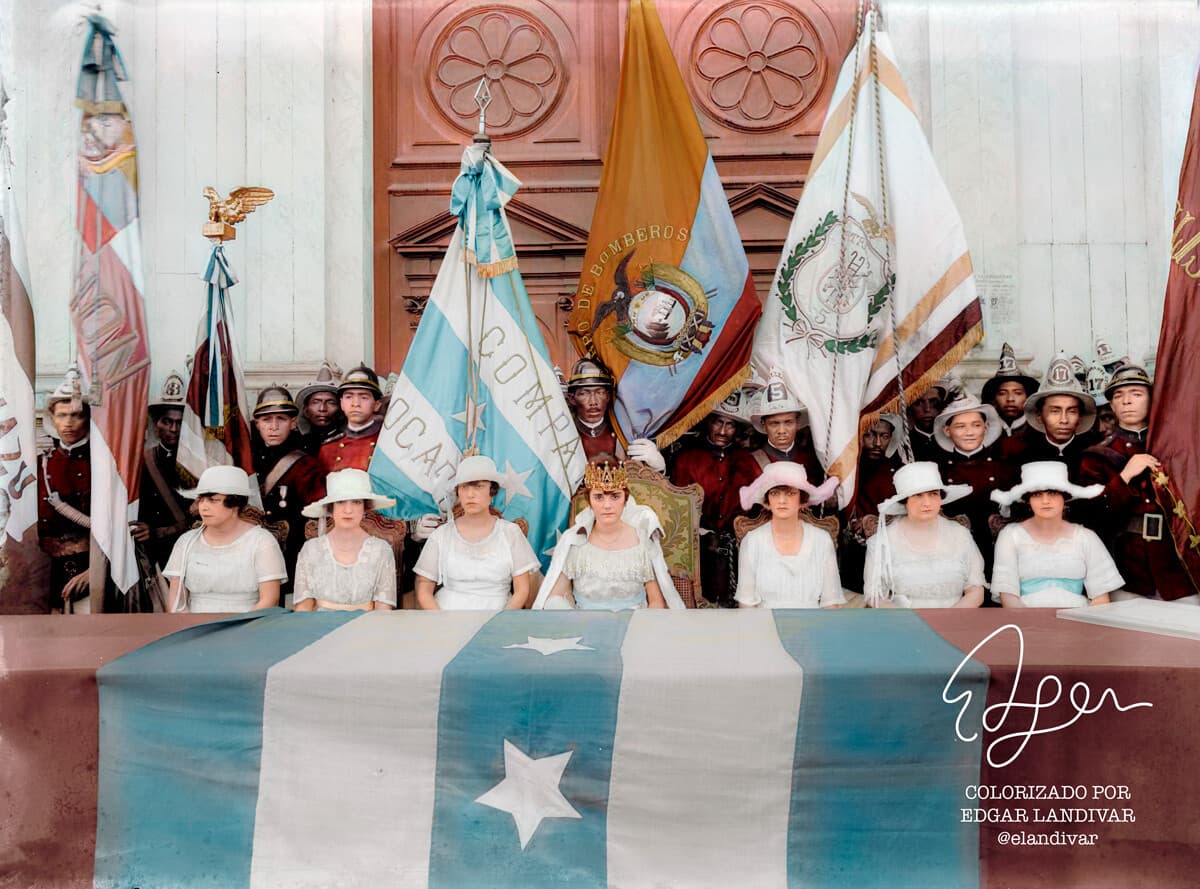
An old book of Guayaquil in full color
A handpicked selection of colorized photos brings century-old Guayaquil back to life, from its trams and firemen to faces from a vanished era.
Archimedes' Death Ray: Myth or Real Weapon?
Did Archimedes really set the Roman fleet ablaze with mirrors at Syracuse? What the ancient sources and the MIT and MythBusters experiments reveal.