
Archimedes' Death Ray: Myth or Real Weapon?
Did Archimedes really set the Roman fleet ablaze with mirrors at Syracuse? What the ancient sources and the MIT and MythBusters experiments reveal.
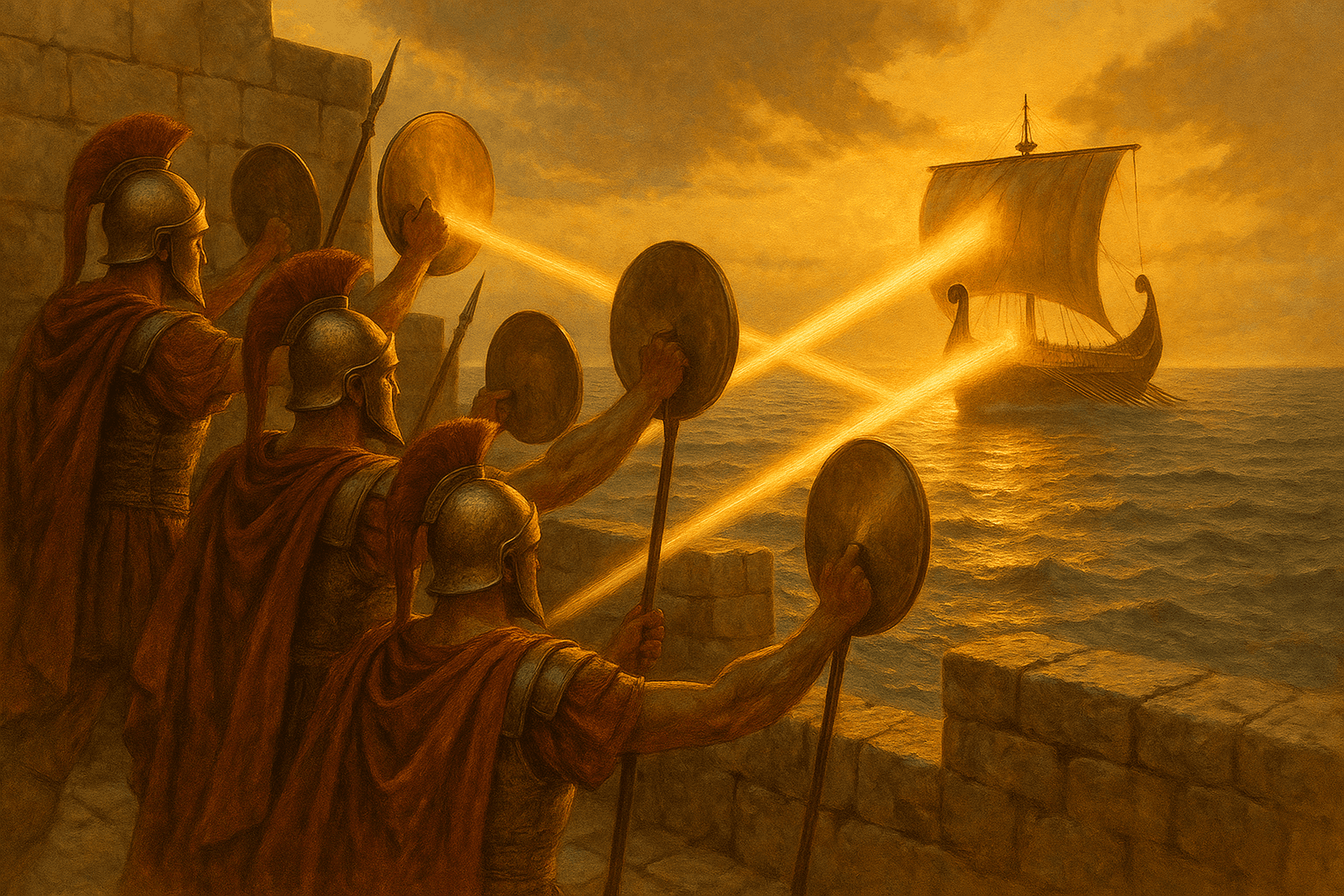
The image is magnificent: in 212 BC, as the Roman fleet closes in on the walls of Syracuse, dozens of citizens raise great bronze mirrors under the Sicilian sun. The rays converge on the wooden hulls and, one by one, the ships burst into flame in the middle of the sea. The mind behind the weapon would be Archimedes, the greatest mathematician of antiquity. It is one of the most quoted scenes in the history of science. The trouble is that it almost certainly never happened — and the way the legend grew is more interesting than the heat ray itself.
Who Archimedes was and what he did at Syracuse
Archimedes of Syracuse (c. 287–212 BC) was the great genius of the Greek world: he calculated an approximation of π, laid the foundations of hydrostatics with his famous "Eureka!" in the bath, and designed war machines that drove the Roman army to despair. During the siege of his home city by the consul Marcus Claudius Marcellus, the ancient sources do credit him with real and plausible inventions: catapults with adjustable range, and above all the "Claw of Archimedes," a kind of crane with a grappling hook that seized the prows of Roman ships, lifted them and capsized them.
Of all those devices, the most picturesque — the incendiary mirrors — is precisely the only one no eyewitness mentions. Neither Polybius, who wrote about the siege only a few decades later, nor Livy, nor Plutarch mentions a solar weapon. And they were hardly shy: all three enthusiastically describe the claws, the catapults and the terror Archimedes spread among the Romans. The silence about the mirrors, in writers so meticulous, is the first crack in the story.
Where the legend came from
The heat ray appears for the first time several centuries after Archimedes' death. The satirical writer Lucian of Samosata, around AD 200 — that is, some 400 years too late — wrote that Archimedes destroyed the enemy ships "by artificial means," without saying which. His contemporary Galen spoke of pyreia (something like "fire-devices"), an equally vague term.
The one who put the mirrors on stage was Anthemius of Tralles, architect of the Hagia Sophia, in a 6th-century treatise titled On Burning Mirrors: there he imagines that Archimedes used many small flat mirrors to concentrate the sun. And in the 12th century the Byzantine scholar John Tzetzes added the details we still repeat: hexagonal mirrors mounted on hinges, placed "a bowshot away." By then Archimedes had been dead for over 1,300 years. The story, in other words, grew more precise the further it drifted from the event: the classic signature of a legend that swells, not of a memory that is preserved.
The physics problems
Even granting that the Greeks could make and polish hundreds of identical mirrors, the weapon collides with reality. To ignite wood you have to hold the focal point of light motionless on the same spot of a target rocking on the waves, for several minutes, on a perfectly clear day. Each mirror would have to be re-aimed by hand and coordinated with the rest while the ship moves. An enemy with sails, oars — and far cheaper flaming arrows — was not going to sit still waiting to burn.
There is one devastating historical detail: Polybius and Plutarch report that the decisive Roman assault on the sea walls of Syracuse came at night. A weapon that runs on sunlight is spectacularly useless in the dark. That is why thinkers such as Descartes, Kepler and others already treated the story as a mere fable centuries before any laboratory existed to test it.
What the experiments said
The temptation to try it is old. In the 17th century the Jesuit Athanasius Kircher claimed to have set wood alight from a distance with mirrors, and in 1747 the French naturalist Buffon managed to burn planks and melt lead with a rig of 168 little mirrors… but at a few meters and against fixed targets, not moving ships. The most cited modern test was run in 1973 by the Greek engineer Ioannis Sakkas: he lined up dozens of sailors holding bronze mirrors and set fire to a tar-coated wooden boat about 50 meters away. Impressive — but the boat was still and on dry land.
In 2005, a group at MIT repeated the trial with 127 flat mirrors aimed at an oak mock-up: after about ten minutes of cloudless sun, the focal point reached nearly 600 °C and the wood caught fire. The very same result turned into "myth busted" when the team took the setup to the show MythBusters and aimed at a real boat at combat distance: from 45 meters they only managed to char and smolder the wood, with no sustained flame. Under battle conditions — a distant, moving target beneath a real sky — the weapon would not burn. The verdict of the show was blunt: busted.
Why the story survives
That the heat ray is almost certainly false does not diminish Archimedes; on the contrary, it returns him to what he was: an engineer whose real inventions were enough to terrify a superpower. The mirror legend survives because it fits what we want to believe about the ancient genius, just like other famous facts repeated without checking; we already saw how the Piri Reis map "proves" an ice-free Antarctica it never drew. It is the same trap: projecting onto the past a precision it never had.
The fascinating thing is that doubt also pushed science forward. The urge to test the story led people to build mirrors, measure focal points and truly understand how solar energy is concentrated — the same kind of experimental curiosity that would later give us instruments like the vacuum pump or the barometer. Archimedes needed no death ray to be the greatest of his age: mathematics, pulleys and an iron claw were enough. The rest was added, centuries later, by our imagination.
References
- "Archimedes' heat ray," Wikipedia. en.wikipedia.org
- "Did Archimedes light Roman ships on fire using sunlight? A 13-year-old found out," NPR. npr.org
- "2.009 Archimedes Death Ray: Idea Feasibility Testing," MIT. web.mit.edu
- "Common Errors (1): Archimedes' Heat Ray," Livius / rambambashi. rambambashi.wordpress.com
Do you enjoy stories where the famous fact turns out to be false? Continue with the Piri Reis map or explore the whole Past Science section.
Categories
The books · born from this blog
Atahualpa con su abrigo de pelo de murciélago
y otras 49 historias verdaderas que parecen mentira
Available on Amazon
Tocar madera
Pequeña historia de las supersticiones que el mundo no ha podido soltar
Available on Amazon
100 futuros
Cien escenarios del mundo que viene con la inteligencia artificial
Available on AmazonYou may also like
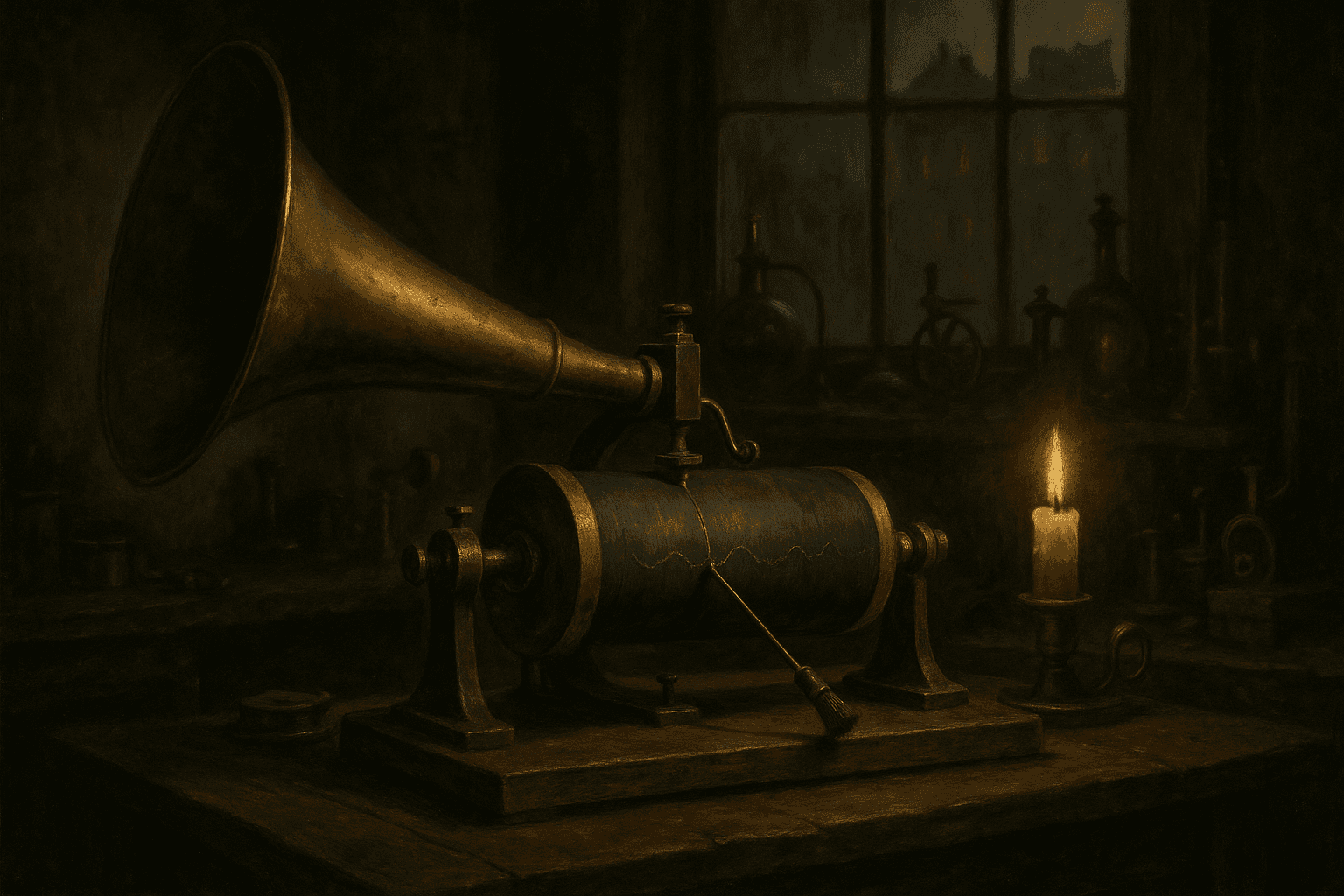
The oldest recorded voice: sound before Edison
In 1860, 17 years before Edison, a French typesetter recorded the oldest human voice we can hear today. This is how we finally heard the past.
The History of Zero: The Number We Took Ages to Accept
The history of zero: from a dot in an Indian manuscript to Brahmagupta's rules and the Florence ban. How we finally learned to write nothing down.
The Antikythera Mechanism: A 2,000-Year-Old Computer
The Antikythera mechanism is the oldest known analog computer: a bronze Greek machine, found in a shipwreck, that could predict eclipses 2,000 years ago.