
The Panamanian Swamp That Nearly Bankrupted Scotland
In 1698, Scotland bet a national fortune on founding a colony in Panama's Darién. Two years later it had no colony, no money — and no independence.
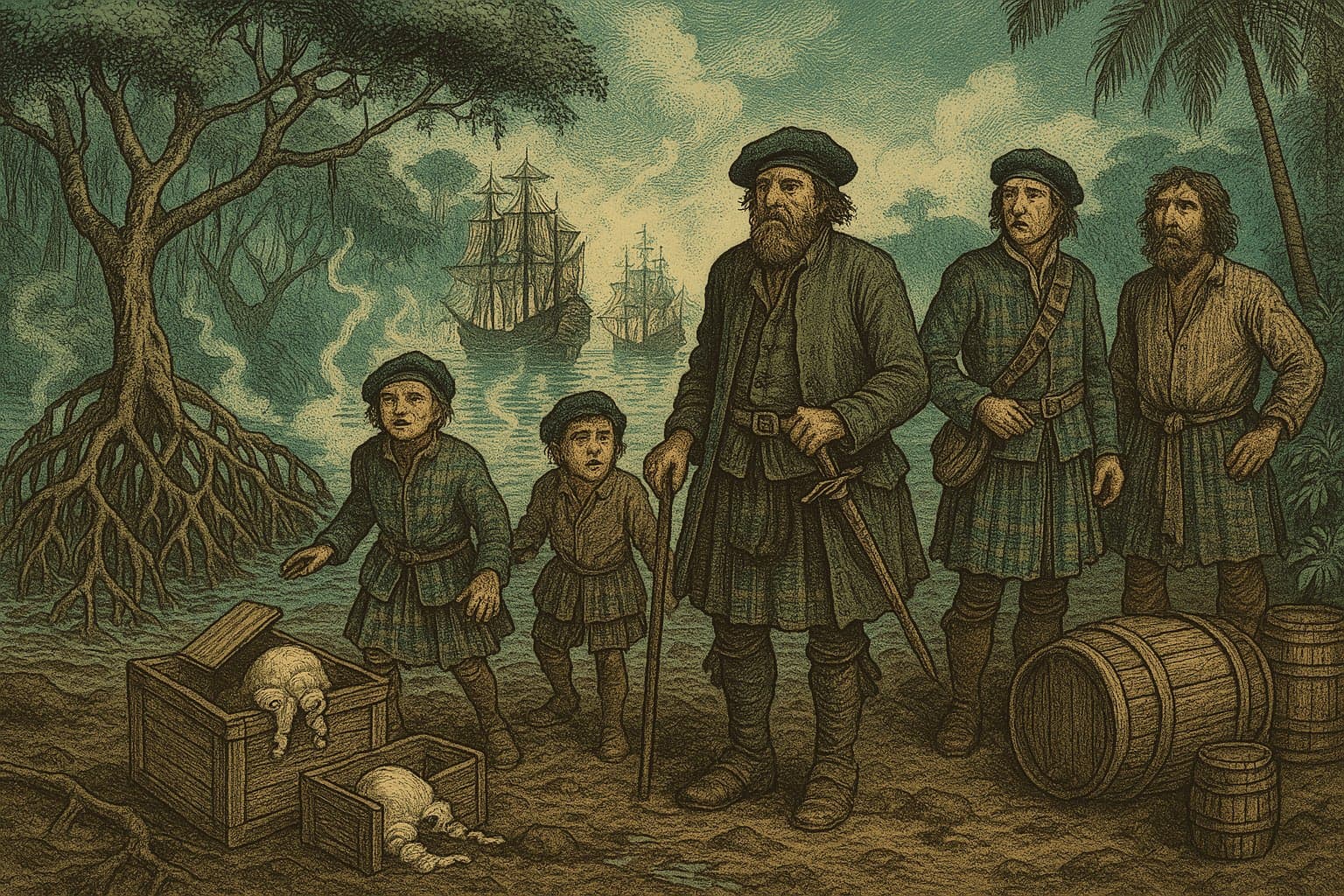
Trivia question: what does a Panamanian mangrove swamp have to do with Scotland being part of the United Kingdom? Answer: practically everything. At the end of the 17th century, Scotland —an independent, poor and ambitious country— decided to stake its economic future on a single card: founding a trading empire in the Darién, the jungle strip that today Panama shares with Colombia. The bet went so catastrophically wrong that the country was left ruined and, a few years later, signed its union with England. Scottish independence, to a great extent, lies buried in a swamp on our continent.
The idea was brilliant (on paper)
The plan had an author with serious credentials: William Paterson, the Scot who had co-founded none other than the Bank of England. His reasoning was impeccable: the Darién was the waist of the Americas, the “door of the seas and key of the universe” — whoever controlled that passage could trade with both oceans and take a cut of the world's commerce. (The idea, by the way, was correct: two centuries later somebody would build, right nearby, a canal that changed the world. The problem was never the geography; it was everything else.)
Scotland bought the dream whole. The Company of Scotland raised £400,000 sterling in a few weeks — estimates run from a fifth to half of all the circulating capital in the country. Nobles, widows, guilds, entire towns: half the nation put its savings into the Darién. It wasn't an investment; it was a national wager.
Wigs and bibles for the tropics
In July 1698 the first 1,200 colonists set sail, and their cargo manifest belongs in a museum: period records speak of hundreds of bibles and catechisms, thousands of combs —Paterson had heard the natives wore their hair long—, powdered wigs, mirrors, gloves and heavy Scottish wool cloth. To sell. In the Darién. Where humidity hovers near one hundred percent. The colonists founded “New Edinburgh” in their colony of “Caledonia”, and discovered within weeks what any inhabitant of the tropics would have told them for free: that the rainy season shows no mercy, that fever does not negotiate, and that the Guna people, being sensible, had not the slightest interest in buying combs.
Malaria and dysentery did the rest. Of the 1,200 in the first expedition, about 300 survived, abandoning everything within a year. And here comes the geopolitical cruelty: King William —king of England and of Scotland, but protective of his peace with Spain— ordered the English colonies in the Caribbean not to sell the Scots so much as a biscuit. When the second expedition of a thousand colonists arrived, unaware that the first had fled, it found ruins — and shortly afterward, a Spanish siege. In all, of some 2,500 colonists, more than 80% died. By 1700, Caledonia had ceased to exist.
Bought and sold for English gold
The bill arrived in Edinburgh: the national capital evaporated, half the country with empty pockets and its morale sunk in Darién mud. When, years later, union with England was negotiated, the treaty included a very persuasive clause: the “Equivalent”, a payment of £398,085 destined in good part to compensate the shareholders of the Company of Scotland — capital plus interest. In 1707, the Scottish parliament voted its own dissolution and the Kingdom of Great Britain was born. Historians debate how much weight the Darién carried against other factors, but the poet Robert Burns left the popular verdict in writing decades later: “We're bought and sold for English gold.”
This story is first cousin to another we have already told: that of the Germans who almost kept Venezuela. Europe spent centuries crashing imperial dreams against American reality, and the Darién was perhaps the most expensive crash per capita of them all: an entire country wagered on an isthmus it had never seen, with a cargo of wigs as a business plan. The Darién jungle is still there, so impassable that to this day it interrupts the Pan-American Highway — the only unbuilt stretch on the road from Alaska to Patagonia. Places that have bankrupted kingdoms deserve respect.
References
- "William Paterson", Encyclopædia Britannica (Britannica Money), Encyclopædia Britannica, Inc. britannica.com
- "The Darien Scheme", National Museums Scotland, Edinburgh. nms.ac.uk
- John Prebble, The Darien Disaster, London, Secker & Warburg, 1968. penguin.co.uk
Categories
The books · born from this blog
Atahualpa con su abrigo de pelo de murciélago
y otras 49 historias verdaderas que parecen mentira
Available on Amazon
Tocar madera
Pequeña historia de las supersticiones que el mundo no ha podido soltar
Available on Amazon
100 futuros
Cien escenarios del mundo que viene con la inteligencia artificial
Available on AmazonYou may also like
The history of the stethoscope and Laennec's modesty
In 1816 a French doctor felt too awkward to press his ear to a patient's chest, so he rolled up paper — and the stethoscope was born.
Placebo: the Latin word that means «I shall please»
«Placebo» means «I shall please» in Latin and began as a medieval funeral chant. Here is how it jumped from the church to medicine and its famous effect.
Scurvy: the disease that killed more sailors than storms
Scurvy killed more sailors than battles and shipwrecks combined. Its cure was discovered, forgotten, and rediscovered over and over for centuries.