
Salt, Taxes, and the Revolutions It Sparked
For centuries the salt tax filled the coffers of kings and empires—until it triggered smuggling, riots and even Gandhi's famous march to the sea.
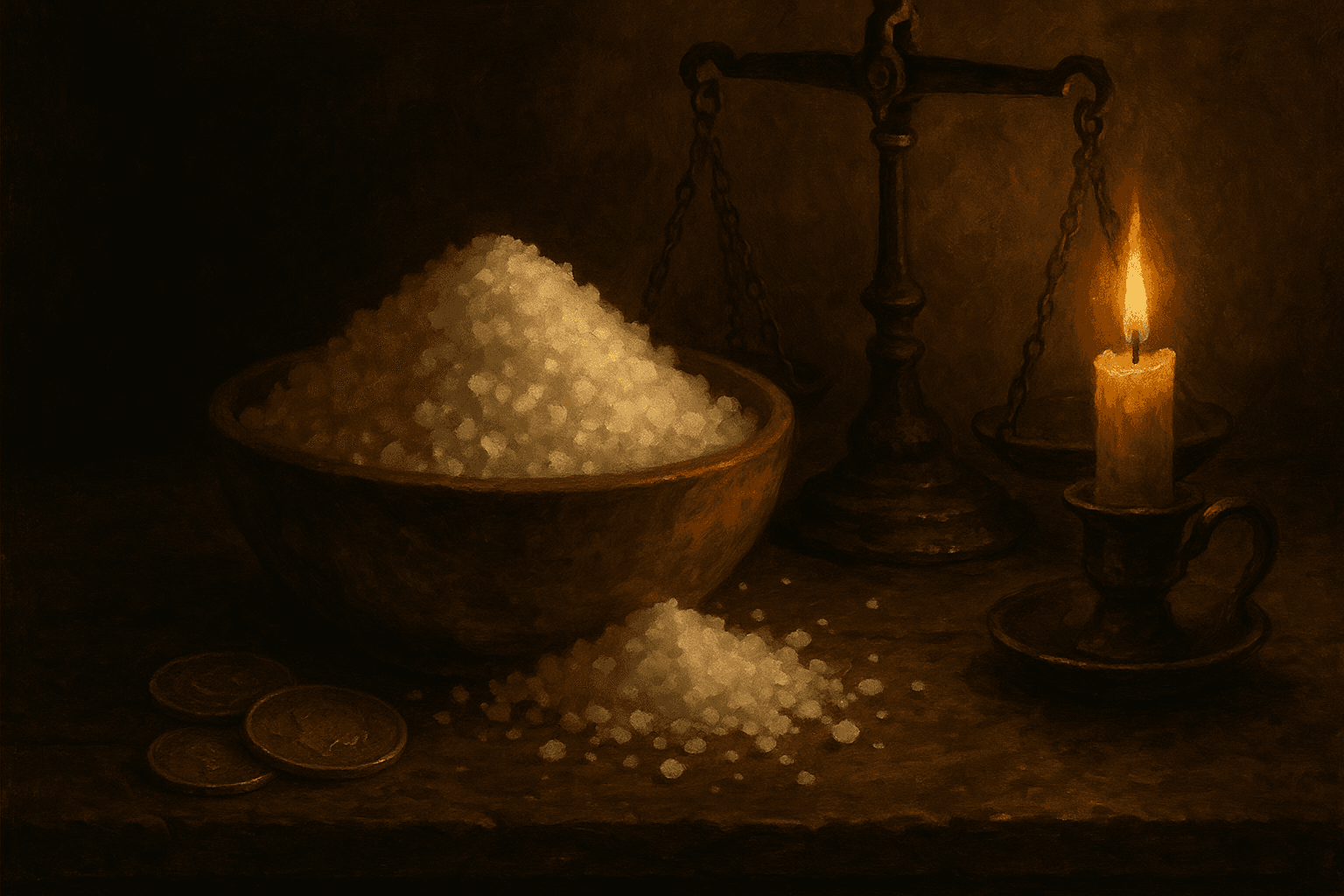
Today salt is the cheapest thing in the supermarket: a kilo costs less than a piece of candy, and nobody guards it. For most of history it was exactly the opposite. Salt was a strategic good, indispensable for preserving food before refrigeration existed, and that is why governments discovered something dangerously tempting: if everyone needs salt and no one can live without it, taxing it is an almost perfect money machine. Out of that temptation came some of the most hated taxes in history and, with them, more than one revolt and even a revolution.
Why salt was worth so much
Before the refrigerator, the only way to keep meat and fish for months was to salt them. Salt dried food and killed bacteria, so armies on campaign, ships on long voyages, and any family hoping to get through the winter without going hungry all depended on it. A product that indispensable—one you also can't make at home in any quantity—is a tax collector's dream: demand doesn't fall even when the price rises, because nobody can simply stop buying salt.
That value left its mark even on language. The ancient Roman Via Salaria, the "salt road", linked the salt pans of Ostia with the Italian interior centuries before Rome organized its network of roads. And the Roman habit of associating salt with pay is part of where the word "salary" comes from. Salt didn't just season food: it structured whole economies.
China: the oldest monopoly in the world
The first to turn salt into a large-scale fiscal tool was the Chinese state. In 119 BCE, Emperor Wu of the Han dynasty declared an imperial monopoly on salt to finance his costly military campaigns against the northern nomads. The state controlled production, transport and sales, and salt became the empire's second-largest source of revenue, behind only the land tax.
The system worked so well that it survived, with ups and downs, for more than two thousand years. But it had a recurring side effect: because official salt was expensive, smuggling flourished, and again and again the networks of salt smugglers ended up turning into rebel armies. Several revolts that shook Chinese dynasties began with men who started out trafficking cheap salt and ended up defying the emperor. For Chinese power, salt was both its best treasury and a permanent fault line.
The gabelle: the tax that helped ignite France
In Europe, the most famous example is French. The gabelle was the tax on salt, and it became permanent around the mid-14th century. It was no ordinary tax: the state monopolized the sale and forced everyone over the age of eight to buy a minimum amount of salt each year—the so-called sel du devoir, the "obligatory salt"—at a price set by the crown.
What made it especially hateful was its inequality. The price of salt could be ten times higher in some provinces than in others: around Paris people paid a fortune, while some regions in the south were nearly exempt. The nobility and the clergy, of course, were left outside the tax. The result was massive smuggling: the faux-sauniers, salt traffickers, would cross from a cheap region to an expensive one to resell. In the years before the Revolution, thousands of people were imprisoned, sent to the galleys, or fined for selling or possessing contraband salt.
When the French Revolution broke out, the gabelle was among the most frequently cited grievances against the Old Regime, alongside the other burdens crushing the third estate. The National Assembly abolished it on March 21, 1790. The freedom didn't last long: Napoleon reinstated it in 1806, and the salt tax, in one form or another, survived in France until 1946. Like so many stories about money, the tale of the gabelle shows that how a tax is collected can weigh as heavily as how much it collects.
Gandhi and the salt march
The most famous chapter came in the 20th century, on the other side of the world. In colonial India, the British government held a monopoly on salt: Indians were forbidden to produce or sell it on their own, even though the sea around them was full of it. Everyone had to buy salt that was expensive and taxed by the empire. It was a tax that hit the richest and the poorest alike, and for exactly that reason Mahatma Gandhi chose it as a symbol.
In March 1930, Gandhi set out on foot from his retreat with a few dozen followers and walked some 385 kilometers to the coastal village of Dandi. On April 6, reaching the sea, he bent down and picked up a handful of salt from the shore: a tiny gesture that, technically, broke British law. That image set off a campaign of civil disobedience across the country; by the end of the year, about 60,000 people had been jailed. The salt march did not immediately repeal the tax, but it turned a handful of white crystals into the emblem of Indian independence.
A mineral with too much power
That a cheap seasoning could produce thousand-year-old monopolies, smugglers turned rebels, and one of the most famous protests of the 20th century says something about how power works. Salt was the point where the state touched everyone equally, every day, at the table of every home. Taxing that point was effective, but it also turned every meal into a reminder of the tax. And when a tax becomes visible on every plate, sooner or later someone decides enough is enough. Like other stories where money and everyday life cross paths, the story of salt teaches that great conflicts don't always begin with great questions: sometimes they begin with something as small as the salt shaker.
References
- "Gabelle", Encyclopædia Britannica: history of the French salt tax, its compulsory and unequal character, and its role in the discontent that preceded the Revolution. britannica.com
- "Salt in Chinese history", Wikipedia: the salt monopoly from Emperor Wu of Han (119 BCE), its weight in imperial revenue, and its link to smuggling and rebellion. wikipedia.org
- "Salt March (1930)", Encyclopædia Britannica: Gandhi's march to Dandi, the breaking of the salt law on April 6, 1930, and the civil-disobedience campaign it unleashed. britannica.com
- "Gabelle", Wikipedia: details on the sel du devoir, regional price differences, the smuggling of the faux-sauniers, and the 1790 abolition. wikipedia.org
Interested in stories where the economy meets daily life? Continue with the origin of "salary" and that of "dollar", or browse the whole history section.
Categories
The books · born from this blog
Atahualpa con su abrigo de pelo de murciélago
y otras 49 historias verdaderas que parecen mentira
Available on Amazon
Tocar madera
Pequeña historia de las supersticiones que el mundo no ha podido soltar
Available on Amazon
100 futuros
Cien escenarios del mundo que viene con la inteligencia artificial
Available on AmazonYou may also like
Rubber Before Goodyear: The Gum That Melted
Before vulcanization, rubber was a gum that melted in summer and cracked in winter. From the Maya to Goodyear, here's how it was finally tamed.
Porcelain: the Chinese secret Europe tried to steal
For centuries Europe paid fortunes for Chinese porcelain without knowing how it was made. This is the story of a hundred-year industrial espionage.

The History of Glass: The Material That Changed the World
Glass went from Egyptian luxury to everyday object thanks to Roman glassblowers, and later gave science its telescope and microscope.