
Vikings Never Wore Horned Helmets
Not a single horned Viking helmet exists in all of archaeology. The myth was invented by the costume designer of a Wagner opera in 1876.
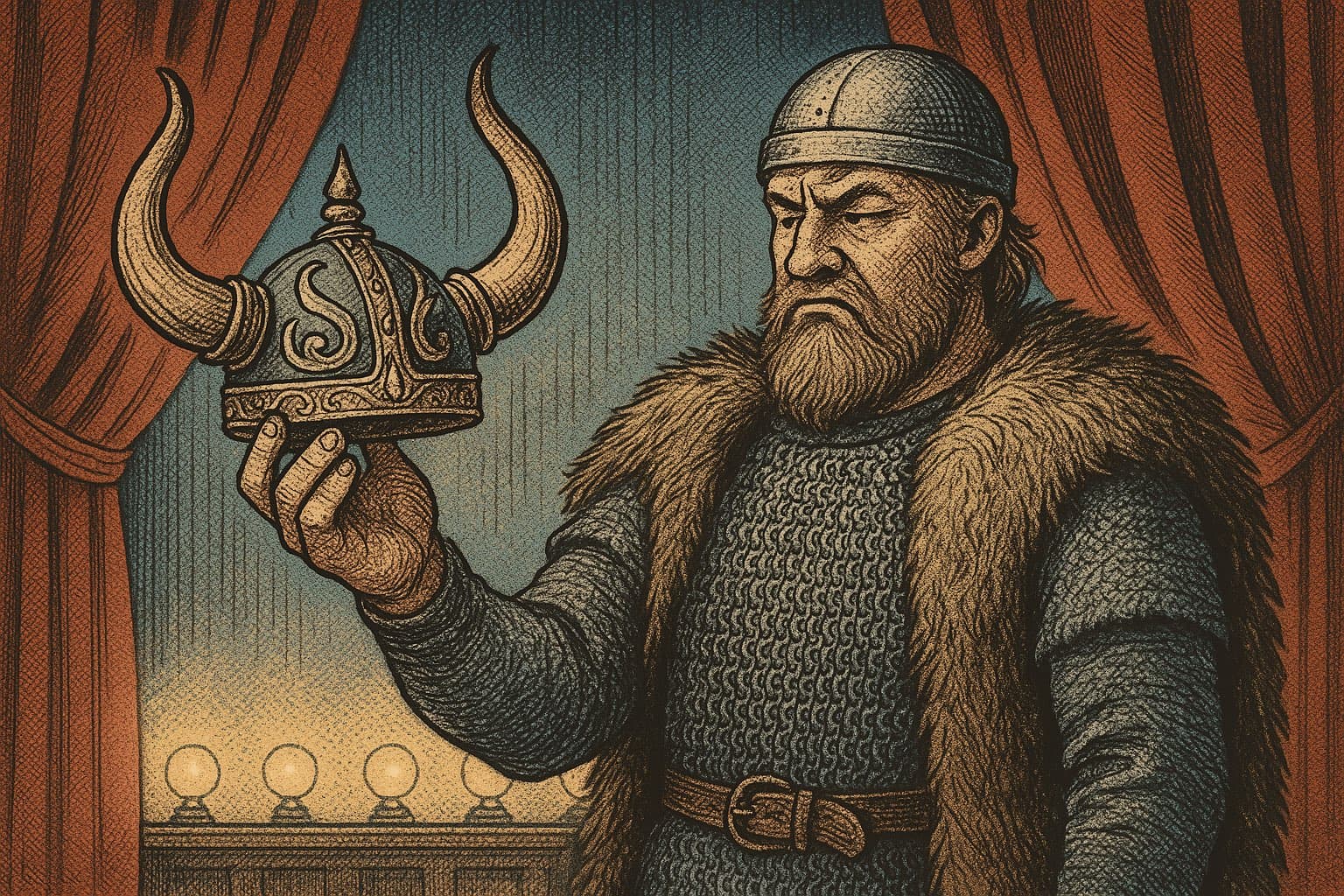
Close your eyes and picture a Viking. Almost certainly you saw a burly warrior with a helmet crowned by two enormous horns. It is one of the most solid images in popular culture: it's in the costumes, the sports logos, the cartoons, the Minnesota Vikings mascot. And it is, from start to finish, false. In more than a century of excavations across Scandinavia, archaeologists have found not one single horned Viking helmet. Not one. The most famous image of an entire people is a theater costume barely a century and a half old.
Why horns are a terrible idea
Let's start with logic, which should already raise suspicions. A helmet exists so that things glance off: a sword or axe striking a smooth dome gets deflected. Add two horns and you have created the perfect handlebar for your enemy to hook his blow on, wrench your neck around, or simply rip the helmet off your head. In a real fight, horns are not a fearsome ornament: they are a suicidal disadvantage. The Vikings were many things, but not stupid: their real helmets, the precious few that survive, were simple, functional iron domes. The most famous one, the Gjermundbu helmet found in Norway, is a rounded cap with an eye guard. Zero horns.
The real culprit carries a baton
So where did the horns come from? From the opera. In 1876, at the premiere of Richard Wagner's Ring of the Nibelung cycle in Bayreuth, costume designer Carl Emil Doepler dressed the Norse characters in winged and horned helmets to give them a mythological, grandiose, primitive air. The audience of German Romanticism —in love with a heroic and somewhat invented Germanic past— adored it. The image leapt from the stage to illustrations, from there to schoolbooks, and from there to the universal imagination. In a single opera season, a costume designer put on an entire people a hat they had never worn.
There is an honest nuance: horned helmets did exist in ancient Scandinavia, but from the Bronze Age —like the Veksø helmets in Denmark—, more than a thousand years before the Vikings, and they were almost certainly ceremonial or religious objects, not war gear. It is likely that 19th-century archaeologists, upon unearthing them, associated them loosely with “the Norse” and lent Doepler's costume a false patina of evidence. The myth was built, like so many, by mixing a pinch of decontextualized truth with a generous dose of showmanship.
The company the myth keeps
What fascinates me is the staying power of these fabricated images. As we saw with the curse of Tutankhamun —another myth owing more to press and showbiz than to history—, a good visual fiction beats reality by knockout and moves into our heads for generations. Viking horns survive neither archaeology nor common sense, but they survive something more powerful: they look spectacular on a stage, a costume or a football helmet. The real Vikings crossed the Atlantic five hundred years before Columbus and founded cities from Dublin to Kyiv; their fantasy headgear, on the other hand, was designed by a German for opera singers. The real story is almost always better than the costume — it just rarely is the one we remember.
References
- National Museum of Denmark, "Viking helmets" (Historical knowledge: The Viking Age), en.natmus.dk. en.natmus.dk
- Roberta Frank, "The Invention of the Viking Horned Helmet", in M. Dallapiazza et al. (eds.), International Scandinavian and Medieval Studies in Memory of Gerd Wolfgang Weber, Edizioni Parnaso, Trieste, 2000, pp. 199–208. ingebretsens-blog.com
- National Museum of Denmark, "The Viksø helmets" (Historical knowledge: The Bronze Age), en.natmus.dk. en.natmus.dk
Categories
The books · born from this blog

Atahualpa con su abrigo de pelo de murciélago
y otras 49 historias verdaderas que parecen mentira
Available on Amazon
Tocar madera
Pequeña historia de las supersticiones que el mundo no ha podido soltar
Available on Amazon
100 futuros
Cien escenarios del mundo que viene con la inteligencia artificial
Available on AmazonYou may also like

The Ten Days of October That Never Existed
In 1582 Pope Gregory XIII erased ten days: October 4 was followed by October 15. Here is why the Julian calendar failed and the Gregorian took its place.

Ada Lovelace and the First Program Never Run
In 1843 Ada Lovelace wrote history's first algorithm for a machine that was never built. This is the story of the first computer program, a century early.

Poyais: The Country That Never Existed
Gregor MacGregor invented a Central American country, Poyais, and sold bonds and land to hundreds of Britons who sailed off to a nation that never existed.