
When Lead Was in Gasoline, Paint and Almost Everything
For centuries lead was in wine, paint, gasoline and even makeup. The story of the toxic metal it took humanity millennia to finally give up on.
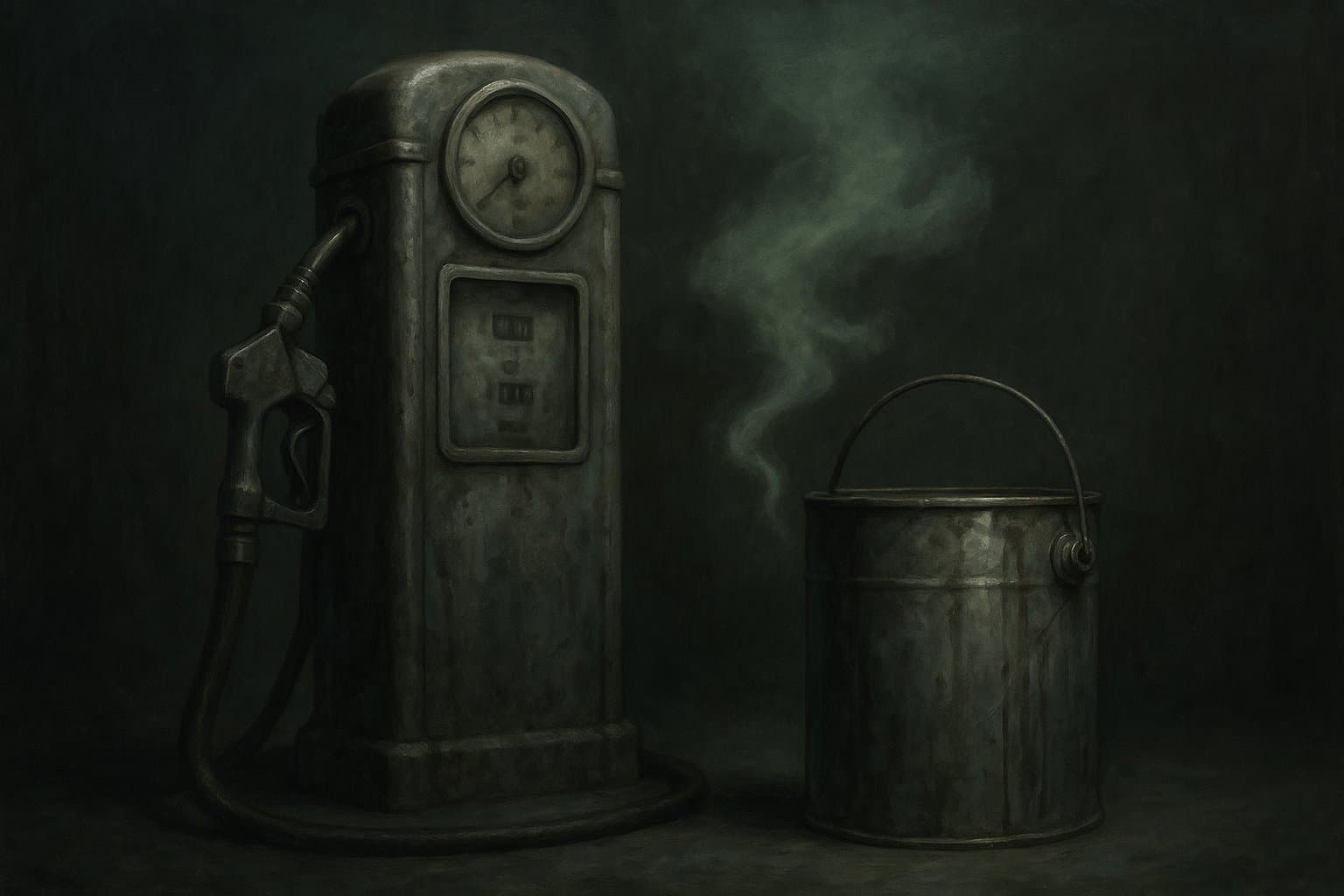
Today we treat lead as what it is: a poison. We took it out of paint, out of pipes and out of gasoline, and we anxiously measure every microgram that shows up in a child's blood. But for almost all of human history the opposite was true: lead was everywhere precisely because it was cheap, soft, easy to melt and surprisingly useful. It was in the wine, in the makeup, in the plates, in the pipes and, by the twentieth century, inside the tank of nearly every car on the planet. This is the story of how a toxic metal worked its way into almost everything we touched, and of how hard it was to get it back out.
Rome's favorite metal
The love affair with lead is ancient. The Romans adored it: it was easy to shape and did not rust like iron, so they used it for almost everything. They made the pipes that carried water to their cities out of it —which is where the word «plumbing» comes from, from the Latin plumbum, lead— and even their dishes and cups.
The water was not the worst of it. The Romans sweetened their wine and preserved fruit with a syrup called sapa or defrutum, made by boiling grape must in lead pots. As it boiled, the metal formed lead acetate, a sweet-tasting compound we still call «sugar of lead». In practice, the Roman elite poisoned themselves slowly with every cup. Ancient physicians already described the symptoms of saturnism —the classical name for lead poisoning— without fully understanding its cause.
The white face of death
Lead also went straight onto people's faces, literally. From Greece and Rome to Renaissance Europe, a white pigment called white lead (ceruse) was the fashionable makeup for achieving pale, flawless skin. Queens, courtesans and actors coated their faces with it, not knowing they were poisoning themselves: ceruse dries out and ruins the skin, which pushed people to apply even more layers to hide the damage, in a vicious, toxic circle.
That same pigment had another commercial virtue: it covered beautifully. White lead became the basis of paint for centuries, prized for its opacity, durability and brightness. It was on the walls of houses, on toys and on cribs. Its use peaked around 1922, just as science was beginning to grasp the harm it caused, especially to children who breathed its dust or bit the walls. The United States did not ban lead paint in homes until 1977; much of Europe waited until 1992. It is the same logic as other dangerous fashions of the era, like the one where we brushed our teeth with radioactive paste: the product first, the warning much later.
The chemist who put lead in gasoline
The most astonishing chapter arrived with the automobile. In December 1921, a General Motors engineer named Thomas Midgley Jr., working under Charles Kettering, discovered that adding tetraethyl lead (TEL) to gasoline eliminated the annoying engine «knock» and allowed more powerful cars to be built. It was an elegant solution to a real engineering problem.
The trouble was that it was lead, and everyone knew it. So much so that the company decided to sell it under the brand name «Ethyl», carefully avoiding the word «lead» in advertisements and reports. The factory soon began claiming lives: in 1924, at the Standard Oil plant in Bayway, New Jersey, several workers went mad and died amid hallucinations after breathing the vapors; the building was nicknamed «the house of butterflies» because of the workers' delusions. There were deaths too at the Dayton and DuPont plants in Deepwater. Midgley himself suffered lead poisoning and, at a press conference, washed his hands in TEL and inhaled its vapors to «prove» it was safe.
In 1925, the U.S. Public Health Service convened a conference to settle the matter. Sales were suspended for a year while it was studied, but the committee concluded there was not enough evidence to ban it. Leaded gasoline marched on and, within a few decades, filled the air of the entire world with a neurotoxic poison. Midgley, incidentally, holds a sinister record: years later he would also invent CFCs, the gases that would tear a hole in the ozone layer. Few human beings have altered the planet's atmosphere so much.
The man who measured the poison in the air
Getting the lead out of gasoline took half a century and the stubbornness of one scientist. In the 1950s, the American geochemist Clair Patterson was trying to calculate the age of the Earth by measuring lead isotopes in meteorites. To do it he had to invent the first «clean rooms» in history, because lead was contaminating all his samples. Along the way he arrived at the figure we still trust today: the Earth is about 4.55 billion years old.
But that ever-present contamination intrigued him. By analyzing ice layers from Greenland and Antarctica —a kind of frozen archive of the atmosphere— Patterson showed that lead levels in the air had shot up right after TEL was introduced, reaching nearly a hundred times the natural level. The planet's lead was not ancient: we had put it there ourselves, in a single generation. As in the story of lithium, that other metal that changed jobs several times, here an element went from industrial promise to global problem.
Patterson devoted the rest of his life to a lonely crusade against the lead industry, which attacked him and tried to silence him. He won. Starting in the 1970s, the United States began phasing out TEL; sales of leaded gasoline for on-road cars ended completely on January 1, 1996. Japan banned it before anyone else, in 1986; the last country in the world to abandon it was Algeria, in 2021. A century after Midgley, the planet finally stopped burning lead.
The invisible bill
Was all that delay worth it? The numbers are chilling. Lead is a neurotoxin: it damages the developing brain, lowers IQ and impairs impulse control. Recent studies estimate that lead exposure stripped hundreds of millions of IQ points from humanity and contributed to millions of cardiovascular deaths. There is even a «lead-crime hypothesis», which links the rise and fall of violence in many countries to the rise and fall of lead in gasoline, with a lag of about twenty years: the generation that grew up breathing it.
It is a lesson that repeats throughout the history of science, as with so many remedies that once seemed miraculous: a substance is adopted for its immediate usefulness, and its harm is understood —and paid for— only much later. Lead was in Rome's wine, on the faces of queens, in the walls of houses and in the air of the whole twentieth century. It took us millennia to understand that something so useful was poisoning us, and barely a few decades —and a handful of stubborn scientists— to finally begin letting it go.
References
- «Tetraethyllead», Wikipedia. en.wikipedia.org
- «Thomas Midgley Jr.», Wikipedia. en.wikipedia.org
- «Clair Patterson», Wikipedia. en.wikipedia.org
- «How the world eliminated lead from gasoline», Our World in Data. ourworldindata.org
Do you enjoy stories of dangerous substances that were once perfectly normal? Continue with radioactive toothpaste or explore the whole history section.
Categories
The books · born from this blog
Atahualpa con su abrigo de pelo de murciélago
y otras 49 historias verdaderas que parecen mentira
Available on Amazon
Tocar madera
Pequeña historia de las supersticiones que el mundo no ha podido soltar
Available on Amazon
100 futuros
Cien escenarios del mundo que viene con la inteligencia artificial
Available on AmazonYou may also like
The history of the stethoscope and Laennec's modesty
In 1816 a French doctor felt too awkward to press his ear to a patient's chest, so he rolled up paper — and the stethoscope was born.

Placebo: the Latin word that means «I shall please»
«Placebo» means «I shall please» in Latin and began as a medieval funeral chant. Here is how it jumped from the church to medicine and its famous effect.
Scurvy: the disease that killed more sailors than storms
Scurvy killed more sailors than battles and shipwrecks combined. Its cure was discovered, forgotten, and rediscovered over and over for centuries.