
Hurricane, hammock, canoe: the first American words
Canoe, hurricane and hammock were the first words the Americas gave to Spanish and English. All three were born in Taíno, a now-extinct Caribbean tongue.
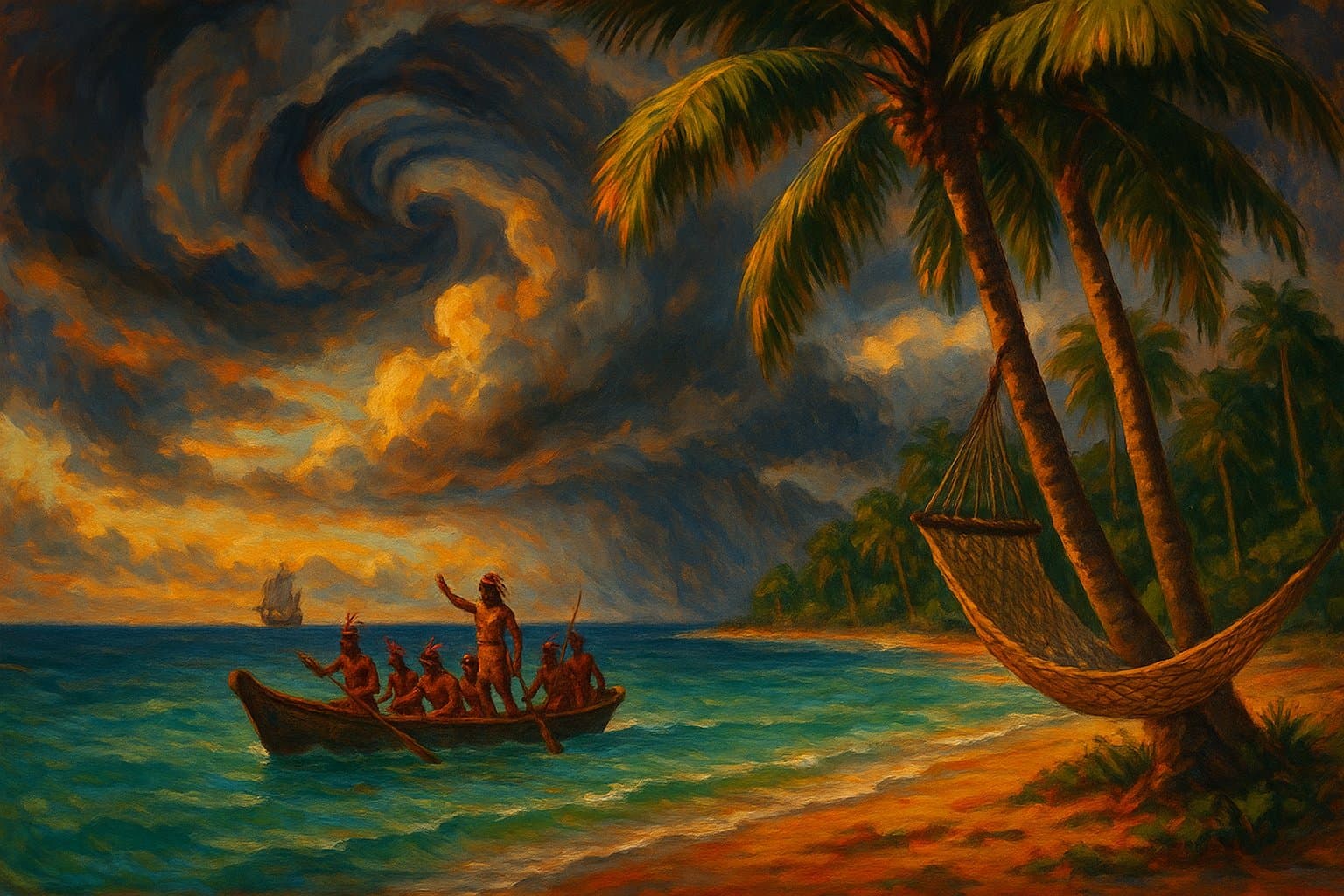
Long before chocolate, tomato or potato arrived, the Americas had already handed Europe its first loanwords. They came not from Nahuatl or Quechua, but from a language now extinct: Taíno, spoken by the peoples Columbus met when he stepped onto a Caribbean beach in 1492. Out of that first encounter came words we use every day without suspecting where they were born. Three of them —canoe, hurricane and hammock— were the pioneers, and from Spanish they traveled onward into English, French and half the world.
Taíno, the first American language Europe ever heard
Taíno belonged to the great Arawakan family and was the dominant language across the Greater Antilles —Hispaniola, Cuba, Puerto Rico, Jamaica—, the Bahamas and much of the Caribbean arc when the Europeans arrived. It was, quite literally, the first Indigenous American language a European ever bumped into. No wonder, then, that it supplied the first handful of American loanwords to Spanish, and that many of them —naming plants, animals and objects Europe had never seen— became indispensable at once.
Taíno died out as a spoken language barely a century after contact, wiped out along with the people who spoke it. But it survived, fossilized, inside Spanish: roughly three thousand words of Taíno origin are thought to linger in the Caribbean varieties of the language, and about twenty even reached English. Barbecue, cay, iguana, maize, tobacco, savanna, cacique, manatee and cannibal all share the same cradle.
«Canoe»: the first American word in history
Of all of them, canoe holds a special honor: it is the earliest word of American origin recorded in Spanish. On 26 October 1492, barely two weeks after landfall, Christopher Columbus jotted it down in his journal. Until then he had described the Indigenous boats with the word almadía —an Arabic borrowing he had brought from home—, but hearing the Taíno name their vessels, each carved from a single hollowed trunk, he adopted their term: canoa.
The leap from anecdote to dictionary was dizzying. The word spread so fast among sailors and chroniclers that by around 1495 Antonio de Nebrija had already included it in his Vocabulario español-latino, printed in Salamanca. It was thus the first Americanism to enter a European dictionary, just three years after the first voyage. In Taíno the word seems to have meant something close to «hollowed tree» —which is exactly what it was: a trunk burned and scraped out into a boat. From Spanish, canoa passed into English as canoe, into French as canoë and into countless other tongues. It is one of those linguistic journeys much like the one we tell in the origin of «hazard», «chess» and «checkmate», only this time the starting point was not the East, but a Caribbean shore.
«Hurricane»: the name of a storm god
For the Taíno, the word hurricane named far more than a weather event: hurakán was the force —for some, the deity— of the great Caribbean tempests. Spanish chroniclers seized on it immediately, because it described something their language had no word for: those colossal cyclones, with no equivalent in the Mediterranean, capable of erasing an entire fleet from the map.
The term carries a fascinating echo as well: in K'iche' Maya mythology, preserved in the Popol Vuh, there is a god named Huracán, «heart of the sky», lord of storm and lightning, who takes part in the creation of the world. Scholars debate whether the two names are related or whether it is a coincidence of sound between two distinct Caribbean peoples; either way, half the planet now calls the storm hurricane, ouragan or huracán using a word born in the Antilles. As happens with «panic» and the god Pan, it is another everyday word with a god hidden behind it.
«Hammock»: the hanging bed that won over sailors
The third pioneer is the hammock. The Taíno slept in beds of woven fiber slung between two trees or two posts, a perfect solution for a humid climate full of crawling critters. The word —hamaca— named that hanging weave, and the Spanish adopted it along with the invention itself.
Few things travel as well as a good practical idea. The hammock turned out to be ideal for life aboard ship: it took up little room, could be hung and stowed in seconds, and rode the roll of the vessel without tipping out its sleeper. By the late sixteenth century, the British Royal Navy was already fitting the decks of its warships with hammocks for the crew. From there it moved on to gardens, beaches and backyards around the world. A Taíno word ended up rocking English sailors in the middle of the Atlantic.
Three words, one first encounter
Canoe, hurricane and hammock capture the exact instant when two worlds that had ignored each other began to trade things —and names. Europe had no words for the single-trunk boat, the Caribbean cyclone or the hanging bed, so it borrowed those of the people already living here. They are the tip of an enormous iceberg: much of what we eat, sail and name in the Americas hides an Indigenous root, as also happens with the origin of the word «chocolate», from Nahuatl, or with more local voices like «guagua» in the Andes. Every time someone mentions a hurricane or lies down in a hammock, they are unknowingly repeating the first words the Americas ever said to the world.
References
- «Taíno language», Wikipedia. en.wikipedia.org
- «Canoe», Online Etymology Dictionary. etymonline.com
- «Hurricane», Online Etymology Dictionary. etymonline.com
- «Hammock», Online Etymology Dictionary. etymonline.com
Enjoy the stories behind words? Continue with the origin of «chocolate» or explore the whole etymology series.
Categories
The books · born from this blog
Atahualpa con su abrigo de pelo de murciélago
y otras 49 historias verdaderas que parecen mentira
Available on Amazon
Tocar madera
Pequeña historia de las supersticiones que el mundo no ha podido soltar
Available on Amazon
100 futuros
Cien escenarios del mundo que viene con la inteligencia artificial
Available on AmazonYou may also like
Cipher and zero: two words born from the same void
«Cipher» and «zero» come from the same Arabic word, sifr, meaning «empty». How one void gave us two words that today seem like opposites.

Hazard, chess and checkmate: words from dice and the board
«Hazard» comes from Arabic az-zahr, the die; «chess» and «checkmate» from Persian shah. Three everyday words that arrived with medieval board games.
The Origin of “Ñapa”: From Quechua to Lagniappe
Where does the word ñapa come from? From Quechua yapa, “something added.” The story of the market freebie that traveled to Louisiana and became lagniappe.