
The Origin of “Ñapa”: From Quechua to Lagniappe
Where does the word ñapa come from? From Quechua yapa, “something added.” The story of the market freebie that traveled to Louisiana and became lagniappe.
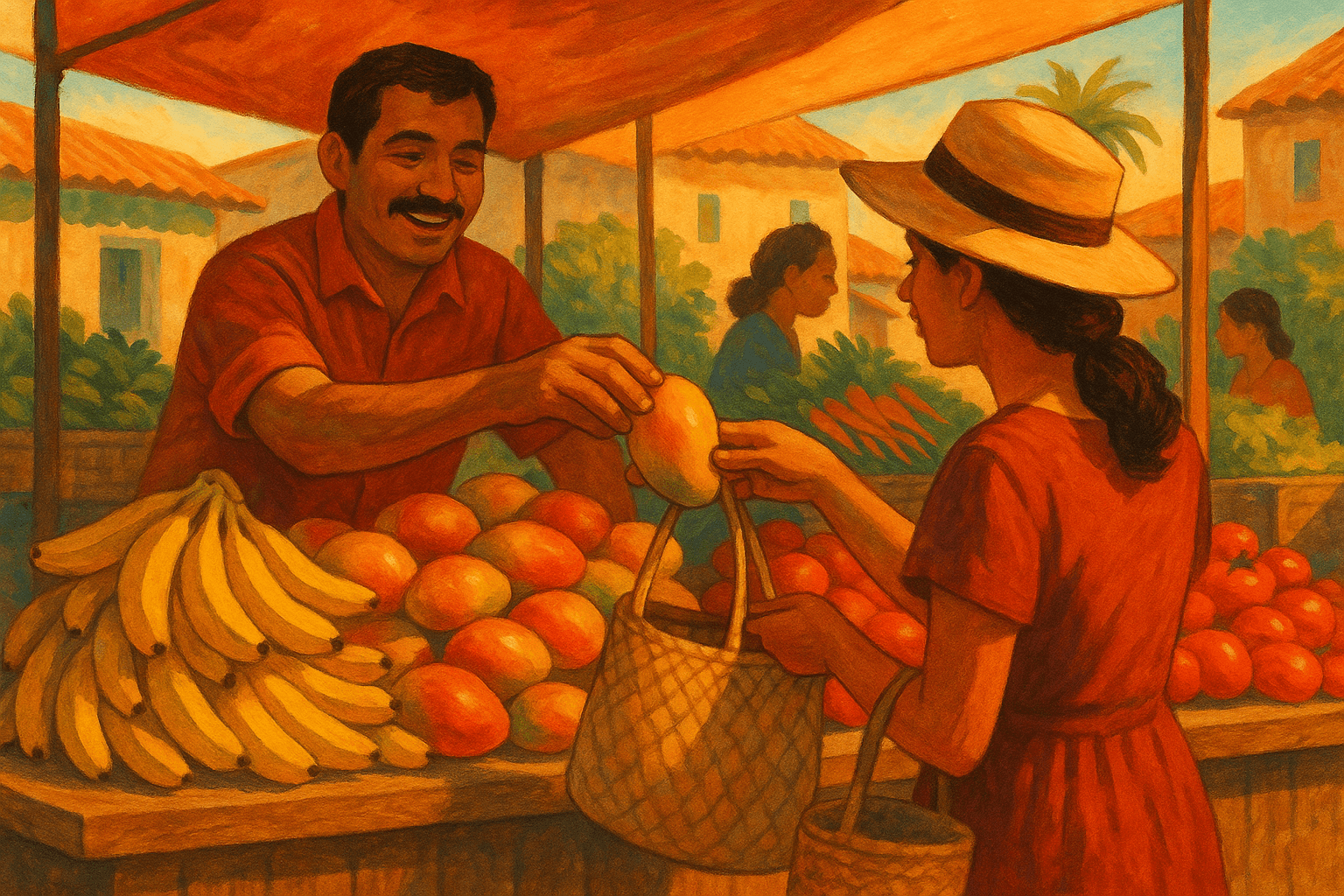
When a market vendor in Caracas, Cartagena or Guayaquil tosses an extra banana into your bag and says esto va de ñapa (“this one’s a freebie”), they are repeating, without knowing it, a custom and a word that were born in the Andes long before Spain ever reached the Americas. A ñapa is that little something extra given when a good sale is closed: the added fruit, the change rounded up, the gesture that seals the deal. And behind that everyday courtesy lies a Quechua word that ended up traveling all the way to the English of Louisiana.
From Quechua yapa to the Caribbean ñapa
The origin lies in the Quechua word yapa, meaning “addition,” “increase” or “supplement,” from the verb yapay, “to add” or “to increase.” It was —and still is— a practice of Andean markets: when buying, the customer asks for their yapa, the small extra the seller grants as a courtesy. After the conquest of the Inca Empire, the word passed into American Spanish and spread from Peru across the continent.
Across much of South America —Argentina, Chile, Bolivia, Peru, Ecuador, Paraguay, Uruguay— the word survived almost intact as yapa. But in the Caribbean and the north of the continent —Venezuela, Colombia, Panama, Cuba, the Dominican Republic, Puerto Rico, Central America— the initial y turned into ñ and ñapa was born. That shift in sound, from /y/ to /ñ/, is a well-known phenomenon: a spontaneous palatalization, the same kind of popular slippage that has shaped so many Spanish words. Yapa and ñapa are, at heart, the same word with two different haircuts.
It is not the only Quechua inheritance we use without noticing. American Spanish is full of these Andean loanwords: we tell the story of how “condor,” “puma” and “pampa” came from Quechua, and of “cancha,” from Inca enclosure to football pitch. Ñapa belongs to that same family, but with a twist: it names not an animal or a place, but a gesture of commercial generosity.
The ñapa: economy, courtesy and trust
What makes the ñapa interesting is that it was never an obligation. The buyer may “ask for ñapa” at the end of the transaction, but giving it remains up to the seller. It is an optional gift, a social lubricant that turns a cold purchase into a relationship: whoever receives ñapa comes back, and whoever gives it builds loyalty. In many popular markets the ñapita —the affectionate diminutive— is almost a farewell ritual, the final smile that goes with the goods.
The custom is ancient and not exclusive to the Americas: the idea of “a little extra for good measure” appears in Europe’s “baker’s dozen,” the thirteen loaves handed over for twelve to avoid fines for selling short. But the name Spanish uses for that gesture is genuinely Andean, and it traveled attached to the practice through every market where haggling and personal dealing are still alive.
The unlikely journey to Louisiana: lagniappe
Here the story takes a turn that sounds made up. In the late eighteenth century, the Spanish Empire governed the territory of Louisiana —including New Orleans— for decades, a city where Spanish, French and English mingled in the port and the marketplace. There la ñapa —article and all— was heard by French speakers, who Frenchified it into the spelling lagniappe, pronounced “lan-yap.” And so a Quechua word crossed the continent, jumped into Spanish, took on its Caribbean ñ, and ended up embedded in the Creole French of the Gulf Coast.
The term became so rooted that Mark Twain devoted an enthusiastic passage to it in Life on the Mississippi (1883). He wrote that in New Orleans they had picked up “one excellent word —a word worth traveling to New Orleans to get: lagniappe,” and defined it as “something thrown in, gratis, for good measure,” the exact equivalent of the thirteenth roll in a baker’s dozen. Twain recounted, amused, how shopkeepers would add a sweet or a small gift “for lagniappe” when closing a sale, and how the word could even round off a conversation. Today lagniappe is still alive in Louisiana as a synonym for an unexpected bonus or surprise extra.
A fossil of generosity
The ñapa is, in the end, a small linguistic and cultural fossil. Its route —from Quechua yapa to Andean Spanish, on to the Caribbean ñ, and through New Orleans into English lagniappe— sums up how words travel: attached to a concrete human gesture, in this case the act of giving a little more than agreed. It is the same way other Indigenous words slipped into several languages, as we tell in the story of “hurricane,” “hammock” and “canoe,” the first American words that Spanish gave the world.
Every time someone asks for ñapa in a market, or a Louisianan uses lagniappe without suspecting its origin, the same impulse born in the Andes centuries ago repeats itself: the idea that a good deal doesn’t end at the fair price, but in that little excess of generosity that turns a purchase into an encounter. The next time someone slips an extra into your bag, remember you are receiving an Inca word wrapped in fruit.
References
- “Ñapa,” Tesoro de los diccionarios históricos de la lengua española (RAE-ASALE): historical record of the word and its Quechua origin. rae.es
- “Yapa,” Wikipedia (Spanish): from Quechua yapa, “addition or supplement”; an Andean idiom and its geographic spread across the Americas. es.wikipedia.org
- “Lagniappe,” Wiktionary: borrowed from Louisiana French, from Spanish la ñapa, a variant of yapa, from Quechua yapa / yapay. en.wiktionary.org
- Mark Twain, Life on the Mississippi (1883), ch. 44: his praise of lagniappe as “the thirteenth roll in a baker’s dozen.” gutenberg.org
Enjoy the stories behind words? Continue with the origin of “cancha” and the Quechua words we speak every day, or browse the whole etymology series.
Categories
The books · born from this blog
Atahualpa con su abrigo de pelo de murciélago
y otras 49 historias verdaderas que parecen mentira
Available on Amazon
Tocar madera
Pequeña historia de las supersticiones que el mundo no ha podido soltar
Available on Amazon
100 futuros
Cien escenarios del mundo que viene con la inteligencia artificial
Available on AmazonYou may also like
Condor, puma and pampa: the Quechua we speak
Condor, puma and pampa come from Quechua, the language of the Incas. Here is how these and other Andean words reached Spanish, English and everyday speech.
The origin of the word alcohol: from makeup to the glass
«Alcohol» comes from the Arabic «al-kuhl», a black powder used as eye makeup. How a cosmetic ended up naming the most famous drink in the world.
The origin of the word bikini: a nuclear explosion
«Bikini» comes from the Pacific atoll where the U.S. tested atomic bombs in 1946. A French designer named his swimsuit that way so it would be «explosive».