
Hazard, chess and checkmate: words from dice and the board
«Hazard» comes from Arabic az-zahr, the die; «chess» and «checkmate» from Persian shah. Three everyday words that arrived with medieval board games.
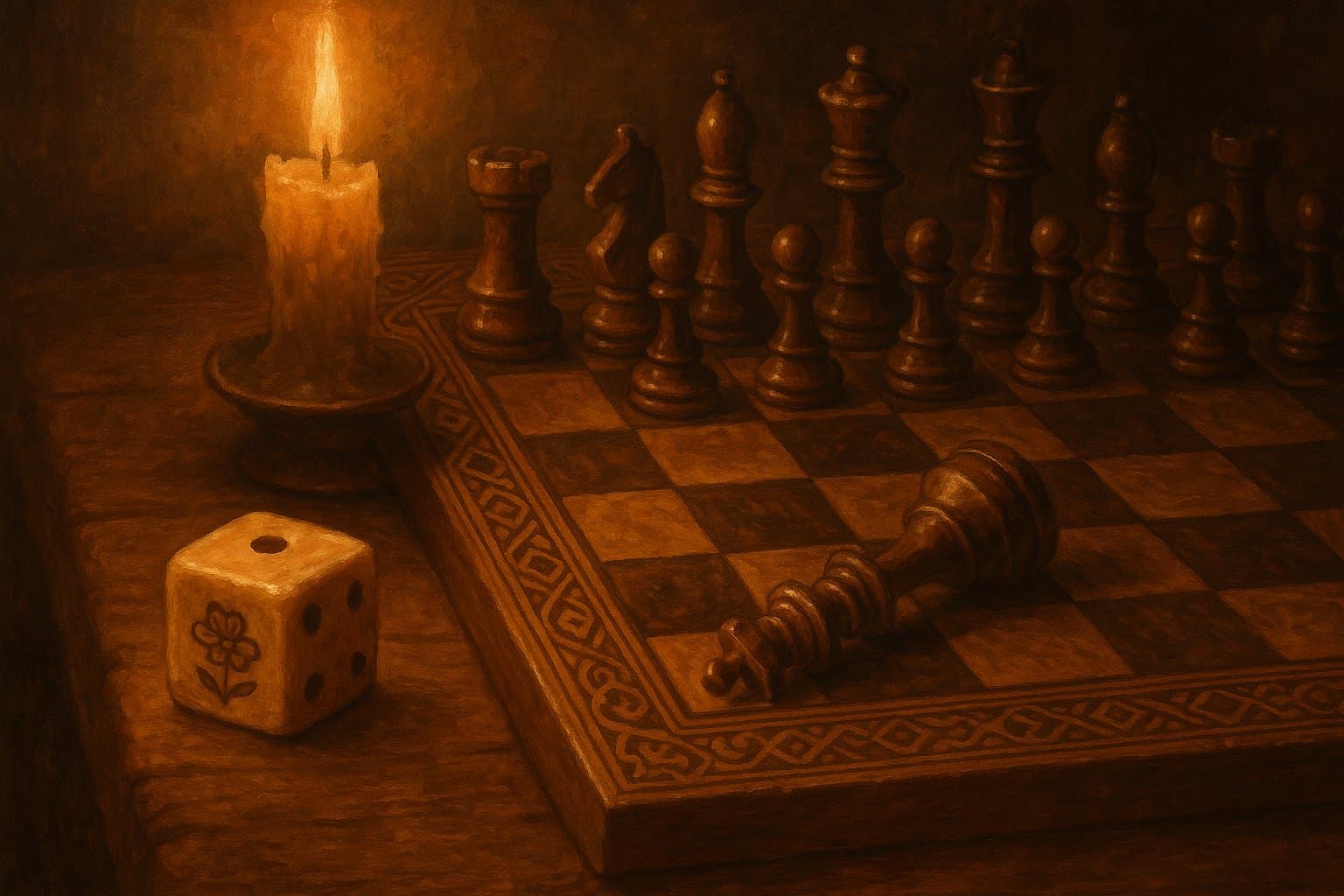
Every time someone talks about a game of hazard, moves a chess piece or announces «checkmate», they are unknowingly repeating words that traveled thousands of miles and through several languages before settling into English. All three were born on a gaming table —some dice, a board— and reached Europe through the same door: the medieval Arab and Persian world. This is the story of how a die with a flower carved on it and a cornered king ended up in our everyday vocabulary.
«Hazard»: a die with a flower
The word hazard goes back to the Arabic az-zahr (الزهر), which meant «flower». At first glance the link makes no sense: what does a flower have to do with luck? The answer lies in dice. In the medieval games of the Mediterranean, one face of the die —or of the knucklebone, its bony ancestor— was decorated with a small engraved flower. Arab players ended up calling the die itself az-zahr, «the flower», after the design it carried.
From there the leap was natural: if the die was az-zahr, then to roll the dice —to trust the game to luck— became a matter of chance. Spanish borrowed the word as azar (luck, chance), and from Spanish it passed into Old French as hasard and then into English as hazard. In English it first named a specific medieval dice game called hazard, and over time took on the meaning of «danger» or «risk» it has today. It is a journey much like that of so many Arabic loanwords, as we tell in the origin of the word «algebra», another term that begins with the telltale prefix al-.
«Chess»: from India to Baghdad to Spain
Chess has an even longer pedigree. Its ancestor was born in India, around the sixth century, under the Sanskrit name chaturanga, meaning «the four parts» or «the four limbs of the army»: infantry, cavalry, elephants and chariots —the four military divisions represented on the board.
From India the game passed to Sasanian Persia, where chaturanga became chatrang. When the Arabs conquered Persia, they adapted the word to their own phonetics —they lacked some of its sounds— and it became shatranj (شطرنج). With the spread of Islam, the game and its name reached al-Andalus. The Arabic ash-shatranj was reshaped through medieval Spanish forms like acedrex and axedrez into modern ajedrez. The English word chess took a slightly different route: it comes, through Old French esches, from the plural of «check» —which brings us to the next word. It is the same India–Persia–Arab world–Iberia route followed by the numerals we use and the idea of zero, as we recall in why there is no year zero.
«Check»: the Persian king hidden in the board
The word check —the warning that the king is under attack— comes directly from the Persian shah (شاه), meaning «king». It is the same shah of the Persian emperors. To say «check» is to shout «the king!»: a warning that the most important piece is in danger.
That Persian shah slipped into more words than you might guess. Beyond the chess «check», it gave English cheque —the slip of paper that «verifies» a payment— and even exchequer, the British treasury, named after the checkered cloth, patterned like a chessboard, on which the accounts were once calculated. A Persian king from around the year 600 still beats inside the word we use today for a bank draft.
«Checkmate»: is the king dead?
And so we reach the phrase that ends every game. For centuries it has been repeated that checkmate means «the king is dead», reading mate as the Arabic mata, «he died». It is a lovely explanation, but probably wrong.
The original expression is the Persian shah mat. In Persian, mat does not mean «dead», but «helpless», «stunned», «with no escape». Shah mat meant, rather, «the king is trapped» or «the king is left stumped» —which is exactly what happens on the board: the king does not die, he is simply cornered with no legal move left. It was Arabic speakers who, adopting the Persian phrase, reinterpreted it through their own word mata («to die») and hung on it the deadly sense it still drags around. A linguistic misunderstanding a thousand years old that we keep repeating every time we topple the opponent's king —much as we carry false legends about other words, as we saw in «assassin» and the legend of hashish.
Three words, one and the same game
Hazard, chess and checkmate sum up an extraordinary cultural journey. A die with a flower on the Arab coast, a strategy game invented in India, a cornered Persian king on a board: three tabletop objects that, crossing borders, turned into everyday words. Spanish inherited nearly all of them from Arabic, and from Spanish many kept traveling into French and English. Every time we play —or simply speak of luck and risk— we unknowingly echo those medieval games. And they are not the only ones: much of our vocabulary hides stories like these, such as that of the Baghdad mathematician who gave his name to the «algorithm».
References
- «Hazard», Online Etymology Dictionary. etymonline.com
- «Chess», Online Etymology Dictionary. etymonline.com
- «Shatranj», Wikipedia. en.wikipedia.org
- «Checkmate», Online Etymology Dictionary. etymonline.com
Enjoy the stories behind words? Continue with the origin of «algebra» or explore the whole etymology series.
Categories
The books · born from this blog
Atahualpa con su abrigo de pelo de murciélago
y otras 49 historias verdaderas que parecen mentira
Available on Amazon
Tocar madera
Pequeña historia de las supersticiones que el mundo no ha podido soltar
Available on Amazon
100 futuros
Cien escenarios del mundo que viene con la inteligencia artificial
Available on AmazonYou may also like
Hurricane, hammock, canoe: the first American words
Canoe, hurricane and hammock were the first words the Americas gave to Spanish and English. All three were born in Taíno, a now-extinct Caribbean tongue.
Cipher and zero: two words born from the same void
«Cipher» and «zero» come from the same Arabic word, sifr, meaning «empty». How one void gave us two words that today seem like opposites.
The Origin of “Ñapa”: From Quechua to Lagniappe
Where does the word ñapa come from? From Quechua yapa, “something added.” The story of the market freebie that traveled to Louisiana and became lagniappe.