
Panic: the god who terrified shepherds at high noon
The word “panic” comes from the god Pan, who struck shepherds and armies with a sudden, causeless fear. This is the story behind the terror.
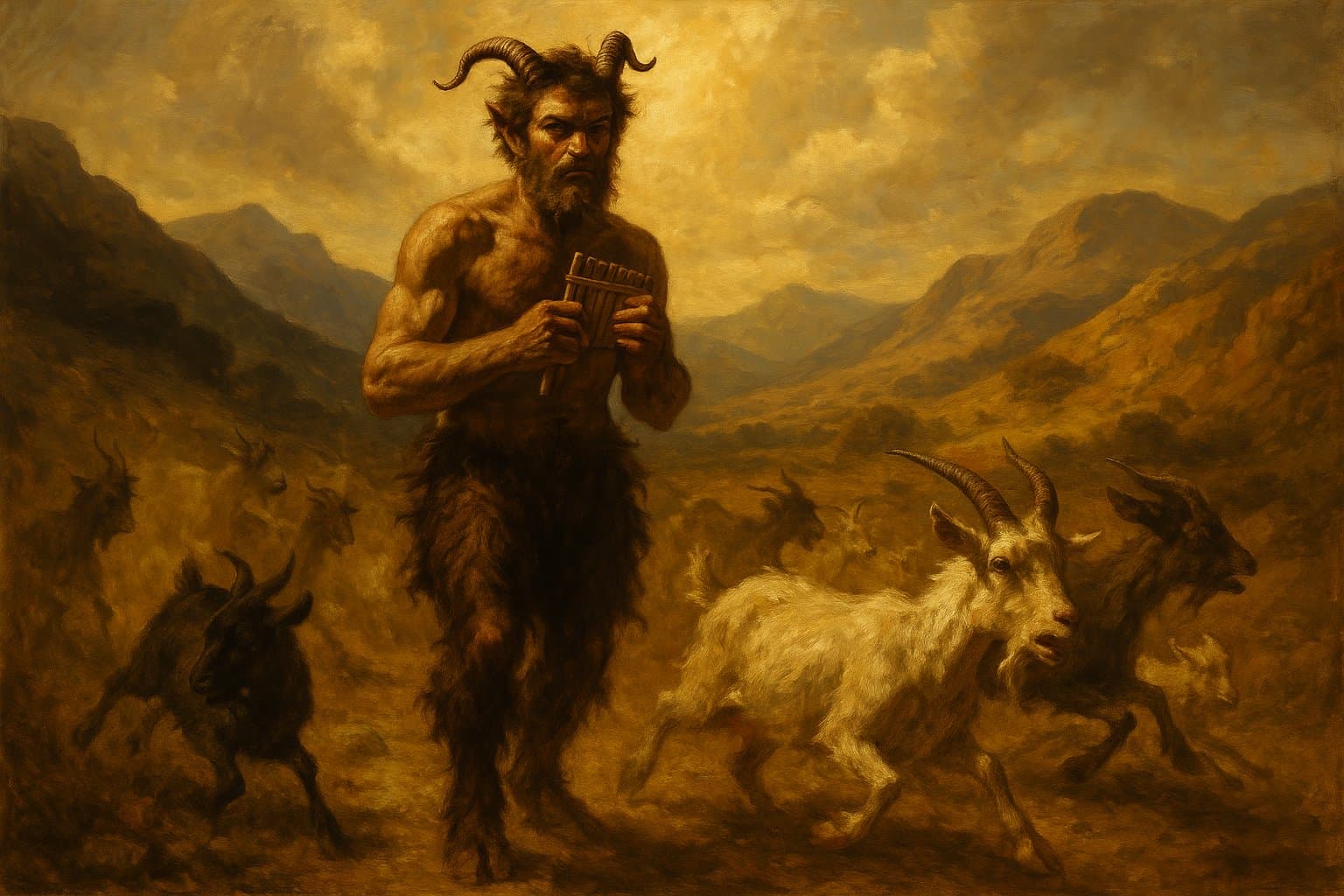
When you say panic gripped you —that surge of fear that arrives all at once, without warning and often for no clear reason— you are unknowingly invoking a very specific god of ancient Greece. The word doesn't come from some abstract root meaning “fear.” It comes from a proper name: Pan, the half-man, half-goat god of shepherds, woodlands and flocks. The Greeks called that sudden terror panikón deima, “the fright of Pan,” because they literally believed he was the one who sent it. Almost three thousand years later, the god is still scaring us every time we open our mouths.
The half-goat god of the flocks
Pan was no first-rank deity like Zeus or Athena. He was a rustic, Arcadian god: horns, goat legs, a shaggy beard, forever tied to lonely mountains, caves and livestock. He presided over herds and fertility, played his reed pipe and chased nymphs through the woods. His name, by the way, does not mean “all” —that is an old folk etymology, a pun the Homeric Hymn to Pan already made—: modern linguists link it to an ancient Indo-European root bound up with pasture and the act of grazing, the same family that gives us “pastor” and “pasture.” Pan was, above all, the guardian of those who tend animals.
And as every shepherd knows, the lonely mountain isn't always peaceful. Sometimes, in the utter silence of an empty valley, an entire flock suddenly bolts, no predator in sight, swept along by a contagious terror with no cause. The ancients had a perfect explanation for that: Pan had passed by.
The terror of noon
The dangerous hour was midday. As the sun beat straight down and the countryside fell silent, Pan took his nap, and woe to the shepherd who woke him. In Idyll I by the poet Theocritus, a goatherd refuses to play the pipe at that exact hour with a chilling warning: we may not pipe at noon, “we fear Pan, for at that hour he rests, weary from the hunt; and he is bitter, and sharp anger sits ever on his nostril.” Noon was his sacred hour, and the silence of the midday heat his temple. Breaking it was paid for with a sudden, irrational fear that seized the whole body.
That is why panic, for the Greeks, carried two hallmarks: it came all at once and it came for no reason. That is the exact signature of what psychology today calls a panic attack —a discharge of terror that appears out of nowhere, with no real threat— and language preserved the nuance more faithfully than our memory did, just as it happened with Narcissus and the true myth behind “narcissist”.
The panic that won a battle
Pan's fear did not stay among the flocks: it moved to the battlefield. When an entire army broke and scattered at night, seized by a collective, inexplicable terror —noises in the dark, shadows, the sense that something invisible was lurking—, the Greeks credited the god. And Pan, they said, knew how to turn that weapon in favor of his own.
The most famous episode is the battle of Marathon, in 490 BC. According to Herodotus, when the Athenians sent the runner Pheidippides to Sparta to ask for help against the Persians, the messenger met Pan himself on a mountain in Arcadia. The god called him by name and complained that the Athenians paid him no cult despite how often he had helped them. The Athenians won —and the Persians fled in a rout, gripped by panic— and, grateful, they consecrated to Pan a grotto beneath the Acropolis with yearly sacrifices. The god of shepherds had earned a shrine in the heart of the great city by doing what he did best: sowing terror.
The nymph who became a flute
An etymological detour as a bonus, because the myth of Pan hid more than one word. The instrument that always accompanies him —the pipe of unequal reeds— was born, according to Ovid, of a frustrated love. Pan pursued the nymph Syrinx, a devotee of Artemis determined not to be his; cornered at a riverbank, she begged for help and was turned into a bed of reeds just as the god thought he had caught her. Embracing only the reeds, Pan's sigh made them sound, and from that improvised music he cut the tubes and built his instrument. He called it the syrinx, after the lost nymph. The same root gave us, centuries later, the word syringe: the nymph's hollow tube ended up, against all odds, in the infirmary.
“The great god Pan is dead”
And yet Pan has an ending no other Greek god shares: he is the only one said to have died. Plutarch tells it in On the Obsolescence of Oracles. During the reign of Tiberius, a ship crowded with passengers was sailing toward Italy when, as the wind dropped near the island of Paxi, a voice called three times to the Egyptian pilot, Thamus, and ordered him: when you pass Palodes, announce that “the great god Pan is dead.” Thamus obeyed, and no sooner had he spoken the words than a huge lament of many mingled voices burst from the shore, as of a weeping multitude.
The scene fascinated people for centuries. Early Christians read it as the perfect symbol of the end of paganism: the old gods dying just as a new faith was being born. But the finest irony was language's. The god died —or so the voice over the sea said—, his temples went dark, his grottoes emptied; and still Pan did not vanish entirely. He lives on in a single word we all use every day to name the fear that arrives without warning. Like the War of the Worlds panic that never actually happened, sometimes what truly endures from a story is not the fact, but the name we gave it.
References
- Herodotus, Histories, Book VI, 105-106 (Pheidippides' encounter with Pan and the Athenian cult after Marathon), trans. A. D. Godley (Loeb Classical Library), Cambridge, Harvard University Press, 1922. perseus.tufts.edu
- Theocritus, Idyll I (“Thyrsis”), lines 15-18 (the ban on piping at noon for fear of Pan), in The Greek Bucolic Poets, trans. J. M. Edmonds (Loeb Classical Library), 1912.
- Plutarch, On the Obsolescence of Oracles (De defectu oraculorum), 17 (419b-e), the death of the great god Pan. penelope.uchicago.edu
- Ovid, Metamorphoses, Book I, lines 689-712 (Pan and Syrinx, the origin of the reed pipe), trans. A. D. Melville, Oxford, Oxford University Press, 1986.
Do you enjoy the stories behind words? Continue with does “travel” really come from a torture device and the origin of the word “assassin”, or explore the whole etymology series.
The books · born from this blog
Atahualpa con su abrigo de pelo de murciélago
y otras 49 historias verdaderas que parecen mentira
Available on Amazon
Tocar madera
Pequeña historia de las supersticiones que el mundo no ha podido soltar
Available on Amazon
100 futuros
Cien escenarios del mundo que viene con la inteligencia artificial
Available on AmazonYou may also like
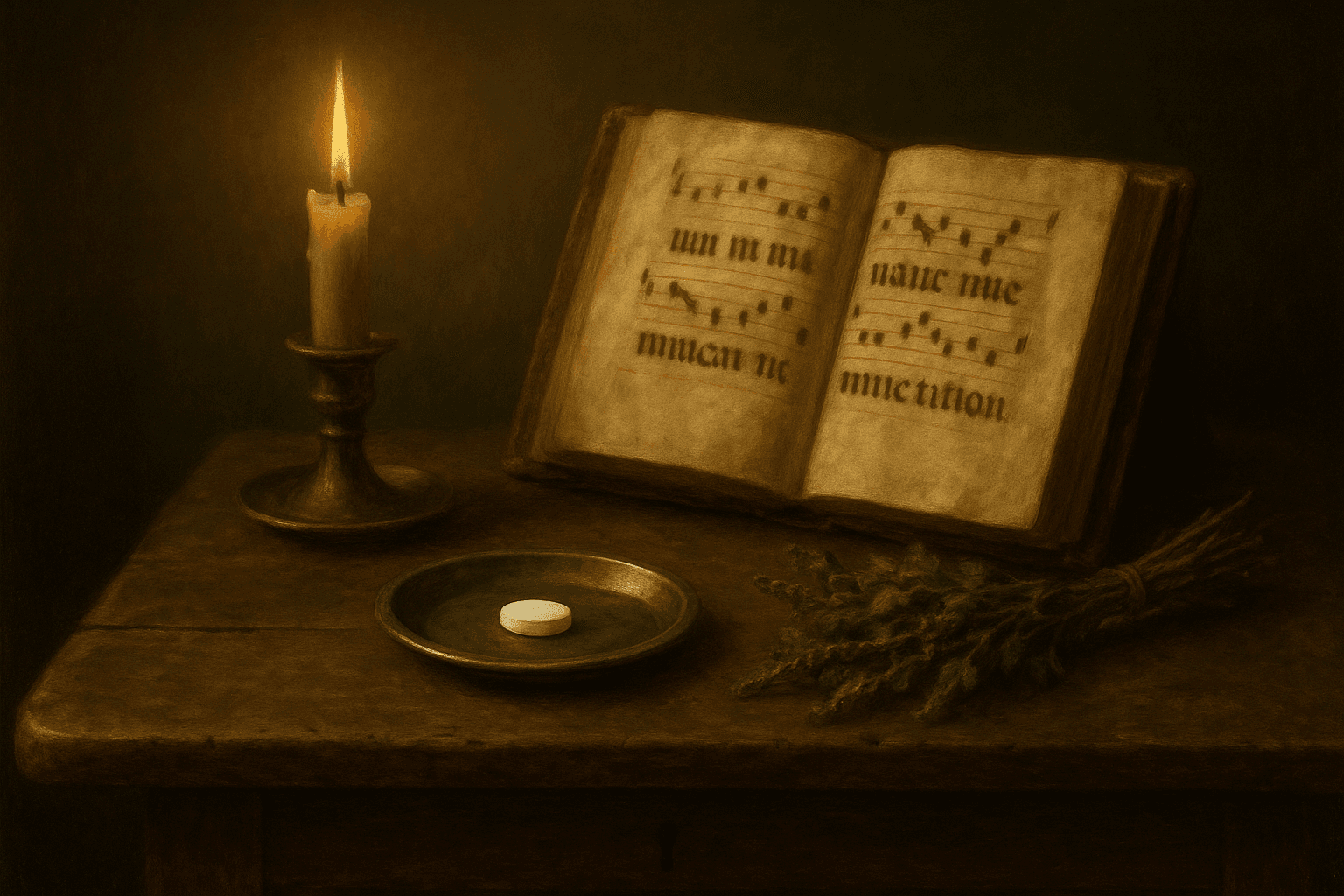
Placebo: the Latin word that means «I shall please»
«Placebo» means «I shall please» in Latin and began as a medieval funeral chant. Here is how it jumped from the church to medicine and its famous effect.
The Origin of the Word “Quarantine”: 40 Days in Venice
Where does the word quarantine come from? From the 40 days that Venice and Ragusa forced ships to wait during the Black Death. Here is its story.
The Origin of the Word “Dollar”: a Bohemian Valley
Where does the word dollar come from? From a silver-mining valley in Bohemia and a 16th-century coin. The story of the thaler that conquered the world.