
The Chilling Origins of the Word Defenestrate
To defenestrate now means to oust an official, but the word was born from a brutal Prague custom: literally hurling councilmen out of windows.
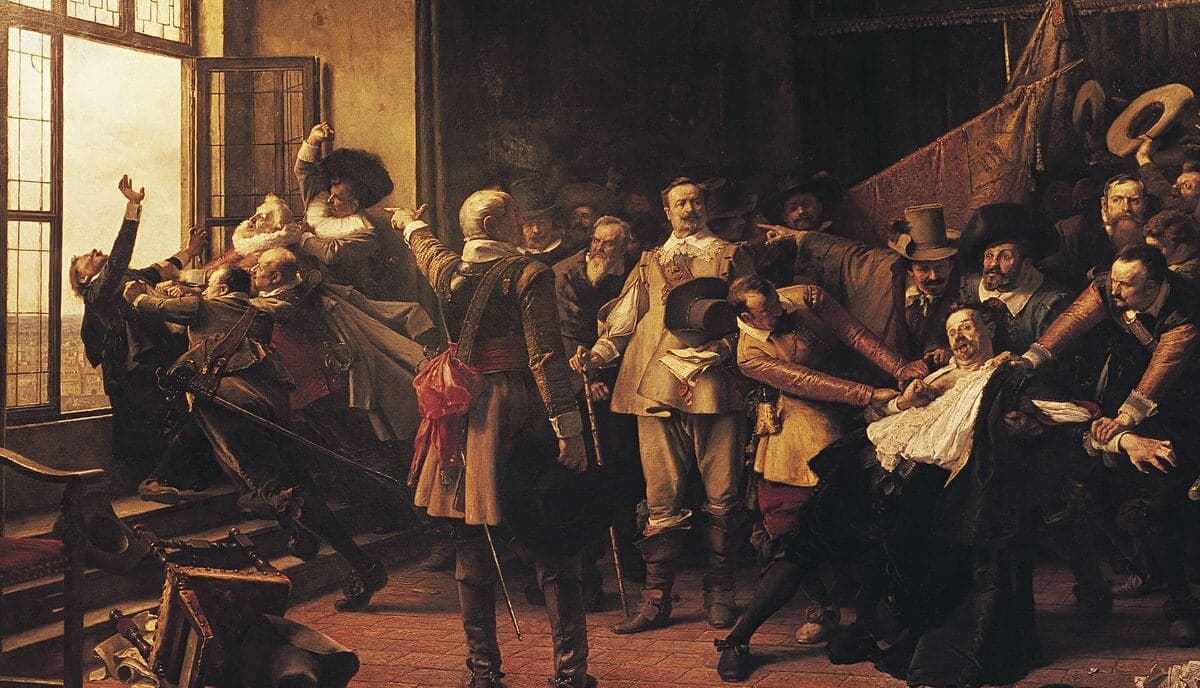
To defenestrate means to remove someone from office or suddenly force them out of their position, and it is a word that keeps echoing through the news. What almost no one knows is that its origin is far more literal and chilling than its political use.
But this word has a very particular history, and behind its meaning hides the bizarre practice of punishing—read: assassinating—an official by throwing them out a window. Indeed, the word comes from the Latin "fenestra," which means just that: window.
Religious Conflicts with the Monarchy
It all began in July 1419, in the city of Prague, when Jan Zelivsky, the priest of the church of "Our Lady of the Snows," decided to organize a peaceful procession to protest recent decisions by the City Council. The crowd of protesters gathered outside the Council to demand that the decision be reversed, tempers flared, and at a certain point someone threw a stone from one of the windows of the Council building, with such bad luck that it struck Zelivsky himself.
The crowd went mad and stormed the building, cornering the mayor and six other Council officials. Without much thought, they decided to throw them out the window. Some died from the fall, others at the hands of protesters who delivered the final blow.
Since no previous "defenestrations" were known, this episode, logically, was called "The First Defenestration."
But religious conflicts still had a long way to go in Prague. The Catholic Church had fragmented, and one branch became the Hussite Church—in fact, our earlier priest Zelivsky was a Hussite.
In 1483, the Hussites were upset that a Catholic had been elected king of Bohemia, the region where Prague was located. In turn, the new Catholic king Vladislaus II hatched a plan to suppress the more radical Hussites, driving them out of Prague or killing them, paradoxically with the collaboration of the more conservative Hussites.
To cut to the chase, the radical Hussites preempted the execution of the plan and once again stormed the Council, cornered its officials, and… guess what happened?… exactly, they threw them out the window. The mayor and several councilors died. This was, that's right, "The Second Defenestration." And I'm not making up the title—that's really what it's called in the history books.
The Third Defenestration
This third incident is probably the most important of all from a historical standpoint, as it was the trigger for what was called "The Thirty Years' War," which left many dead and involved much of Europe.
It happened in 1618, and the fuse was lit, again, in Prague. Once more, the religious bent of the monarchy clashed with the mood of a certain part of the population, which ended in the window-launching of three high government officials. They were thrown from the famous Hradčany Castle, today a popular tourist monument. Beautiful, by the way.
Those thrown had the luck of not dying, as they fell into the castle moats, full of manure; but even though this event didn't result in immediate fatalities, it served as a pretext for the start of a cruel war, whose complex unfolding is beyond the scope of this article.
The Defenestration of Prague in 1618 was a key moment in the Thirty Years' War, a conflict that devastated much of Europe. The incident was seen as an act of rebellion against the emperor and his advisors, and led to the formation of a Protestant alliance that opposed the Catholic Church and imperial powers. Since then, the Defenestration of Prague has become a symbol of resistance and struggle against oppression, and has been used as a metaphor in numerous political contexts.
So ends the history of the window-throwings that gave rise to the word DEFENESTRATE.
Today, the word "defenestrated" is commonly used in the world of politics to describe those who have been expelled or fired abruptly and publicly. A recent example is that of Brazil's former health minister, Luiz Henrique Mandetta, who was "defenestrated" from Bolsonaro's government in the midst of the COVID-19 pandemic. The word is also used in other contexts, such as the business world and social media, to describe those who have lost their status or popularity suddenly and dramatically.
If you liked this article, don't forget to recommend neomano.com 😉
References
- Real Academia Española and ASALE, "defenestrar", Diccionario de la lengua española, 23rd ed. (online version). dle.rae.es
- Howard Kaminsky, A History of the Hussite Revolution, Berkeley and Los Angeles: University of California Press, 1967, ch. "1419: From Reformation to Revolution". DOI: 10.1525/9780520399921. doi.org
- Peter H. Wilson, The Thirty Years War: Europe's Tragedy, Cambridge, MA: Belknap Press of Harvard University Press, 2009. hup.harvard.edu
Enjoy the stories behind words? Continue with the story behind the word “boycott” and where “cocolón” really comes from, or browse the whole etymology series.
The books · born from this blog

Atahualpa con su abrigo de pelo de murciélago
y otras 49 historias verdaderas que parecen mentira
Available on Amazon
Tocar madera
Pequeña historia de las supersticiones que el mundo no ha podido soltar
Available on Amazon
100 futuros
Cien escenarios del mundo que viene con la inteligencia artificial
Available on AmazonYou may also like

Origins of the word cocolón and no, it does not come from "cook too long"
Does the word «cocolón» really come from the English «cook too long»? A 1922 Ecuadorian etymology book debunks this popular urban legend.

Placebo: the Latin word that means «I shall please»
«Placebo» means «I shall please» in Latin and began as a medieval funeral chant. Here is how it jumped from the church to medicine and its famous effect.

The Origin of the Word “Quarantine”: 40 Days in Venice
Where does the word quarantine come from? From the 40 days that Venice and Ragusa forced ships to wait during the Black Death. Here is its story.