
Cancha: from Inca enclosure to soccer field
«Cancha» comes from the Quechua kancha, the walled enclosure of the Incas. Here is how it went from temples and corrals to naming soccer fields across half the world.
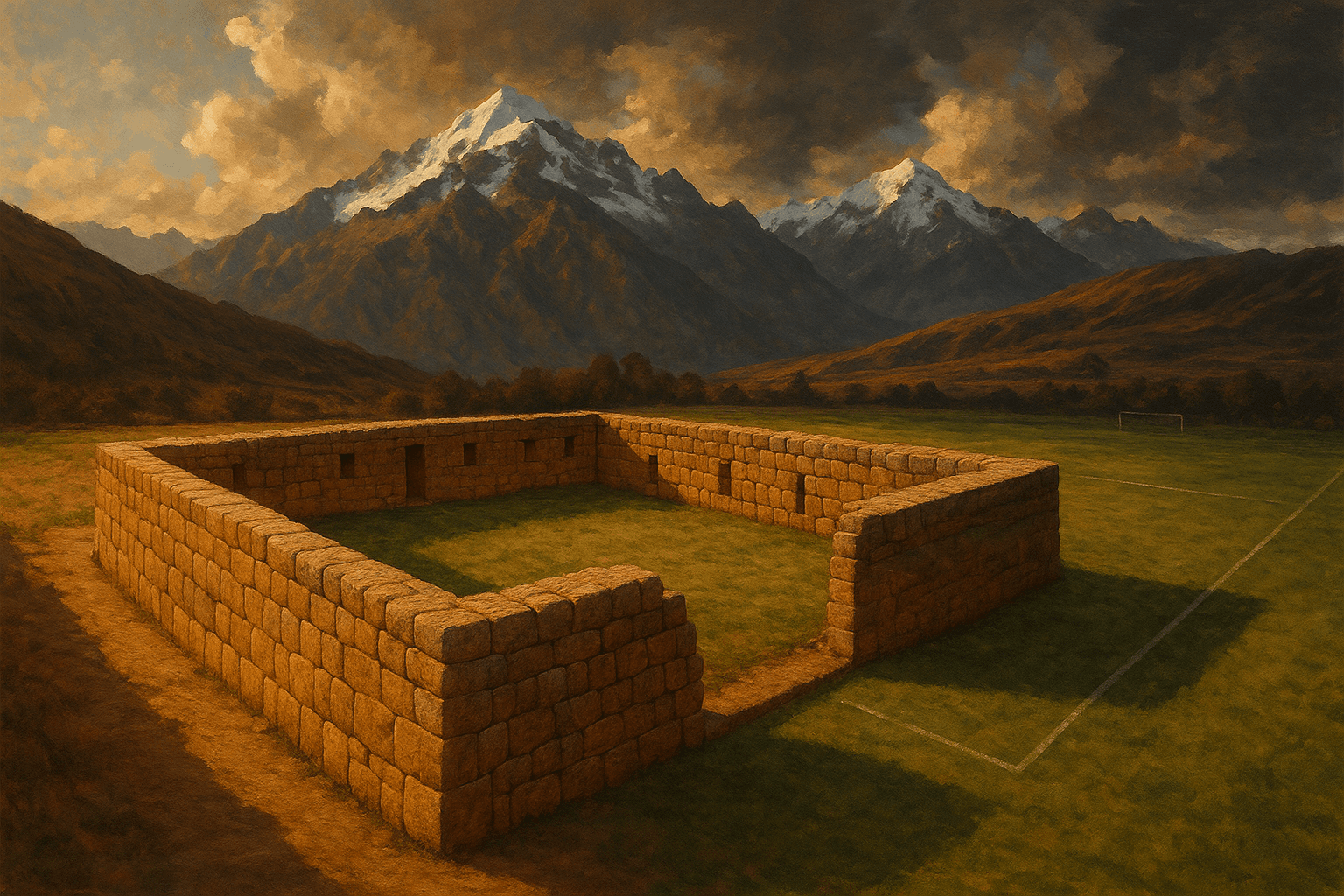
Every time someone steps onto a cancha —the word much of Latin America uses for a soccer pitch, a basketball court or a tennis court— they repeat, without knowing it, a word that echoed in the Andes long before there was ever a ball. Cancha comes from the Quechua kancha, meaning «enclosure», «fenced area» or «walled space». It is one of the Andean words Spanish adopted after reaching the highlands in 1532, just as it did with «condor», «puma» and «pampa», also Quechua, or with the first Taíno words like «canoe» and «hurricane».
The kancha: the brick the empire was built with
In Inca architecture the kancha was not a playing field but the basic building block: a rectangular walled enclosure with several single-room buildings arranged around a central courtyard. That same layout served for a modest dwelling, a palace or a temple, and several kancha grouped together made up the blocks of a city.
The core of Cusco, the imperial capital, was organized precisely into large kancha. The best-preserved example survives today in Ollantaytambo, where each block contains two independent enclosures, each with a single entrance. The word, then, first named a space bounded by walls: the idea of «that which is fenced in».
The golden enclosure that named the holiest temple
The word's most famous trace still stands in the heart of Cusco. The empire's chief sanctuary, the Temple of the Sun, was called Qorikancha (or Coricancha), which translates literally as «golden enclosure»: quri, «gold», plus kancha, «enclosure». Its walls were once sheathed in sheets of gold until the conquest stripped them away, and on its foundations —Inca masonry impossible to move— the Spanish raised the convent of Santo Domingo. In that single name, the same word we now use for a soccer field lives alongside the most venerated building of Tawantinsuyu.
From the fenced yard to the playing field
When Spanish adopted kancha, it kept that central idea of a bounded space. The Royal Spanish Academy lists the word as coming from Quechua kancha, «enclosure, fenced area», and from there records several meanings that trace its journey: a spacious corral or yard for storing things (still current in Argentina, Chile, Ecuador, Paraguay, Peru and elsewhere), a flat, open piece of ground, and finally the space set aside for sports or shows. The leap from corral to stadium is plain common sense: both are flat, delimited ground. That is why across much of the Americas people say «cancha» where Spain would say «pista» or «campo».
The word also took root in figurative speech. «Tener cancha» is to have experience and ease, the informal know-how that only practice gives; «abrir cancha» or «hacer cancha» is to clear the way, to make room. In every case the same original image beats underneath: an open place where something can happen.
The other cancha: the one you eat
There is a curious detail that often causes confusion. In Peru and other Andean regions, «cancha» is also a snack: toasted corn, crunchy, served as a nibble. But that meaning does not come from the same place: it derives from a similar Quechua word, kamcha (or hamk'a), meaning precisely «toasted corn or beans». Strictly speaking they are two different words that Spanish ended up pronouncing alike: one names the enclosure, the other the bite. Corn was the heart of the Andean diet, so it is no surprise it had its own verb and its own name.
A word that never stopped playing
From a walled enclosure in the Andes to the white lines of a stadium, kancha made a journey of nearly five centuries without losing its essence: it still names a bounded space where important things happen. Like so many Andean words that survive hidden in Spanish, or the Nahuatl words we eat every day, cancha carries inside a history almost no one remembers while cheering a goal. The next time someone says «see you on the cancha», they will be invoking, without knowing it, the golden enclosure of the Incas.
References
- «cancha», Diccionario de la lengua española, RAE-ASALE. dle.rae.es
- «cancha — etymology and meanings», Wiktionary. wiktionary.org
- «Inca kancha», Wikipedia. wikipedia.org
- Eva Bravo, «Cancha: del maíz al estadio, una palabra que nunca dejó de jugar». ebravo.es
Enjoy the stories behind words? Continue with the Quechua we speak without knowing it or explore the whole etymology series.
Categories
The books · born from this blog
Atahualpa con su abrigo de pelo de murciélago
y otras 49 historias verdaderas que parecen mentira
Available on Amazon
Tocar madera
Pequeña historia de las supersticiones que el mundo no ha podido soltar
Available on Amazon
100 futuros
Cien escenarios del mundo que viene con la inteligencia artificial
Available on AmazonYou may also like
The Origin of “Ñapa”: From Quechua to Lagniappe
Where does the word ñapa come from? From Quechua yapa, “something added.” The story of the market freebie that traveled to Louisiana and became lagniappe.
Condor, puma and pampa: the Quechua we speak
Condor, puma and pampa come from Quechua, the language of the Incas. Here is how these and other Andean words reached Spanish, English and everyday speech.
Potato, papa and batata: the great tuber mix-up
«Papa» comes from Andean Quechua and «batata» from Caribbean Taíno: two unrelated tubers that Europe blended into one word, potato.