
The First Message Ever Sent Over the Internet Was 'LO'
On October 29, 1969, the first message in internet history was meant to be 'login', but the network crashed after just two letters: 'LO'.
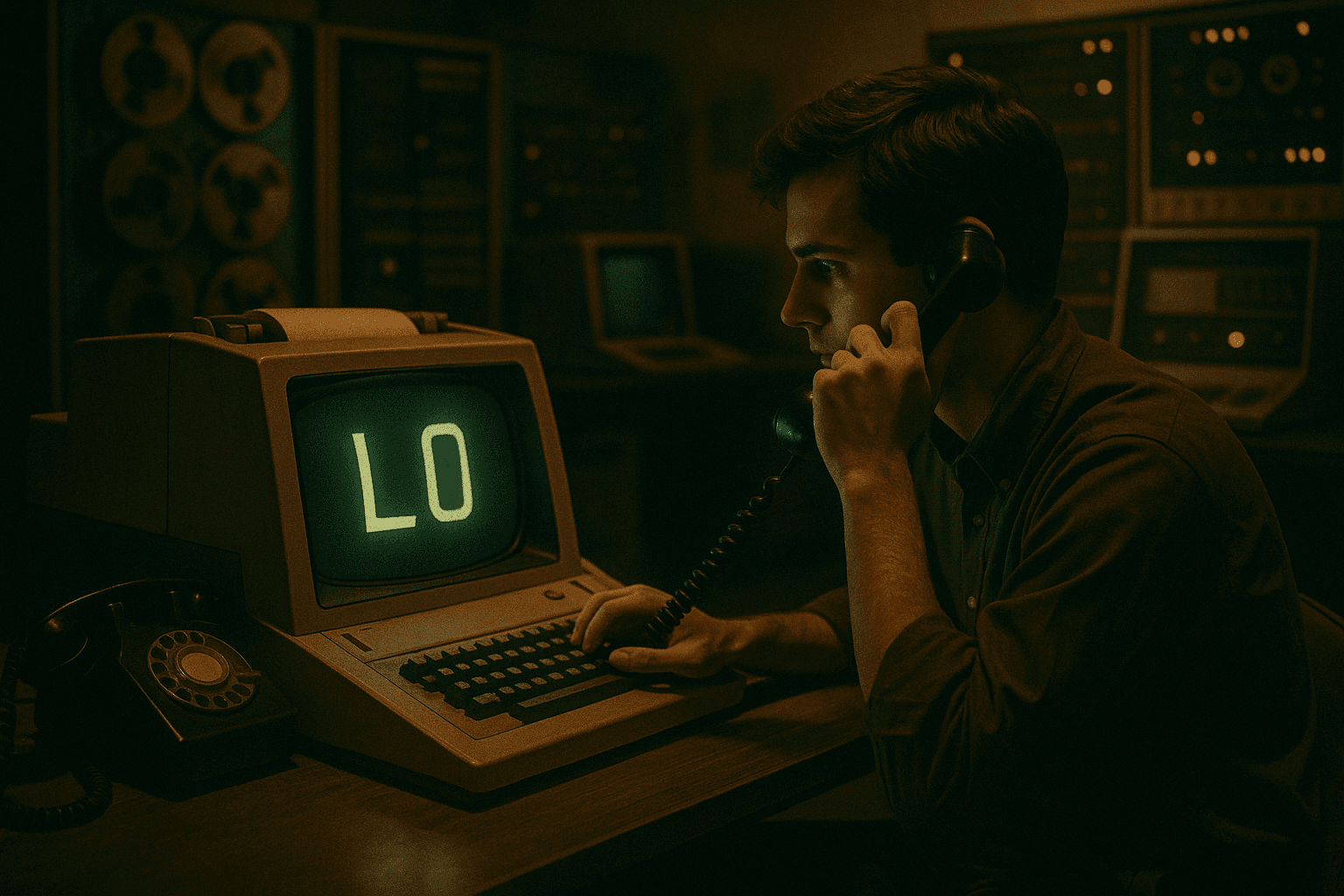
When we picture the birth of the internet, we imagine something solemn: a historic phrase, a headline, maybe an official photo. The reality was far humbler and far more human. On the night of October 29, 1969, the first message to travel across the network that would become the internet never arrived complete. It was supposed to be the word «login», but the system crashed after two letters. And so, by accident, the first word ever to cross the internet was «LO». This is the story of that night.
What ARPANET was, and why it existed
In the late 1960s, at the height of the Cold War, the U.S. Department of Defense was funding —through its agency ARPA (Advanced Research Projects Agency)— a project that seemed strange for its time: connecting different computers, at distant universities, so they could share resources and data. The computers of that era were enormous, wildly expensive, and did not talk to one another. The idea that a machine in California could «log into» another one hundreds of miles away sounded almost like science fiction.
That project was called ARPANET, and it is the direct ancestor of the internet. Rather than wiring the big computers together directly, the network used intermediary boxes called IMPs (Interface Message Processors), built by the company BBN from a rugged Honeywell DDP-516 minicomputer. Each IMP was, in essence, the great-grandfather of the router: it took data from its local computer, sliced it into packets, and sent it down the phone line to the next node. That idea of chopping information into pieces traveled over the same kind of lines that, years later, the modem would use to make the internet screech through the telephone.
Two computers, 300 miles, and a 50 kbps line
ARPANET's first connection joined two nodes: the University of California, Los Angeles (UCLA), where professor Leonard Kleinrock worked, and the Stanford Research Institute (SRI), some 300 miles to the north. UCLA had an SDS Sigma 7 computer; SRI had an SDS 940. Between them ran a leased telephone line at 50 kbps —a speed that would feel like torture today, but was a luxury back then.
The plan was simple on paper: from UCLA, log into the SRI computer, as if a user in Los Angeles were sitting at the Stanford machine. To do that, you had to type the command login. On the UCLA side was graduate student Charley Kline; on the SRI side, programmer Bill Duvall. Each of them also held a telephone, because to test whether the network worked… they needed to talk over the plain old voice line.
The night of «LO»
It was around 10:30 p.m. on October 29, 1969. Charley Kline began typing the command and, over the phone, confirmed it letter by letter with Bill Duvall on the other end. The scene, as its participants tell it, is delightfully domestic:
Kline typed the «L». «Did you get the L?», he asked over the phone. «Yes, I got the L», Duvall replied. He typed the «O». «The O?» «Yes, the O.» Then he typed the «G»… and the SRI computer crashed. A bug in the SDS 940 software brought down the connection right on the third letter. The system never finished the word.
So the first «message» to travel across the network we now call the internet was, literally, «LO». As Kleinrock himself would later joke, without meaning to they had transmitted something almost biblical: «lo!», as in the old expression «lo and behold». There was no prepared speech, no phrase for posterity; there was a programming error and two letters. About an hour later, once the bug was fixed, Kline managed to send the full login —but the internet's first word had already been written by accident.
The phrase history would have preferred
There is a charming irony in all of this. Months earlier, when the first IMP arrived at UCLA, Kleinrock's team had daydreamed about what inaugural message would be worthy of the occasion. When Samuel Morse unveiled the telegraph in 1844, he sent a solemn quotation: «What hath God wrought». When Alexander Graham Bell tested the telephone, he called his assistant: «Mr. Watson, come here». Great phrases for great inventions.
ARPANET, on the other hand, left us a «LO» cut in half by a system crash. And perhaps it is the perfect symbol of how all of this was built: not with solemnity, but with engineers testing, failing, and trying again. The very same «fix it as you go» culture we would see decades later in so many technical milestones, from the birth of Unix to Grace Hopper and the first computer «bug».
From two nodes to a whole network
That two-node connection did not stay alone for long. By December 5, 1969, ARPANET already had four nodes: UCLA and SRI were joined by the University of California, Santa Barbara and the University of Utah. Four very different computers, from different manufacturers, speaking the same language of packets for the first time. It was a tiny network —small enough to fit in a hand-drawn sketch— but it held the seed of everything to come.
From those four nodes would grow, over the years, email, the TCP/IP protocols, the World Wide Web and, finally, the internet we now carry in our pockets. Billions of messages cross the network every second, most of them trivial, some important, almost none remembered. But the very first of them all, the one that opened the door, was barely half a word broken by an error: «LO». A beginning as imperfect as it was deeply human.
References
- «Internet First Words», Leonard Kleinrock (UCLA). lk.cs.ucla.edu
- Novak, Matt. «The First Internet Message Ever Sent Was "LO"», Paleofuture / Gizmodo. paleofuture.com
- «The First Message Transmission», ICANN. icann.org
- «Interface Message Processor», Wikipedia. en.wikipedia.org
Do you enjoy these stories about the origins of technology? Continue with the history of the modem or explore the whole science & tech section.
Categories
The books · born from this blog
Atahualpa con su abrigo de pelo de murciélago
y otras 49 historias verdaderas que parecen mentira
Available on Amazon
Tocar madera
Pequeña historia de las supersticiones que el mundo no ha podido soltar
Available on Amazon
100 futuros
Cien escenarios del mundo que viene con la inteligencia artificial
Available on AmazonYou may also like
The Telegraph: The Victorian Internet
The telegraph shrank weeks of mail into minutes of cable. How Morse, Cooke and a wire under the Atlantic built the Victorian internet and shrank the world.
How the First Cameras Worked: Dark Room to Kodak
From Ibn al-Haytham's camera obscura to Niépce's first photo and the 1888 Kodak: how the earliest photographic cameras actually worked and evolved.
The First Personal Computer Wasn't the One You Think
Almost everyone credits the 1975 Altair as the first personal computer, but several came earlier: from Olivetti in 1965 to the Kenbak-1 in 1971.