
The History of the Floppy Disk and the Save Icon
The floppy disk held 80 KB in 1971 and survives today as the «save» icon many young people never touched. This is the full history of the floppy disk.
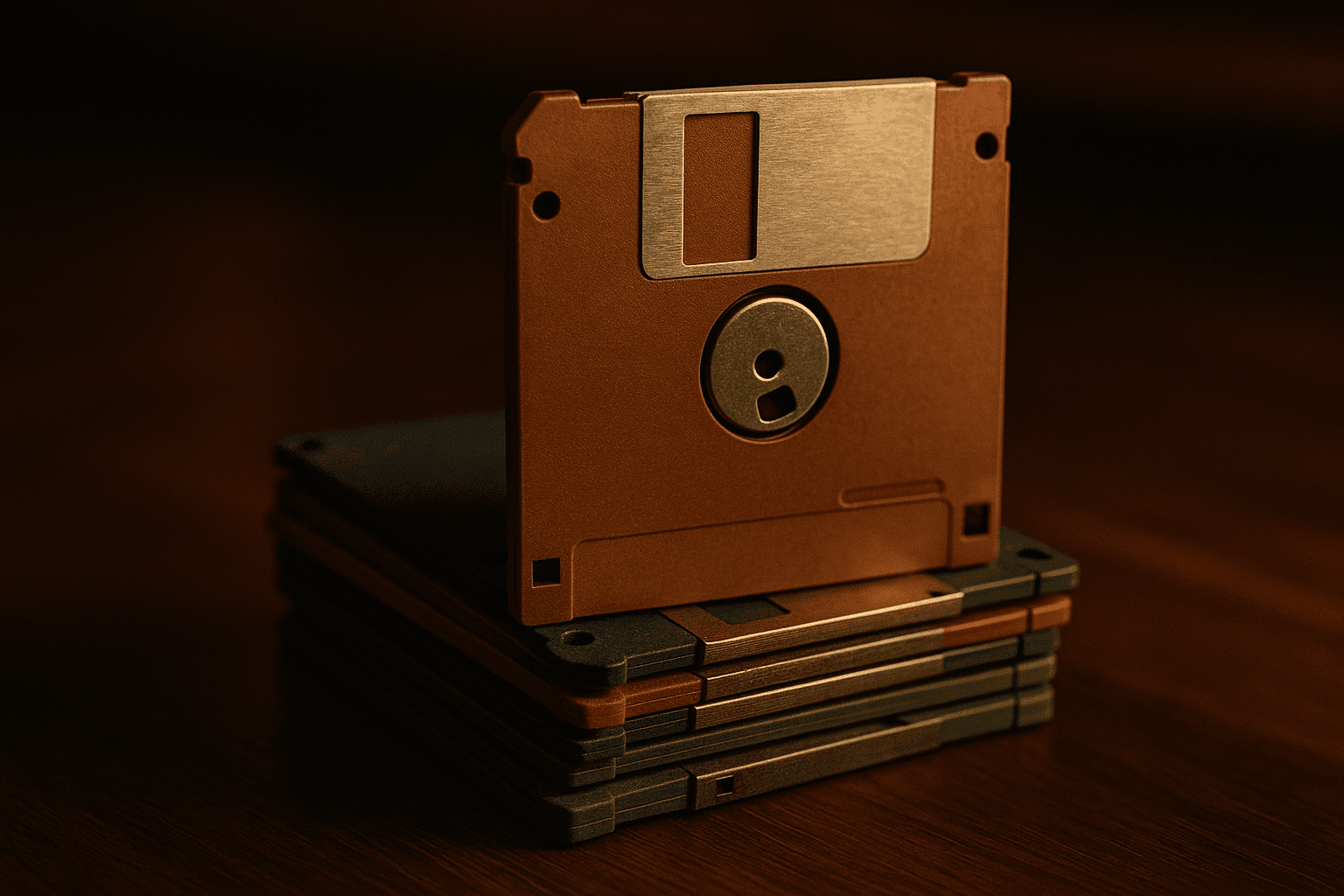
There is an object almost nobody uses anymore that still appears on your screen dozens of times a day: the floppy disk. That little square with a slot, the one drawn on the "save" button in nearly every program, is the silhouette of a technology that ruled computing for three decades —and that many of the people who see it daily have never held in their hands. This is the story of the floppy disk, from an IBM lab to the icon that refused to die.
1971: a flexible disk to boot a mainframe
The problem that gave birth to the floppy was very specific. In the late 1960s, IBM's enormous computers had to load their microcode —the internal instructions that made them run— every time they powered on, and doing it with punched cards or tape was slow and expensive. In 1967, product manager Alan Shugart, at IBM's San Jose lab in California, assigned David L. Noble to develop a cheap, disposable medium for that task.
The solution arrived in 1971: the IBM 23FD, nicknamed "Minnow." It was a flexible 8-inch, read-only disk able to store 80 KB —the equivalent of about 3,000 punched cards. The drive itself was led by Warren L. Dalziel, while Ralph Flores and Herbert Thompson devised a fabric-lined jacket that cleaned and protected the disk from dust every time it spun. The disk was so flexible —"floppy"— that the nickname ended up naming the entire category.
From IBM to the world: 8, 5¼ and 3½ inches
Shugart left IBM in 1969 and, after a stint at Memorex —where his team shipped the first read-write floppy drive in 1972— founded Shugart Associates in 1973, which became the dominant maker of 8-inch drives. But the great leap toward the general public came through miniaturization.
In 1976 came the 5¼-inch floppy, smaller and cheaper, which became the standard for the first generation of personal computers and held about 360 KB. And in 1981, Sony introduced the format almost everyone remembers: the rigid 3½-inch disk, with its hard plastic shell and the metal shutter that slid open when you inserted it. Its "high-density" version, standardized in 1987, held 1.44 MB: the figure burned into the memory of an entire generation. It was the inseparable companion of the desktop computer boom, the machine that stopped being exotic as told in the story of the first personal computer.
Why the "save" button is a floppy disk
When graphical programs needed an icon for the save action, the choice was obvious: throughout the 1980s and 1990s, saving was literally writing to a floppy disk. The little 3½-inch rectangle, with its white label on top and its shutter, became the universal symbol for "keep your work." No one decided in a meeting that it would last forever; it simply stuck.
That phenomenon has a name: a skeuomorph, an element that keeps the shape of a physical object no longer in use, only because the user recognizes it. It is the same kind of visual metaphor that filled screens with folders, trash cans, and desktops; in fact, the reason computer files are called "files" belongs to that same family of nods to the paper office. Today millions of people tap an icon daily whose real-world form they never handled: for them, the floppy is not an object but a pictogram.
The slow death of the floppy… and its holdouts
What killed the floppy was its own limitation: 1.44 MB became laughable once a single digital photo could weigh more. In the late 1990s, the recordable CD and then the USB flash drive offered hundreds of times more capacity. The symbolic blow came in 1998, when Apple released the iMac without a floppy drive —scandalous at the time. In 2011, Sony, the last major manufacturer, halted production.
And yet the floppy clung to life in the most critical corners. Until 2019, the system coordinating part of the United States' nuclear arsenal still used 8-inch floppy disks, precisely because their isolation made them hard to hack. In Japan, hundreds of government procedures required by law that data be submitted on floppy disk, and it was not until 2024 that the government officially declared its "war on floppy disks" won, scrapping the last regulations that mandated them. A format from 1971 took more than half a century to fully retire.
Computing's most stubborn ghost
The next time you hit "save" and see that little square, consider that you are touching the ghost of a technology born to boot up computers the size of a wardrobe. The object vanished from our desks, but its image survived because it did a job nothing else could replace: saying "this means save" at a single glance. Like so many other pieces of tech history —the modem that screeched over the phone or the words inherited from the office— the floppy disk shows that sometimes what outlives an invention is not the object, but the gesture it taught us to make.
References
- "1971: Floppy disk loads mainframe computer data," Computer History Museum — The Storage Engine. computerhistory.org
- "Floppy disk storage," IBM History. ibm.com
- "From Idea to Icon: 50 Years of the Floppy Disk," How-To Geek. howtogeek.com
- "Japan's government is (finally) done with floppy disks," Popular Science. popsci.com
Do you enjoy these stories about everyday technology? Continue with why computer files are called "files" or explore the whole technology section.
Categories
The books · born from this blog

Atahualpa con su abrigo de pelo de murciélago
y otras 49 historias verdaderas que parecen mentira
Available on Amazon
Tocar madera
Pequeña historia de las supersticiones que el mundo no ha podido soltar
Available on Amazon
100 futuros
Cien escenarios del mundo que viene con la inteligencia artificial
Available on AmazonYou may also like

The History of the Match: Fire in Your Pocket
The friction match was born by accident in 1826, poisoned thousands of factory women, and only later became the safe fire we carry in our pocket.

The nocebo effect: when expecting harm creates it
The nocebo effect is the placebo's dark twin: believing a treatment will hurt can make it hurt. Its origin, real cases and what science says.
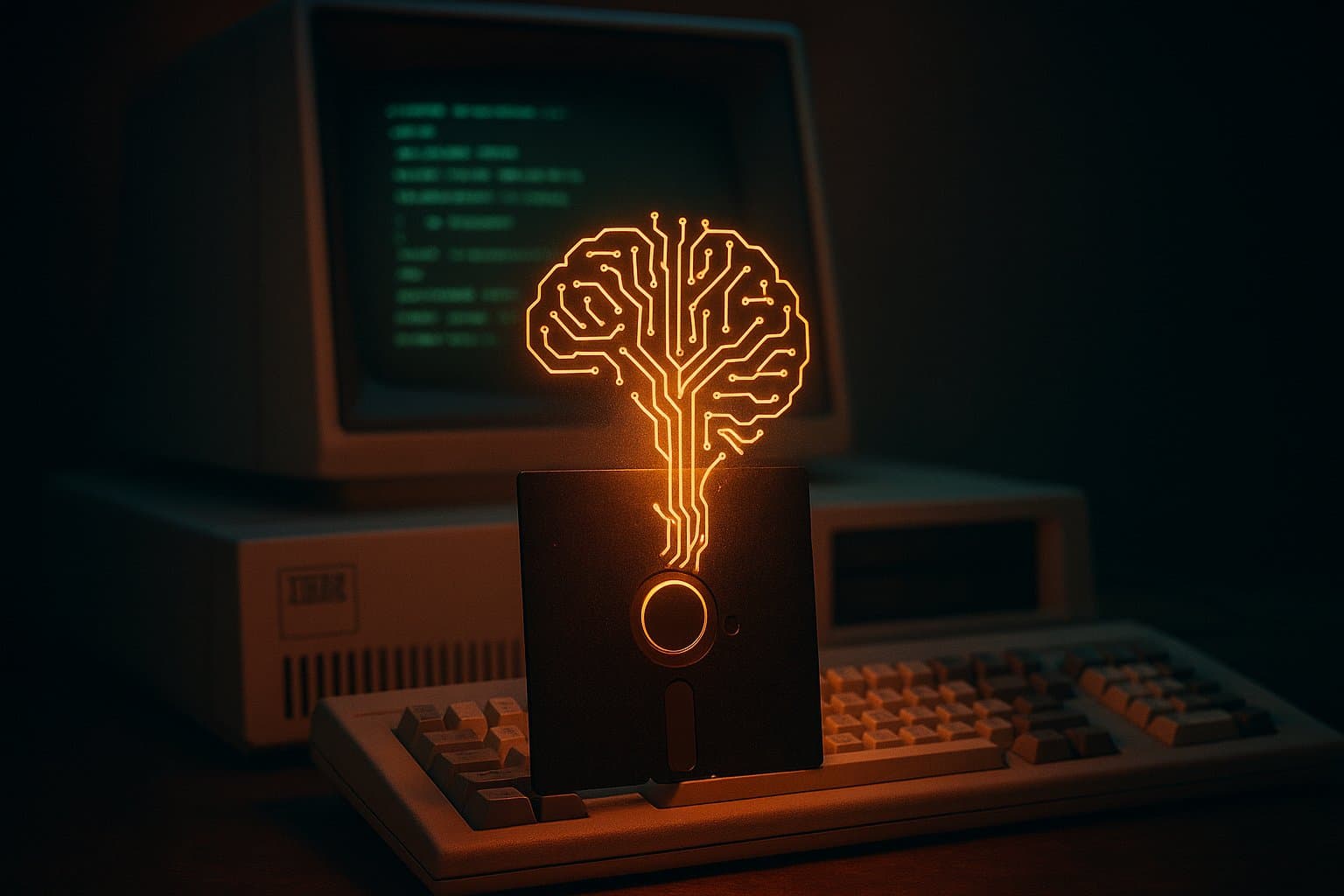
The first computer virus was called Brain
In 1986, two brothers in Lahore wrote Brain, the first PC virus. It destroyed nothing: it guarded their software and left their name, address and phone.