
The Origin of the Word “Money”: the Goddess Juno
Where does the word money come from? From a temple of Juno in Rome where the first coins were struck. The story of a goddess who warned.
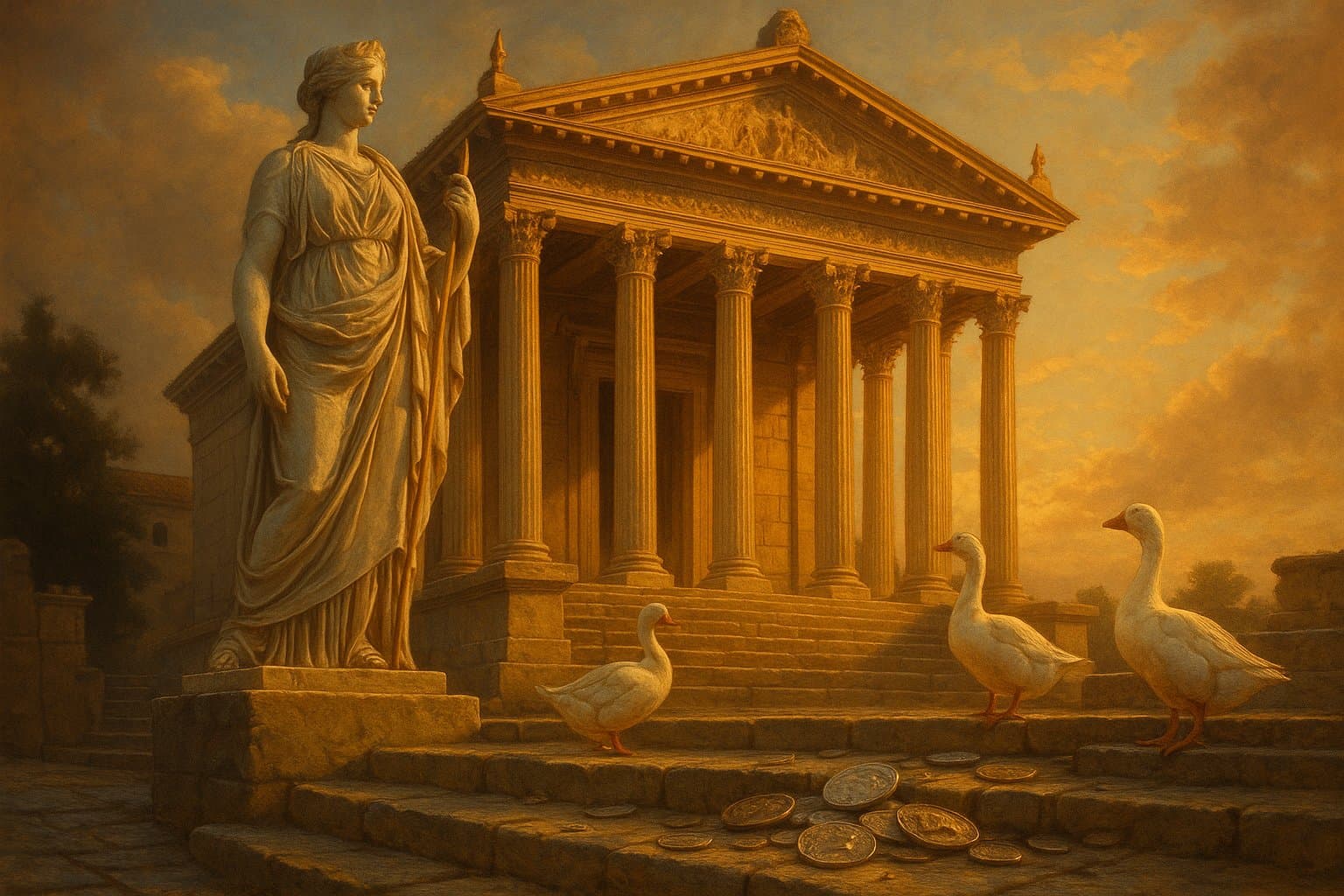
Every time we say money —or moneda in Spanish, monnaie in French, moneta in Italian— we are pronouncing, without knowing it, the surname of a Roman goddess. The word was not born in a bank or a marketplace but in a temple on the Capitoline Hill dedicated to Juno under a curious nickname: Moneta, “the one who warns”. There, beside the goddess’s altar, Rome set up its first money factory, and the name of the place ended up sticking to what came out of it. The origin of “money” is the story of how a divine warning turned into the disc of metal we carry in our pockets.
Moneta: the goddess who warned
On the Capitoline, Rome’s sacred hill, Juno was worshipped under several epithets. One of them was Iuno Moneta. The word Moneta derives from the Latin verb monēre, meaning “to warn, to advise, to admonish, to remind” —the same root that gave us “admonish”, “monitor” and “monument”. Juno Moneta was, quite literally, “Juno the Warner”.
What did she warn about? Roman tradition offered more than one explanation. Cicero relates that during an earthquake a voice from the temple demanded the sacrifice of a pregnant sow to expiate the omen; the name would come from that supernatural warning. But the most famous legend is another one, and it has wings.
The geese that saved Rome
Around 390 BC, the Gauls under Brennus took Rome and laid siege to the Capitol, the city’s last stronghold. One night they tried to climb the slope in silence, unnoticed by the dogs or the sentries. But the geese sacred to Juno —kept inside the sacred precinct even through the famine of the siege— began to honk and beat their wings, waking the defender Marcus Manlius, who threw back the assault. Rome was saved by an animal warning.
Geese were Juno’s bird, a symbol of vigilance, and their timely honking fit perfectly with the epithet Moneta, “the warner”. Whatever the real origin of the epithet —linguists still debate it— to the Romans the goddess of the Capitol was the one who gave warning in time. Those Gauls, by the way, were the very peoples Rome looked down on: folk of a strange tongue whom they scornfully called barbarians.
From temple to mint: where money was born
The temple of Juno Moneta was vowed by the dictator Lucius Furius Camillus during his war against the Aurunci and dedicated around 344 BC, atop the Arx, the northern peak of the Capitoline. In time the Roman state set up its official coining workshop there —or right beside it. From about the third century BC, out of that precinct came the metal pieces with which Rome paid its legions and collected its taxes.
The name of the place did the rest. Moneta stopped meaning only the goddess and her temple and came to name also the money factory (what English calls a “mint”) and, by extension, the coined money itself. A single word came to cover the building, the machine and the product all at once. It is the same mechanism by which a place gives its name to what is done in it: just as when a community decides which object counts as money, custom turns a symbol into an economic reality.
From moneta to money (and to mint)
From that Latin moneta descend, in a direct line, Spanish moneda, Italian moneta, French monnaie and, by another route, English money and the whole “monetary” vocabulary. But the same root had a second, less obvious child: traveling into the Germanic languages, moneta was reshaped phonetically into English mint and German Münze —both meaning “the place where coins are struck”. So “money” and “mint” are, surprisingly, the same Latin word split down two different paths.
The next time you count your coins, remember that you are handling the echo of a watchful goddess and some noisy geese on a night in the fourth century BC. Like so many words we use to count and to pay, “money” hides inside it a story that has nothing to do with economics and everything to do with a temple, a warning, and a people’s faith that their gods were paying attention.
References
- “Money”, Online Etymology Dictionary: from Latin moneta “place for coining money, coin”, originally an epithet of Juno, in whose temple on the Capitoline money was coined; probably from monere “to warn, advise”. etymonline.com
- “Moneta”, Wikipedia: epithet of Juno derived from monere; Rome’s first mint was established beside her temple on the Capitoline, from which moneta came to mean “mint” and “money”. en.wikipedia.org
- “Temple of Juno Moneta”, Wikipedia: temple vowed by Lucius Furius Camillus in the war against the Aurunci and dedicated in 344 BC on the Arx of the Capitoline; seat of Roman coining for centuries. en.wikipedia.org
- “The Temple of Juno Moneta”, Musei Capitolini: history of the Capitoline sanctuary, the legend of the sacred geese and its role as the first mint of the Roman state. museicapitolini.org
Enjoy the stories behind words? Continue with the origin of “enthusiasm” and that of “cipher” and “zero”, or browse the whole etymology series.
The books · born from this blog

Atahualpa con su abrigo de pelo de murciélago
y otras 49 historias verdaderas que parecen mentira
Available on Amazon
Tocar madera
Pequeña historia de las supersticiones que el mundo no ha podido soltar
Available on Amazon
100 futuros
Cien escenarios del mundo que viene con la inteligencia artificial
Available on AmazonYou may also like

The Origin of the Word “Quarantine”: 40 Days in Venice
Where does the word quarantine come from? From the 40 days that Venice and Ragusa forced ships to wait during the Black Death. Here is its story.

The Origin of the Word “Dollar”: a Bohemian Valley
Where does the word dollar come from? From a silver-mining valley in Bohemia and a 16th-century coin. The story of the thaler that conquered the world.

The Origin of the Word “Museum”: House of the Muses
Where does the word museum come from? From mouseion, the temple of the Greek Muses and the great center of learning in Alexandria, long before glass cases.