
The Origin of the Word “Enthusiasm”: A God Within
Where does enthusiasm come from? To the Greeks, enthusiasm meant having a god inside your body. The story of a word that began as sacred possession.
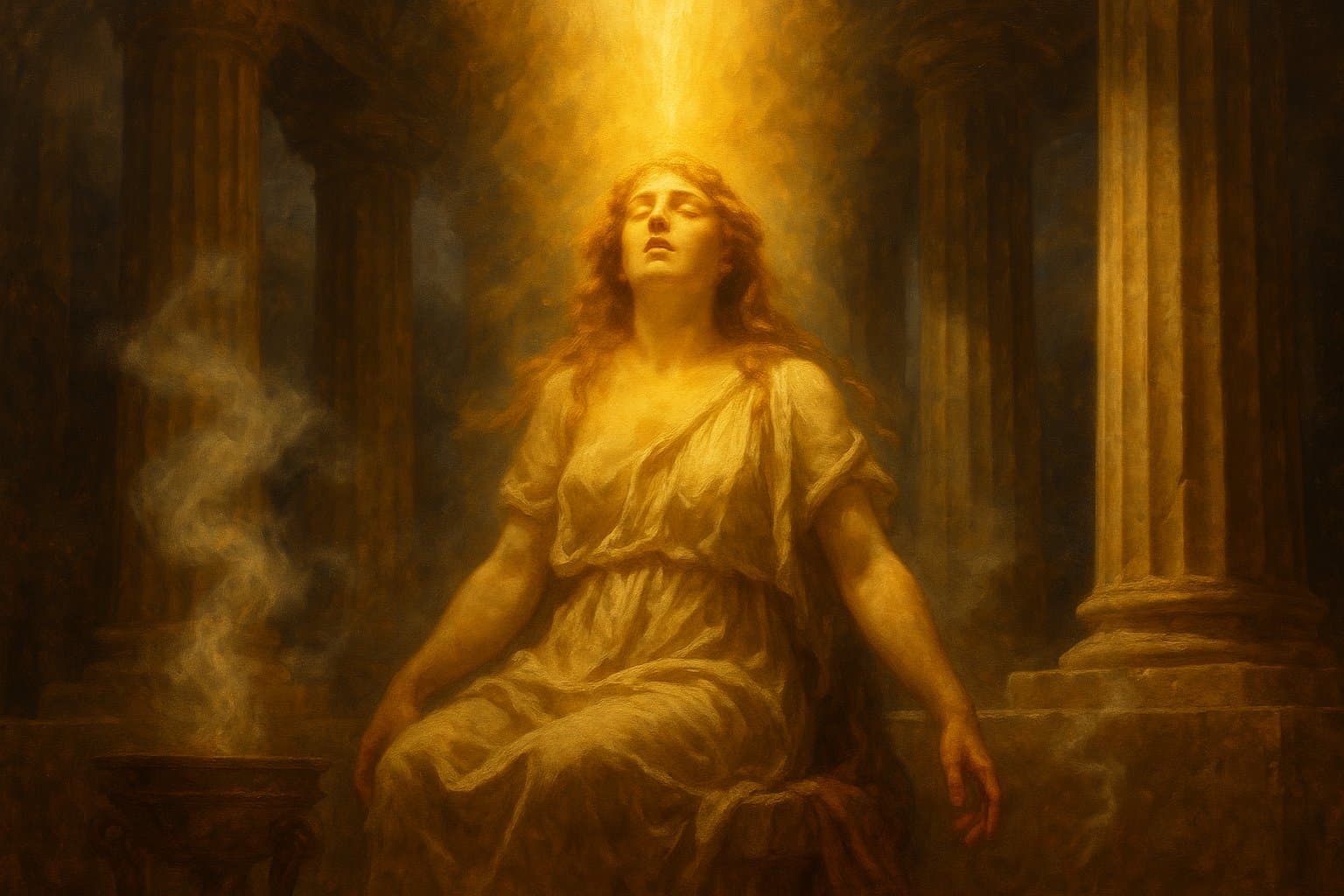
When we say someone does something “with enthusiasm”, we picture energy, eagerness, a broad and contagious smile. But the word enthusiasm hides something far more intense and far more ancient than good cheer: it hides a god. Literally. To the Greeks who coined it, to be enthusiastic was not to be upbeat but to be possessed — to have a divinity installed inside your own body, speaking and acting through you. The origin of “enthusiasm” is one of those etymologies that, once you know it, changes the way you use the word forever.
En, theos: the god that got inside you
The word comes from the Greek enthousiasmós (ἐνθουσιασμός), from the adjective éntheos (ἔνθεος), which breaks apart with almost textbook clarity: en (“within”) + theós (“god”). Éntheos meant, quite bluntly, “having a god inside”, “inspired or possessed by a divinity”. The verb enthousiázein meant “to be inspired by a god, to be in ecstasy, to be rapt”. This was no poetic metaphor: it described a real state of trance in which the person was believed to stop being themselves and become the instrument of a god.
It is the same naming logic by which the word panic was born from the god Pan: the Greeks explained intense emotions as the intrusion of a divine force into the human body. Where we see brain chemistry, they saw the hand of a god.
The sibyl, the poet and the lover
Who was “enthusiastic” in ancient Greece? Not just anyone having a good day. Enthusiasm was the state of the Pythia, the priestess of Delphi who was believed to be possessed by Apollo in order to deliver his oracles amid vapors and confused words. It was the frenzy of the Bacchantes and Maenads swept up by Dionysus in their rites. It was, in short, divine possession in its purest form: the moment a mortal became the mouth of a god.
Plato expanded on the idea in his dialogue Ion: for him, the poet composes not through craft or skill but because a god speaks through him, as a magnet passes its force to iron. The true poet, he said, is “enthusiastic”, beside himself, possessed by the Muses. Alongside the prophet and the poet, tradition added the lover: all three share that condition of being “outside themselves”, inhabited by something greater. In every case the word named a total surrender in which reason handed over command.
From sacred praise to Enlightenment insult
That religious sense traveled into Latin as enthusiasmus and reached the modern languages carrying the aura of trance. But in the Europe of the 17th and 18th centuries the word took a surprising turn: it became pejorative. In the thick of the Enlightenment, “enthusiasm” came to mean exaggerated, fanatical religious fervor — the zealot who swore he heard the voice of God directly and distrusted reason. To Enlightenment thinkers, so in love with calm judgment, saying someone acted “out of enthusiasm” was almost an accusation: it meant being carried away by irrational exaltation. Philosophers like Locke and Hume devoted whole pages to warning against the dangers of enthusiasm.
Only in the 18th century, settling around 1716, did the word soften into the sense that now seems obvious to us: “fervor, ardor, intense eagerness”, with no religious or negative connotation. The god gradually dissolved out of the everyday meaning, just as happened with so many other words that began at an altar and ended up in the street — like the word vaccine, which began with a cow.
A divine trace we still pronounce
So the next time you do something “with enthusiasm”, remember what you are really saying: that a god has gotten inside you and swept you away. It is one of those words, like so many inherited from Greek, that carry hidden in their syllables a way of understanding the world completely unlike our own. The Greeks had no word for “feeling very eager”: they had one for “being inhabited by the divine”. And from that idea, worn down by twenty-five centuries of use, we kept the one we use today to urge someone out of bed with energy. The god is still there, in the first syllable, waiting for someone to notice.
References
- “Enthusiasm”, Online Etymology Dictionary: from Greek enthousiasmos, from entheos “divinely inspired, possessed by a god” (en “in” + theos “god”); the generalized sense “fervor, zeal” became the main one by 1716. etymonline.com
- “Enthusiasm”, Merriam-Webster Dictionary: etymology from Greek enthousiasmos, from enthousiazein “to be inspired”, from entheos “possessed by a god”. merriam-webster.com
- “Enthusiasm”, Wikipedia: the Greek term was applied to manifestations of divine possession, such as the Pythia possessed by Apollo or the Maenads by Dionysus; it acquired a pejorative sense of excessive religious zeal in the 17th–18th centuries. en.wikipedia.org
- Plato, Ion 533d–534e: the poet creates not by skill but by divine inspiration, “enthused” and possessed by the Muses as iron by a magnet. Perseus Digital Library. perseus.tufts.edu
Enjoy the stories behind words? Continue with panic and the myth of the god Pan and the origin of the word “barbarian”, or browse the whole etymology series.
The books · born from this blog

Atahualpa con su abrigo de pelo de murciélago
y otras 49 historias verdaderas que parecen mentira
Available on Amazon
Tocar madera
Pequeña historia de las supersticiones que el mundo no ha podido soltar
Available on Amazon
100 futuros
Cien escenarios del mundo que viene con la inteligencia artificial
Available on AmazonYou may also like

The Origin of the Word “Quarantine”: 40 Days in Venice
Where does the word quarantine come from? From the 40 days that Venice and Ragusa forced ships to wait during the Black Death. Here is its story.

The Origin of the Word “Dollar”: a Bohemian Valley
Where does the word dollar come from? From a silver-mining valley in Bohemia and a 16th-century coin. The story of the thaler that conquered the world.
The Origin of the Word “Museum”: House of the Muses
Where does the word museum come from? From mouseion, the temple of the Greek Muses and the great center of learning in Alexandria, long before glass cases.