
The Origin of the Word “Pagan”: From Villager to Heathen
Where does the word pagan come from? From Latin paganus, villager: the country folk who kept the old gods after the cities had turned Christian.
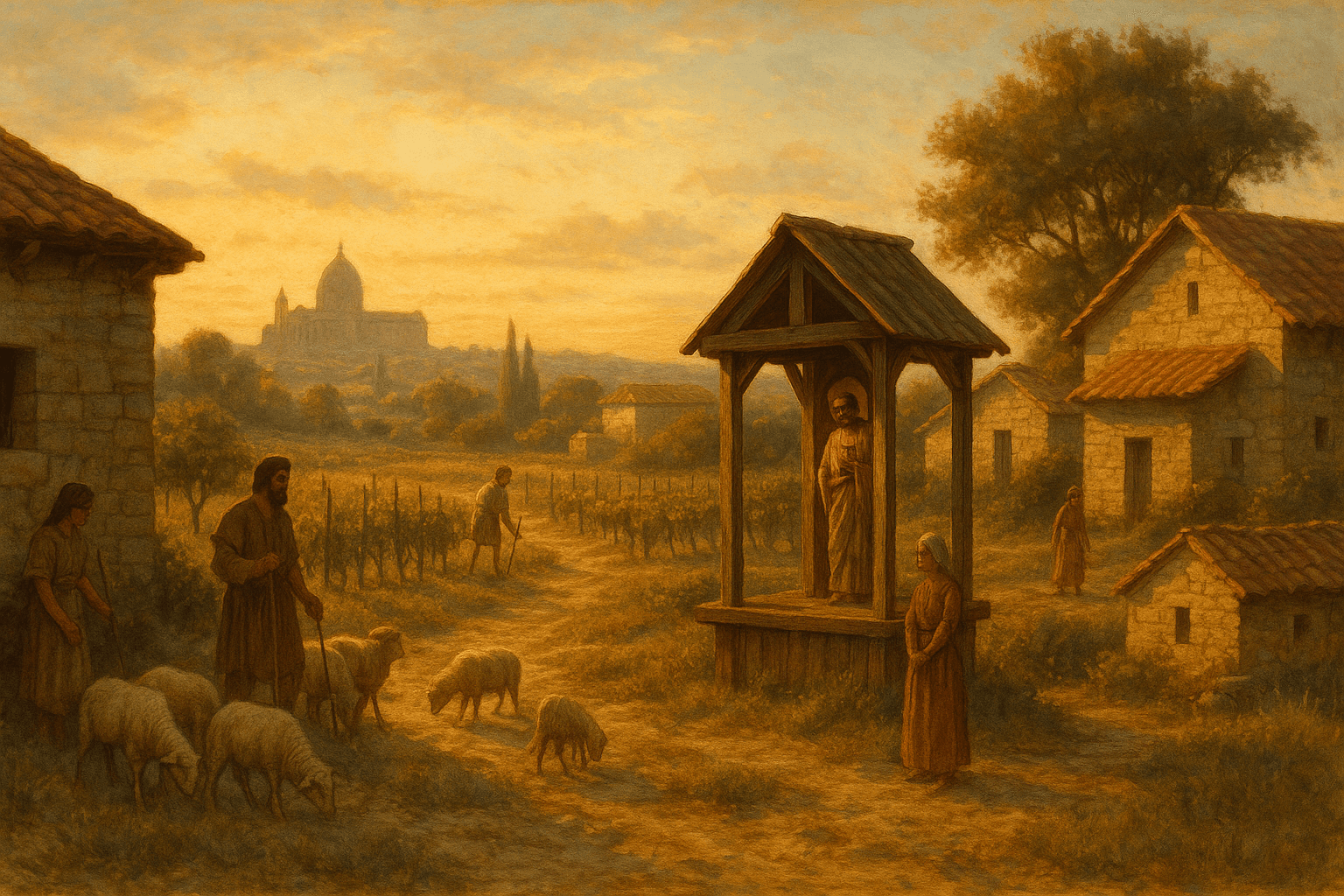
Today pagan is almost a religious label: we use it for everything that does not fit inside Christianity, from the gods of Greece and Rome to Norse rites or any «nature» spirituality. Yet the word was not born in a temple or a council. It was born in the countryside. The Latin paganus was neither a heretic nor an idolater: he was, quite simply, someone who lived in the pagus, the village, the rural district. How such an earthy word ended up meaning «the one who does not believe» is one of the most revealing stories of how Christianity conquered the cities first and only later the whole world.
A marker driven into the ground
The starting point is pagus, which in Classical Latin meant a rural district, a stretch of countryside with defined boundaries. The word comes from the verb pangere, «to drive in», «to fix», «to plant»: a pagus was originally the territory marked out by boundary stones driven into the earth. From it came paganus, «the one from the pagus», that is, the villager, the peasant, the country dweller as opposed to the citizen of the town.
For centuries the word carried no religious weight at all. A paganus was someone rustic, plain, far from the bustle and the fashions of the city. That contrast between country and town —between the polished and the coarse— beats in so many words with a prejudice baked into their origin: it happened with «barbarian», which began by naming the foreigner before it became an insult, and with «cretin», which started out as a compassionate label. Geography and social class slip into language with astonishing ease.
The city believes first
The most widespread explanation is also the most intuitive. Christianity spread across the Roman Empire along the trade routes and urban networks: it grew first in the cities, the ports, the great administrative centres where the apostles preached and the first communities organised themselves. The countryside, scattered and conservative, lagged behind. When the towns were already mostly Christian, the villages still kept the old cults alive: the gods of the woods, the springs and the harvests, bound to the cycles of farming and herding.
So, to the city Christian, «the one from the country» —the paganus— became, almost by geographical accident, a synonym for the person who still worshipped the old gods. In the fourth century, when Christianity was already the favoured religion of the Empire, bishops aimed much of their preaching precisely at those rural pagani, the most attached to their ancestral traditions. The religious meaning of the word settled over the geographical one until it covered it entirely.
The other theory: civilians versus soldiers of Christ
There is, however, a second explanation that many philologists consider stronger, and it has a surprising twist. In Roman military slang, paganus also meant «civilian», the one who was not a soldier. And here the Christian metaphor comes in: the early Christians saw themselves as milites Christi, «soldiers of Christ», enlisted through baptism —which they called sacramentum, the very word for the Roman military oath— in a spiritual army.
From that angle, the paganus was not the peasant but the «civilian» who had not enlisted in the ranks of Christ, the one who stayed out of the spiritual battle. Augustine and other Christian writers played with this image, and for many scholars it is the military sense —not the rural one— that best explains why the word ended up meaning the non-believer. The two theories do not entirely exclude each other: it is likely that both shades, the rustic villager and the unenlisted civilian, reinforced one another.
A pattern that repeats: the heretic of the moor
What is fascinating is that this link between «countryside» and «old religion» was not unique to Latin. The English word heathen —which we translate as «pagan»— comes from heath, the wild moor, the uncultivated waste: literally, «the one who lives on the heath». The same idea, in another language and another climate: the new faith is a thing of the city, and the old beliefs take refuge in the remote places, among shepherds and farmers whom change is slower to reach.
Over time «pagan» shed its farming root completely. It lost the pagus, it lost the peasant, and it became a purely religious and even philosophical term, able to name equally a first-century Roman priest and a modern practitioner of reconstructed spiritualities. Like so many other words that began by describing a place or a trade, «pagan» ended up describing an identity. And within it, for anyone who cares to listen, it still keeps the murmur of the villages that took a little longer to change their gods.
References
- “Pagan”, Online Etymology Dictionary: from Late Latin paganus “pagan”, in Classical Latin “villager, rustic”, from pagus “rural district”; discusses the military-slang theory of “civilian” versus miles Christi. etymonline.com
- “paganus”, Wiktionary: from pagus “country, district” + -anus; records the senses “villager”, “civilian (not a soldier)” and, in Ecclesiastical Latin, “non-Christian”. en.wiktionary.org
- “Does the word ‘pagan’ really come from the word ‘village’?”, Historia Translation: weighs the rural-dweller theory against the military “civilian” sense adopted by early Christians. historiatranslation.com
- “Paganism”, Wikipedia: synthesis of the hypotheses on the shift of paganus from “rural / civilian” to “non-Christian” in the Christian Latin of the fourth and fifth centuries. en.wikipedia.org
Enjoy the stories behind words? Continue with the origin of “barbarian” and that of “cretin”, or browse the whole etymology series.
The books · born from this blog

Atahualpa con su abrigo de pelo de murciélago
y otras 49 historias verdaderas que parecen mentira
Available on Amazon
Tocar madera
Pequeña historia de las supersticiones que el mundo no ha podido soltar
Available on Amazon
100 futuros
Cien escenarios del mundo que viene con la inteligencia artificial
Available on AmazonYou may also like

The Origin of the Word “Quarantine”: 40 Days in Venice
Where does the word quarantine come from? From the 40 days that Venice and Ragusa forced ships to wait during the Black Death. Here is its story.
The Origin of the Word “Dollar”: a Bohemian Valley
Where does the word dollar come from? From a silver-mining valley in Bohemia and a 16th-century coin. The story of the thaler that conquered the world.

The Origin of the Word “Museum”: House of the Muses
Where does the word museum come from? From mouseion, the temple of the Greek Muses and the great center of learning in Alexandria, long before glass cases.