
The Origin of the Word “Petrichor”
The smell of rain has had a name since 1964: petrichor, “the blood of the gods flowing from stone”. This is its story — and its science.
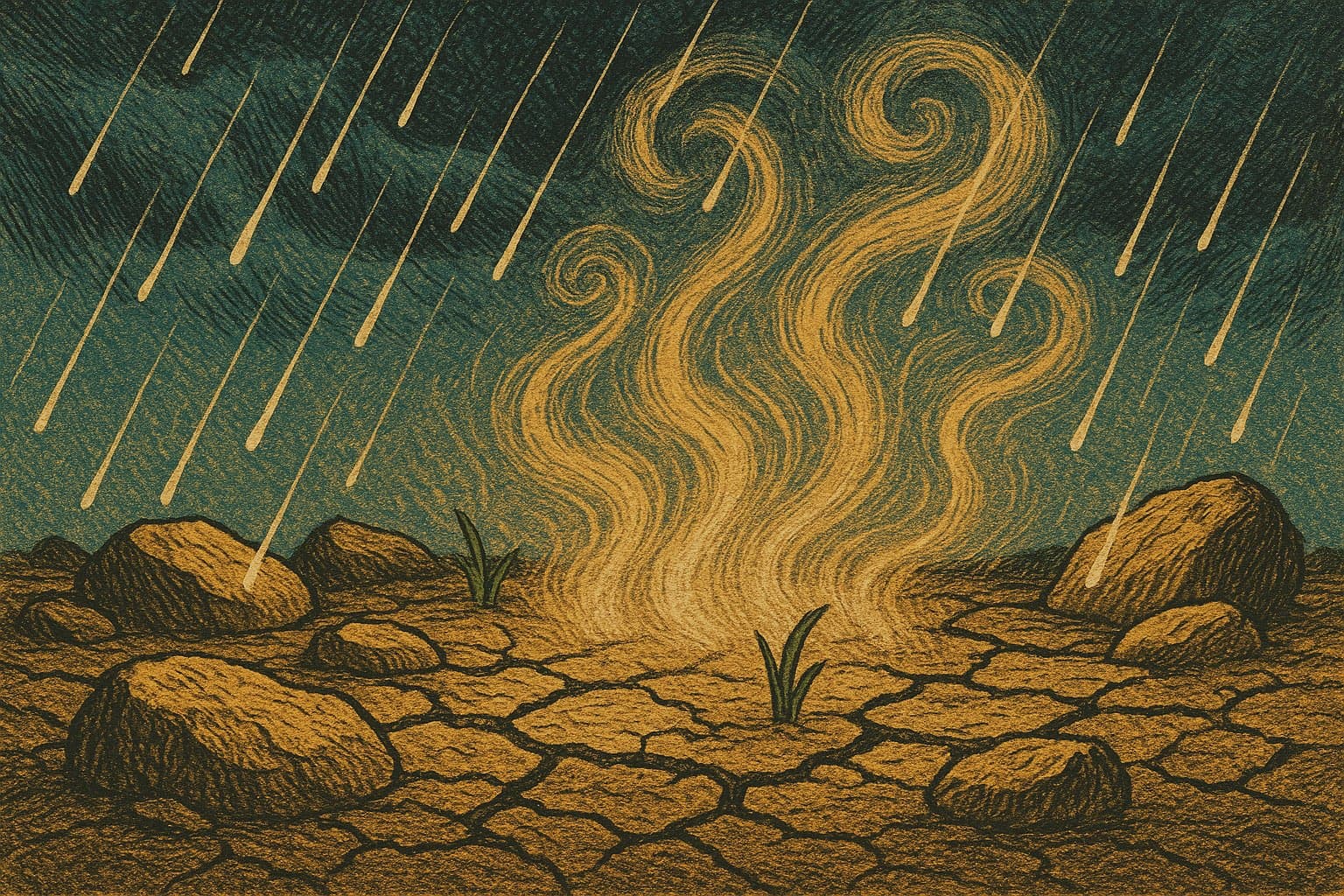
Everybody knows that smell. It rains after weeks of drought and the earth releases an aroma unlike anything else: fresh, mineral, ancient, impossible to describe yet instantly recognizable. The curious thing is that this smell has a name of its own —petrichor— and that the name wasn't coined by a poet: it was invented by two Australian scientists in 1964, in a paper in the journal Nature.
A word built from the blood of gods
Isabel Joy Bear and Richard Thomas, chemists at Australia's CSIRO, had spent years studying why dry earth smells the way it does when it gets wet. When the time came to christen the phenomenon, they refused to settle for something bureaucratic like “argillaceous odour” —the term the industry used— and assembled a brand-new word from two Greek parts: petra (πέτρα), stone, and ichor (ἰχώρ), which in Greek mythology was the ethereal blood that ran through the veins of the gods.
Petrichor, then, literally means “the blood of the gods flowing from stone”. For a technical paper on soil chemistry, that's not bad at all. The Greeks, who had a word for everything —as we saw with ostracism—, would have approved of the loan.
The science behind the smell
So what exactly are we smelling? Several things at once. During a drought, many plants exude oils that accumulate in the soil and on rocks — oils that, among other things, inhibit seed germination, an elegant way of telling the seeds “not yet, wait for the water”. When the rain finally comes, the drops release those oils into the air all at once.
But the main character is a compound called geosmin, produced by soil bacteria (the Streptomyces, the same microbes we owe a good share of our antibiotics to). Geosmin is the “wet earth” note of petrichor, and here comes the fact I find astonishing: the human nose can detect it at concentrations of around 5 parts per trillion — we are more sensitive to geosmin than sharks are to blood. It's also the reason beets taste “earthy” and some river fish taste muddy: it's the very same molecule.
Why such sensitivity? The evolutionary hypothesis is elegant: for our ancestors, smelling distant rain or damp earth meant smelling water, and smelling water meant survival. There is evidence that camels find oases by following the trail of geosmin. That smell we love so much would be, deep down, an instinct millions of years old that still works perfectly.
The perfumers beat science by centuries
As so often happens, practice was centuries ahead of theory. In Kannauj, India's perfume capital, artisans have for generations distilled an oil called mitti attar: the “earth perfume”. They make it by baking discs of dry clay and capturing their aroma with steam — exactly the same oils Bear and Thomas would later describe in Nature. The two Australians gave the phenomenon a name and a chemistry; the Indian perfumers had been bottling it for centuries.
In 2015, researchers at MIT filmed with high-speed cameras the exact moment a raindrop hits porous ground and completed the picture: the drop traps microscopic air bubbles that rise, burst and fire off scent-laden aerosols, which the storm wind then distributes. That's why you can smell petrichor even before it rains where you are: it's the rain from farther away, announcing itself.
Of this whole series of words with stories behind them, this one is my favorite oddity: a laboratory word with the soul of a poem, invented by a pioneering woman chemist and her colleague to name something humanity had spent its entire existence smelling without knowing what to call it.
Enjoy the stories behind words? Continue with why September means seven if it's the ninth month and why Maecenas was a man with a first and last name, or browse the whole etymology series.
Categories
The books · born from this blog

Atahualpa con su abrigo de pelo de murciélago
y otras 49 historias verdaderas que parecen mentira
Available on Amazon
Tocar madera
Pequeña historia de las supersticiones que el mundo no ha podido soltar
Available on Amazon
100 futuros
Cien escenarios del mundo que viene con la inteligencia artificial
Available on AmazonYou may also like
The Origin of the Word “Pixel”: Born in Space
Where does the word pixel come from? It joins pix (picture) and element, and was first published in 1965 at NASA to describe images from probes to the Moon and Mars.

Why Computer Files Are Called Files
The digital file inherits its name from a real office: papers strung on a thread. From the Latin filum to the file system, this is the story of the file.
Why veins look blue when your blood is red
Human blood is never blue—it is always red. So why do veins look blue under the skin? The answer lies in how light travels through your body and how you see.