
The Origin of the Word “Scruple”: a Pebble in the Shoe
Where does the word scruple come from? From Latin scrupulus, the sharp little pebble that lodged in a Roman sandal and would not let you walk on.
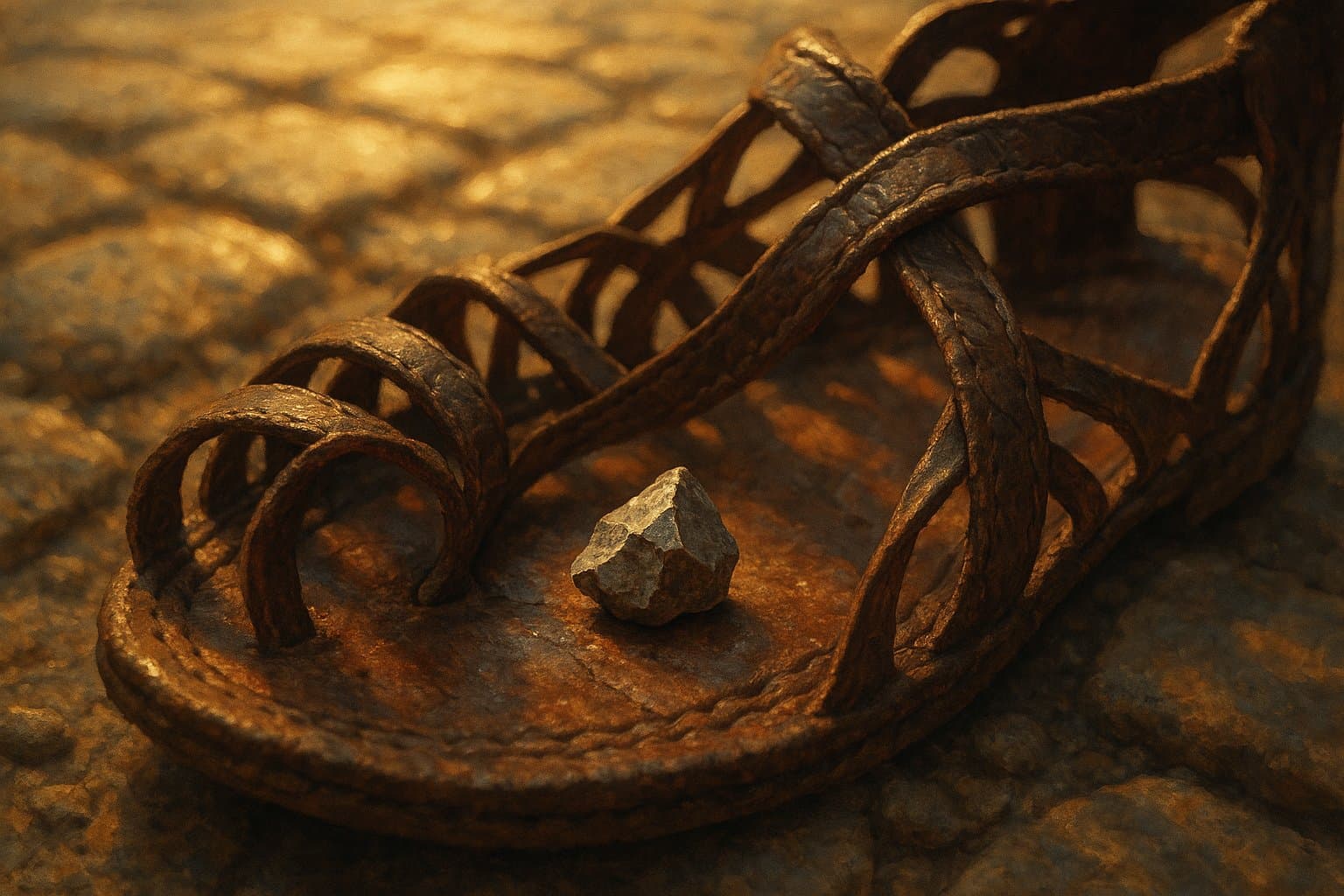
To have a scruple is to feel that nagging doubt that stops us before we act, the small moral voice that says “wait, this isn’t right”. It is an abstract, almost spiritual word. And yet it was born from something as physical and as irritating as a tiny stone in your shoe. The origin of “scruple” lies in the Latin scrupulus, the name the Romans gave to those minute, sharp-edged pebbles that slipped into a sandal and forced you to stop. From the annoyance in the foot to the annoyance in the conscience, the word made a journey of more than two thousand years without changing its central idea: something small that won’t let you move on in peace.
From scrupus to scrupulus: the sharp stone
In Latin, scrupus was a rough, pointed stone, the kind that cuts or pricks. Its diminutive, scrupulus, named a miniature version: a little pebble, a tiny grit just as bothersome. The detail matters, because the power of the metaphor lies exactly there. A big rock can be seen, avoided, kicked aside. A sharp pebble inside your footwear is invisible, it shifts, it hides under the sole and drives its point in with every step. It cannot be ignored and cannot be forgotten: it demands immediate attention and halts your progress.
The Romans, who walked for miles in open sandals over paved roads, knew that minor torture very well. Anyone could picture without effort the exact sensation of a scrupulus digging in under the heel. It was the perfect example of a small discomfort that is impossible to set aside.
Cicero and the stone in the conscience
The leap from the physical to the mental we owe above all to the Latin writers, and to Cicero in particular. As early as the first century BC, scrupulus was used figuratively to name an unease, a pricking worry, a doubt that gives no rest. The image was transparent: just as the little stone spoils your walking, a certain thought spoils your conscience, jabbing again and again until you stop to settle it.
From that metaphorical use came the moral sense we still handle today. The scruple became that ethical doubt that makes us hesitate before doing something questionable, the inner misgiving that works as a warning. It is no accident that many Latin words that now name states of mind began by describing very concrete things: like the vice of putting everything off that already infuriated the Romans, the scruple was an everyday experience before it became a category of the soul.
The scruple you could also weigh
Here comes the part almost no one remembers: for centuries, “scruple” was not only a moral annoyance but also a unit of weight. The Roman scrupulum was the smallest fraction of the uncia (the ounce): exactly 1/24 of an ounce, a little over one gram. The logic is the same one that named the pebble: the scruple was the minute portion, the barely perceptible grain of weight.
That unit survived for millennia. In the apothecaries’ system —the one pharmacies used until not so long ago— the scruple (symbol ℈) equalled 20 grains, about 1.3 grams, and it was the measure by which delicate medicines were dosed. That the same name served for the speck of weight and for the moral doubt is no coincidence: in both cases it is something tiny that nonetheless tips the balance. The Romans applied that same fussiness to their money, as told in the story of the word “money”, born in a temple on the Capitoline.
From scruple to scrupulous
The word’s family grew consistently. To be scrupulous is to act with such care that you attend to the smallest detail —the moral equivalent of noticing every bit of grit on the path. And its opposite, unscrupulous, describes someone who advances without any ethical doubt pricking their step. In several European languages the Latin scrupulus left descendants carrying the same double edge between discomfort and conscience.
The word is documented in English from the late 14th century, always with that sense of misgiving and moral caution. So the next time something gives you a scruple, consider that you are naming, without knowing it, a sharp little pebble in a Roman’s sandal: small, invisible, and determined to make you stop before you take the next step. Like so many words that describe what we feel inside, “scruple” hides an image far more earthbound than its meaning would suggest.
References
- “Scruple”, Online Etymology Dictionary: from Latin scrupulus “uneasiness, anxiety, pricking of conscience”, literally “a small sharp stone”, diminutive of scrupus “sharp stone”; used figuratively by Cicero for a cause of uneasiness. etymonline.com
- “The origin of ‘scruple’”, Word Histories: reconstructs the pebble-in-the-shoe metaphor and Cicero’s figurative use for the pricking of conscience. wordhistories.net
- “Scruple (unit)”, Wikipedia: the Roman scrupulum as 1/24 of the uncia and its survival in the apothecaries’ system as the scruple (℈) of 20 grains, about 1.3 g. en.wikipedia.org
- “Scruple”, Encyclopædia Britannica: apothecaries’ unit equal to 20 grains (one-third of a dram, about 1.296 g), descended from the Roman scrupulum. britannica.com
Enjoy the stories behind words? Continue with the origin of “money” and that of “enthusiasm”, or browse the whole etymology series.
The books · born from this blog

Atahualpa con su abrigo de pelo de murciélago
y otras 49 historias verdaderas que parecen mentira
Available on Amazon
Tocar madera
Pequeña historia de las supersticiones que el mundo no ha podido soltar
Available on Amazon
100 futuros
Cien escenarios del mundo que viene con la inteligencia artificial
Available on AmazonYou may also like

The Origin of the Word “Quarantine”: 40 Days in Venice
Where does the word quarantine come from? From the 40 days that Venice and Ragusa forced ships to wait during the Black Death. Here is its story.

The Origin of the Word “Dollar”: a Bohemian Valley
Where does the word dollar come from? From a silver-mining valley in Bohemia and a 16th-century coin. The story of the thaler that conquered the world.

The Origin of the Word “Museum”: House of the Muses
Where does the word museum come from? From mouseion, the temple of the Greek Muses and the great center of learning in Alexandria, long before glass cases.