
The History of the Elevator and the Vertical City
The history of the elevator: from Elisha Otis's 1854 safety brake to the invention that made skyscrapers and the modern vertical city possible.
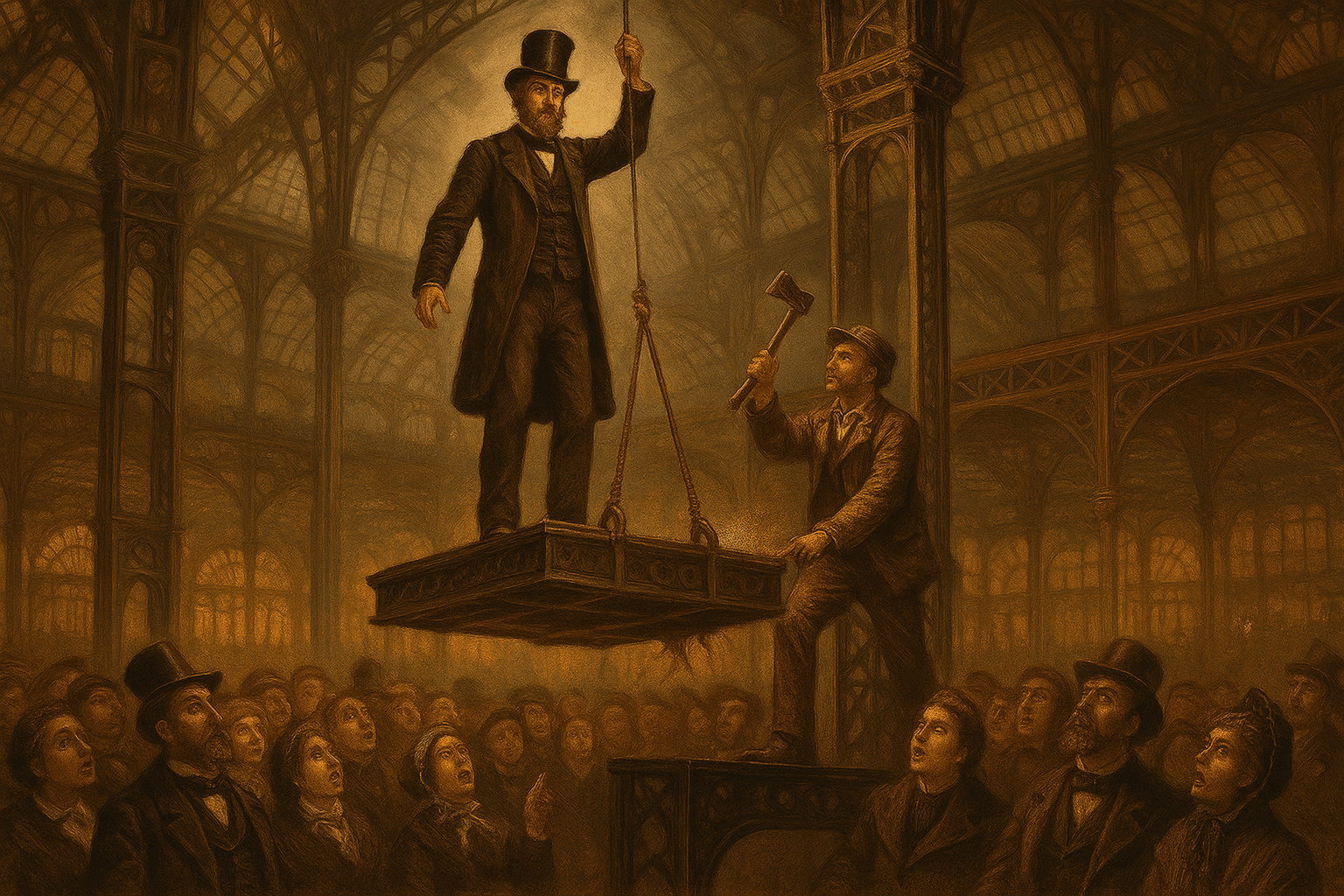
We take it for granted that pressing a button will carry us thirty floors up in under a minute. But for almost all of human history, going up was an exhausting luxury: the higher you lived, the worse your address. The history of the elevator isn't just the story of a machine that goes up and down—it's the story of the invention that turned cities inside out and forced them to grow upward. And its decisive moment wasn't a stroke of genius but a circus trick: a man standing on a platform, ordering the rope that held him to be cut.
Machines that lifted things since antiquity
The idea of raising loads with ropes and pulleys is very old. One of the first such devices is credited to Archimedes, around 236 BC: a hoist with ropes wound on a drum and driven by human muscle. In the Roman Colosseum, archaeologists believe there were between 28 and 30 wooden elevators that raised wild animals—lions, bears, leopards—up shafts some seven meters tall to trapdoors that sprang open onto the sand.
Centuries later, royalty had its own vertical whims. In 1743, Louis XV had a "flying chair" built at Versailles so one of his mistresses could reach her third-floor rooms. All these contraptions shared one problem: they were slow, they depended on muscle or counterweights, and above all they were not safe. If the rope broke, the load—or the person—plunged into the void. That's why, for centuries, elevators moved goods, not people.
The problem wasn't going up—it was not falling
By the mid-nineteenth century, the Industrial Revolution had filled factories with steam engines powerful enough to move heavy platforms between floors. The technology for going up already existed. What was missing was an answer to the question that kept anyone from trusting one of those platforms with their life: what happens when the rope breaks?
That was the knot untied by an American mechanic named Elisha Graves Otis. Working at a bed factory in Yonkers, New York, he was looking for a safe way to hoist machinery to the upper floors. Around 1852 he hit on a solution as simple as it was brilliant: a steel wagon spring connected to the platform. As long as the rope was taut, the spring stayed folded; but if the rope broke and the tension vanished, the spring snapped open and drove a set of pawls into toothed rails on the sides of the shaft, halting the fall in an instant.
1854: the man who ordered his own rope cut
Otis had the invention, but no one wanted to buy it: people still saw elevators as death traps. He needed to win over the public, so he staged one of the boldest publicity stunts of the century. At the Exhibition of the Industry of All Nations, held at New York's Crystal Palace in 1854, Otis set up an open platform and climbed aboard before a crowd.
In front of everyone, he had the platform raised several meters off the ground. Then he ordered an assistant to cut the rope with an axe. The crowd screamed, expecting to watch the inventor fall. But the platform dropped only a few inches before the safety brake caught and held it in midair. Otis took off his hat and delivered the line that went down in history: "All safe, gentlemen, all safe." That piece of theater did for elevators what no patent could have: it turned fear into trust.
From freight hoist to passenger elevator
The demonstration worked. In 1857, Otis installed the first passenger elevator with a safety brake in the E. V. Haughwout & Co. store on Broadway in New York. It was steam-powered and slow by today's standards, but for the first time people stepped into an elevator without feeling they were risking their lives. Otis received his patent in 1861 and died a few months later, never seeing the staggering scale his idea would reach.
The next leap was electric. In 1880, the German inventor Werner von Siemens unveiled the first electrically powered elevator in Mannheim. Cleaner, faster, quieter electric motors replaced steam and hydraulics—right as electricity was beginning to transform everything, a story we tell in the war of the currents between Edison and Tesla. The elevator stopped being a curiosity and became infrastructure.
The invention that turned cities upside down
Here's the part almost no one connects with an elevator: without it, there would be no skyscrapers. Before, a building's height was set by its tenants' legs. Nobody wanted to rent a fifth floor they had to climb on foot, so buildings rarely rose above six or seven stories. The elevator broke that ceiling and let cities that had no room to grow outward grow upward instead.
The change was so profound it flipped the value of real estate. For centuries, the most expensive, sought-after floor had been the ground floor, the one that spared you the stairs; servants and poorer tenants lived up top, under the roof. With the elevator, the logic reversed: the top floor, with its views and its quiet, became the penthouse, the priciest address in the building. A simple button reordered the social hierarchy of housing.
The machine we barely notice
Today the elevator is probably the machine we trust most without a second thought. We step into a box hanging from a cable, press a number, and never once picture the fall—precisely because the brake Otis invented is still there, folded, waiting for a break that almost never comes. Statistically, it's one of the safest forms of transport in existence.
Like so many everyday objects, the elevator hides a story spanning centuries and an unexpected twist—in this case, a fairground stunt. If you enjoy this archaeology of the things we use every day, keep going with the typewriter and its war on bad handwriting or the history of the computer mouse, another button that changed the world without us noticing.
References
- "Elisha Otis," Encyclopædia Britannica. britannica.com
- "Who Invented the Elevator?," HISTORY. history.com
- "Elisha Otis History," Otis Worldwide. otis.com
- "The Electric Elevator," Engineering and Technology History Wiki (ETHW). ethw.org
Love the hidden history of technology? Continue with the war of the currents or explore the whole Science & Technology section.
Categories
The books · born from this blog

Atahualpa con su abrigo de pelo de murciélago
y otras 49 historias verdaderas que parecen mentira
Available on Amazon
Tocar madera
Pequeña historia de las supersticiones que el mundo no ha podido soltar
Available on Amazon
100 futuros
Cien escenarios del mundo que viene con la inteligencia artificial
Available on AmazonYou may also like

The History of the Match: Fire in Your Pocket
The friction match was born by accident in 1826, poisoned thousands of factory women, and only later became the safe fire we carry in our pocket.
The History of Ethernet: How an Office Learned to Share
In 1973, at Xerox PARC, an engineer wired an office's computers to a laser printer. That was the birth of Ethernet, the network we still use today.
The History of the Floppy Disk and the Save Icon
The floppy disk held 80 KB in 1971 and survives today as the «save» icon many young people never touched. This is the full history of the floppy disk.