
Why Does February Have Only 28 Days?
February is the shortest month thanks to Roman number superstition, an impossible sum, and a phantom month that was inserted inside it. Here's the story.
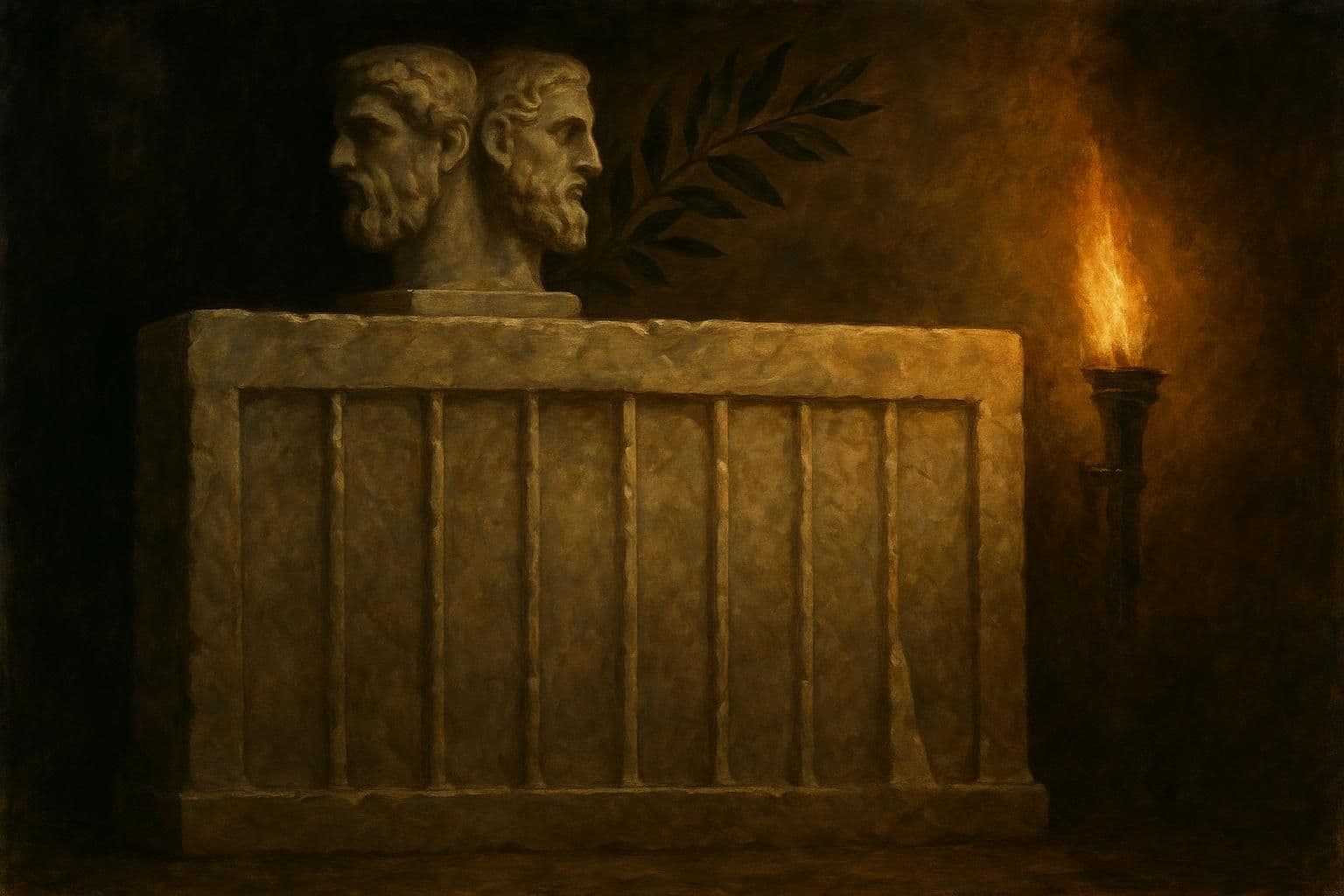
Eleven months have 30 or 31 days. Only one, February, stops at 28 —29 every four years, as if apologizing. It's the most visible oddity in our calendar, and we usually explain it wrong: it was neither a counting mistake nor a last-minute whim, but the sum of a numerical superstition, an arithmetic that wouldn't close, and a phantom month that for centuries slipped inside February. It's worth untangling.
A calendar that began in March
The early Roman calendar, attributed by tradition to Romulus, had only ten months and started in March, with spring and the war season. After December came about sixty days of winter that belonged to no month at all: dead time for the fields and for weapons. It's the same legacy that explains why September means "seven" even though it's the ninth month: the names froze in their original positions.
It was king Numa Pompilius, around 700 BC, who gave that winter gap a name by creating two new months: January, for Janus, the god of beginnings, and February, for the februa, the purification festivals with which the Romans closed the year and honored their dead. And here the trouble begins, because Numa was, let's say, very particular about numbers.
The superstition of even numbers
To square the calendar with the lunar year, Numa needed to spread about 355 days across twelve months. But the Romans of his time believed that even numbers brought bad luck: the odd was the auspicious, the living. So Numa wanted every one of his months to have an odd number of days —29 or 31— and the yearly total to be odd as well.
There he hits a mathematical wall no king can climb: the sum of twelve odd numbers is always even. For the yearly total to come out odd, at least one month had to have, by force, an even number of days. Someone had to carry the bad luck. And what better month than February, the month of purification and of the dead, already dedicated to the departed? A month tied to the underworld could absorb the "impure" days without scandal. February was left with 28 —the only even one— while all the rest divided up 29 or 31.
Mercedonius, the month that came and went
That 355-day year drifted about ten days from the Sun every year. To fix it, the Romans didn't add a loose day: they inserted a whole month called Mercedonius (or Intercalaris) every two or three years. And they inserted it in the most unlikely spot: inside February. After the 23rd —the feast of Terminalia— the 27 or 28 days of Mercedonius were slotted in, and the last days of February were tacked onto the end. February, the short month, was also the month with a trapdoor for cramming in another month.
Whoever decided whether a given year had a Mercedonius was the pontifex maximus, the highest religious authority. And since it was a political office, the temptation was enormous: they lengthened the year when it suited their allies in power and shortened it when their rivals ruled. By the 1st century BC the calendar was so manipulated and out of joint that the harvest festivals were falling in spring. A disaster with a first and last name.
Julius Caesar cuts the knot (but leaves February alone)
In 46 BC, Julius Caesar —also pontifex maximus— ordered the great reform. He abolished the flickering Mercedonius and stretched the year to 365 days by distributing ten extra days among the months, plus one day to be added every four years. Yet, curiously, he barely touched February: he left it at its old 28 days. The ancient superstition had already fossilized, and breaking a seven-century tradition for the sake of symmetry wasn't worth it.
The extra day of leap years wasn't placed at the end of February either, but doubled onto the 24th —the sixth day before the calends of March. That "second sixth" was called in Latin bis sextus, and from it comes, literally, the Spanish word bisiesto ("leap year"). The Gregorian calendar of 1582 fine-tuned the leap-year rule to stop the error from piling up, but it kept the oddity intact: twenty-six centuries later, February is still the month that's missing some days.
The fossil we check every February
So the next time someone complains that February ends too soon, they can assign the exact blame: to a superstitious king who hated even numbers, to a sum that wouldn't close, and to a phantom month that squeezed in between the 23rd and the 24th. As with so many things we do when the year turns, we keep repeating a gesture whose origin almost no one remembers. The calendar, as we've said, is an archaeological site we consult daily —and February is its oldest, strangest piece, the one the Romans left us without ever quite squaring.
References
- Plutarch, Life of Numa, 18-19 (Numa adds January and February, avoids even numbers and leaves February with fewer days). penelope.uchicago.edu
- Censorinus, De die natali liber, ch. XX (the 355-day year, the intercalary month and Julius Caesar's reform). penelope.uchicago.edu
- "Roman calendar" and "Mercedonius", Wikipedia (how the intercalary month worked inside February and its political manipulation). en.wikipedia.org
- "Why Are There Only 28 Days in February?", Encyclopædia Britannica. britannica.com
Enjoy the stories behind the calendar? Continue with why September means seven while being the ninth month and the origin of the Año Viejo, or browse the whole historical curiosities series.
Categories
The books · born from this blog

Atahualpa con su abrigo de pelo de murciélago
y otras 49 historias verdaderas que parecen mentira
Available on Amazon
Tocar madera
Pequeña historia de las supersticiones que el mundo no ha podido soltar
Available on Amazon
100 futuros
Cien escenarios del mundo que viene con la inteligencia artificial
Available on AmazonYou may also like

The Ten Days of October That Never Existed
In 1582 Pope Gregory XIII erased ten days: October 4 was followed by October 15. Here is why the Julian calendar failed and the Gregorian took its place.

Rubber Before Goodyear: The Gum That Melted
Before vulcanization, rubber was a gum that melted in summer and cracked in winter. From the Maya to Goodyear, here's how it was finally tamed.

Porcelain: the Chinese secret Europe tried to steal
For centuries Europe paid fortunes for Chinese porcelain without knowing how it was made. This is the story of a hundred-year industrial espionage.