
Why the QWERTY Keyboard Outlived All Its Rivals
The QWERTY keyboard was fixed in 1873 for typewriters that no longer exist. This is the story of why we still use it despite everything.
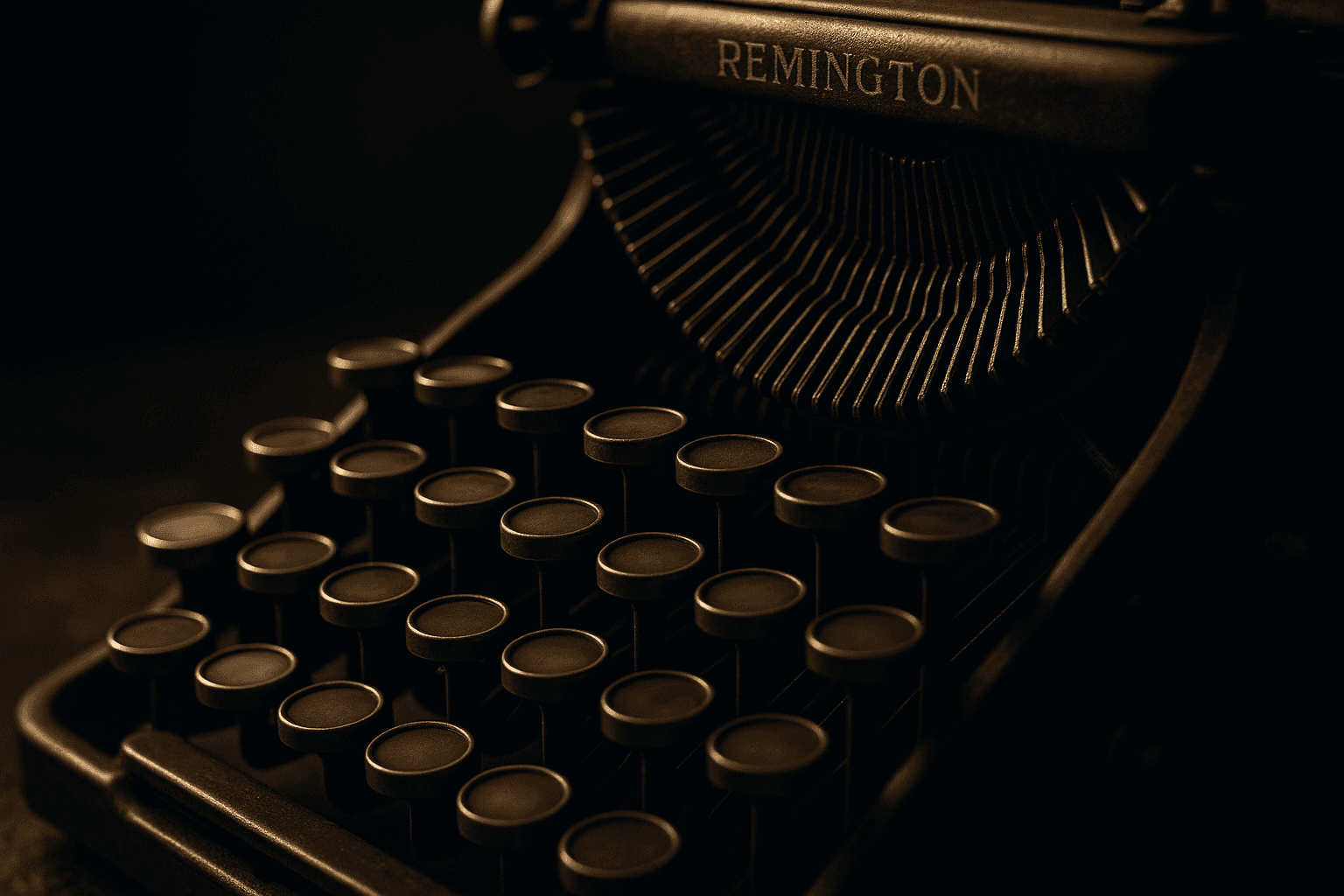
Look at the keyboard in front of you. The top row of letters begins with Q, W, E, R, T, Y, an order that follows no obvious logic: not the alphabet, not letter frequency, not what's comfortable for your fingers. That arrangement was locked in more than a century and a half ago for a machine almost nobody has touched, the mechanical typewriter, and yet it outlived paper, computers, phones, and dozens of "better" proposals. The story of why the QWERTY keyboard won is not the story of a perfect design, but of a habit that became impossible to break.
A typewriter that kept jamming
QWERTY came from Christopher Latham Sholes, a printer and newspaperman from Milwaukee who, in the 1860s, worked with several partners on one of the first practical typewriters. His prototypes arranged the keys almost alphabetically, but the mechanism had a physical problem: each key swung a metal bar carrying a letter, and when two neighboring bars rose at nearly the same instant, they collided and jammed. You had to stop and pull them apart by hand.
That's where the most repeated explanation comes from: that Sholes rearranged the keys to slow typists down and avoid the jams. It's a half-truth. The goal wasn't to make anyone slower, but to separate on the keyboard the pairs of letters most often used together in English, so their bars wouldn't sit side by side and clash. The result looks like a speed brake, but the real aim was mechanical, not sabotage.
The keyboard telegraphers designed
Here's a detail almost nobody mentions. The first customers for those machines weren't writers but telegraph operators, who needed to transcribe, at high speed, messages arriving in Morse code. Research by historians Koichi and Motoko Yasuoka argues that much of the QWERTY order was shaped by listening to those operators, not to writers.
The classic example is the letter S, which ended up wedged between E and Z. In American Morse code, "Z" and the combination "SE" sounded almost identical, and having those keys close together helped the telegrapher decide on the fly what was coming in. In other words: the keyboard you now use to chat was tuned, in part, for a job that consisted of translating dots and dashes. It's a story much like other inventions that changed careers along the way, such as the one surrounding Grace Hopper and the origin of the computer "bug".
1873: Remington turns a quirk into a standard
A keyboard doesn't become universal on its own; it needs a factory behind it. In 1873, Sholes and his partners sold the rights to the machine to E. Remington and Sons, a maker of firearms and sewing machines looking for new business after the Civil War. The following year came the Sholes and Glidden Type-Writer, and later the influential Remington No. 2, both with a layout very close to the QWERTY we know.
With Remington selling thousands of machines and setting up schools that taught typing on that keyboard, the order stopped being one option among many and started to be the norm. When other brands tried to compete, they ran into thousands of typists already trained on QWERTY: switching layouts meant teaching them everything again from scratch, and nobody wanted to foot that bill.
Dvorak, the "scientific" rival that couldn't dethrone it
The most famous challenge arrived in 1936, when professor August Dvorak patented a keyboard designed around efficiency: the most frequent letters on the home row, under the strongest fingers, and a layout meant to alternate hands. On paper it promised less movement and less fatigue.
And yet it didn't win. The studies showing a landslide for Dvorak turned out to be unreliable —Dvorak himself took part in several— and later analyses, like the famous 1990 essay The Fable of the Keys by economists Stan Liebowitz and Stephen Margolis, found the real advantage was small, perhaps a modest few percent. Against that meager saving stood the enormous cost of relearning to type and manufacturing new machines. The math almost always came out the same: not worth it.
The habit trap: why it's so hard to change
QWERTY became economists' favorite example of a phenomenon called path dependence: when a technology prevails not because it's the best, but because it arrived first and piled up users. Economist Paul David gave it its name in 1985 with an article that spoke, right in its title, of "the economics of QWERTY."
The logic is a snowball. The more people know QWERTY, the more machines are built with QWERTY; the more machines there are, the more people learn it. At some point, the advantage that anyone can sit down at any keyboard in the world and type outweighs any technical improvement. That network effect is so powerful it shows up in many technology stories, from video formats to the way Unix spread across the world until it lives in your phone today.
How an 1873 keyboard reached your pocket
When the metal bars disappeared, the original reason for QWERTY —keeping them from jamming— ceased to exist. Computers could have adopted any layout at all. But by then entire generations typed in QWERTY without thinking, and no manufacturer wanted to sell a device that forced people to relearn something so basic.
The final leap came with touchscreen phones. An on-screen keyboard has no mechanical limits: it could show the letters in any order you like. And still, when the iPhone and Android had to draw a keyboard from scratch, they chose the same QWERTY, because it was what people already recognized. So an arrangement meant for telegraphers and metal bars ended up ruling from the screen you carry in your pocket. It didn't survive by being the best, but by arriving on time and never letting go. If you enjoy this archaeology of machines, you might also like the debate over which was the first personal computer.
References
- "QWERTY", Wikipedia. en.wikipedia.org
- Jimmy Stamp, "Fact or Fiction? The Legend of the QWERTY Keyboard", Smithsonian Magazine. smithsonianmag.com
- Koichi Yasuoka and Motoko Yasuoka, "On the Prehistory of QWERTY", ZINBUN. doi.org
- S. J. Liebowitz and Stephen E. Margolis, "The Fable of the Keys", The Journal of Law and Economics (1990). jstor.org
Enjoy the hidden history of technology? Continue with Ada Lovelace and the first computer program or explore the whole Science & Tech section.
Categories
The books · born from this blog
Atahualpa con su abrigo de pelo de murciélago
y otras 49 historias verdaderas que parecen mentira
Available on Amazon
Tocar madera
Pequeña historia de las supersticiones que el mundo no ha podido soltar
Available on Amazon
100 futuros
Cien escenarios del mundo que viene con la inteligencia artificial
Available on AmazonYou may also like
Morse Code: How It Works and Why It Saved Lives
Morse code turns letters into dots and dashes that travel down a wire or a flash of light. Here is how it works, where it came from and why it is still used.
The Telegraph: The Victorian Internet
The telegraph shrank weeks of mail into minutes of cable. How Morse, Cooke and a wire under the Atlantic built the Victorian internet and shrank the world.

The nocebo effect: when expecting harm creates it
The nocebo effect is the placebo's dark twin: believing a treatment will hurt can make it hurt. Its origin, real cases and what science says.