
The Origin of Unix: Why It Lives in Your Phone
Unix was born in 1969 on a forgotten Bell Labs computer. Today its descendants run your phone, your Mac and nearly every server on Earth.
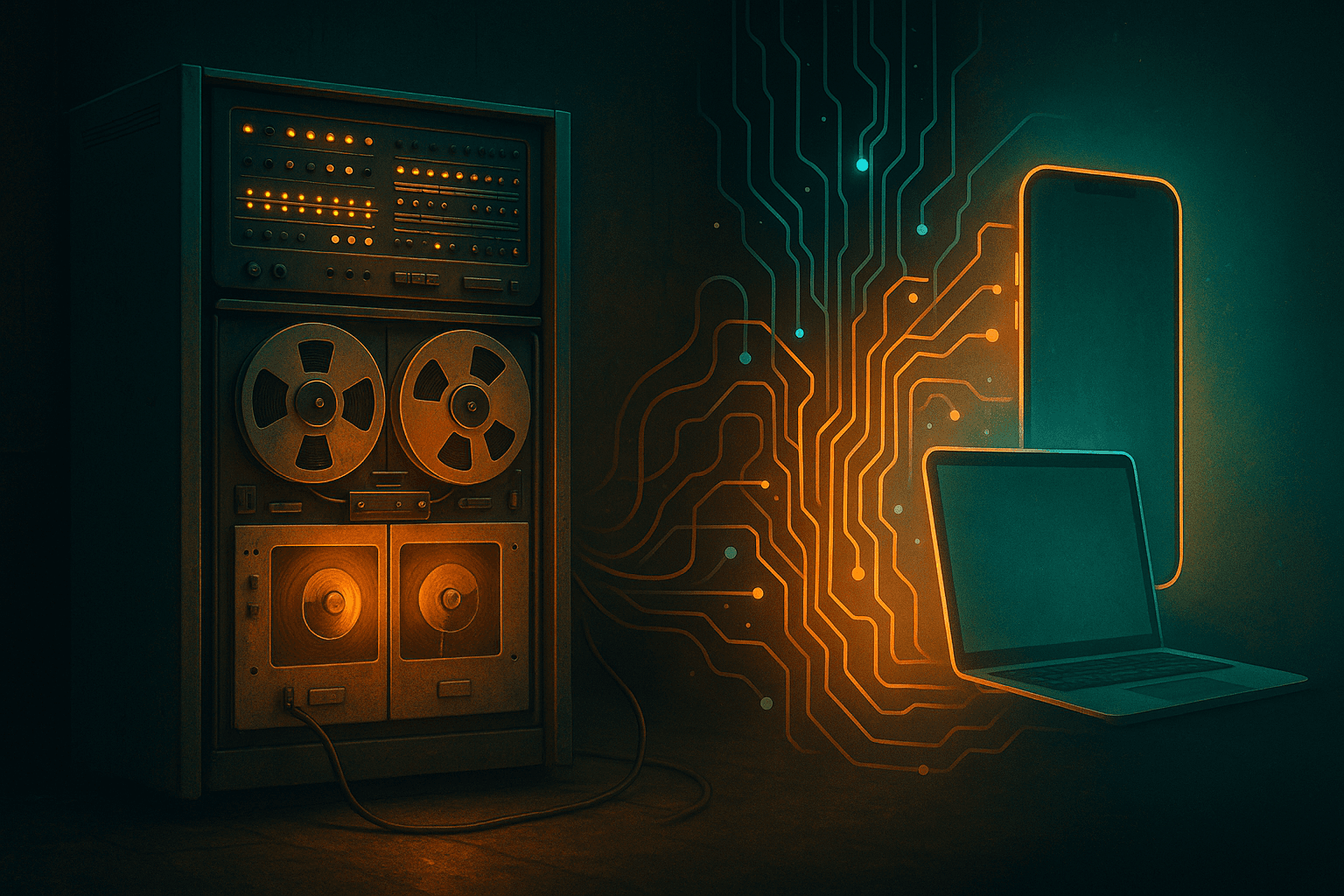
If you're reading this on an iPhone, you're holding Unix in your hand. On an Android, you're holding a close relative. On a Mac, it's Unix almost by the book. And the page you're looking at came from a server that, in all likelihood, also runs a direct descendant of that same system. Half a century after being born in a forgotten corner of a laboratory, Unix is still the invisible skeleton that much of modern computing rests on. The strange part is that it began as an almost clandestine project, built in spare moments, on a computer nobody else wanted to use.
A failure called Multics
The story starts in the mid-1960s with an ambitious, collective project: Multics. MIT, the company General Electric, and AT&T's Bell Labs joined forces to build a time-sharing operating system, one that would let many users work at once on a single mainframe. It was a dream of the era, but a dream that kept slipping away: development dragged on, grew tangled, and never quite delivered anything usable.
By 1969, Bell Labs lost patience and pulled out of Multics. Several of its engineers were suddenly without a project, but with a clear idea in their heads of how a good operating system should work. Among them were two names the history of computing would never forget: Ken Thompson and Dennis Ritchie.
1969: a video game and a forgotten machine
The spark for Unix wasn't some grand strategic vision but something far more human: Ken Thompson wanted to keep playing. He had written a game called Space Travel that simulated the solar system, and running it on Bell's big mainframes was ruinously expensive. So he looked for an alternative and found one gathering dust: a PDP-7, an old and little-used minicomputer.
To make his game run cheaply, Thompson ended up writing, over the summer of 1969, an entire operating system: a file system, a command interpreter, and the basic utilities to copy, edit, and delete. That self-sufficient foundation was the first Unix. The name arrived as a joke: colleagues dubbed it "Unics," a pun that mocked Multics (something like a stripped-down, "emasculated" version of that giant). In time the joke hardened into UNIX, and the official name stuck.
The master stroke: rewriting it in C
The first Unix was written in assembly language, tied to the exact machine it had been built for. In 1972 and 1973, Thompson and Ritchie made a decision that looked minor and technical but proved visionary: they rewrote almost the whole system in a new language Ritchie himself had created, the C language.
The consequence was enormous. No longer bound to the guts of a specific piece of hardware, Unix became the first widely used operating system that could jump from one machine to another and outlive the computer it was born on. Porting it to a different machine no longer meant rewriting the whole thing. That portability is, at bottom, the reason Unix could spread across the world while other systems died along with their hardware. The same idea of separating software from any particular chip resurfaces today in projects like RISC-V, the free processor that wants to be the Linux of hardware.
How a legal accident scattered it across universities
Here comes an unexpected twist. AT&T, the owner of Bell Labs, was a regulated telephone monopoly and, under antitrust agreements, was barred from entering the computer business. It couldn't turn Unix into a commercial product and sell it aggressively. So it did something that sounds odd today: it licensed Unix to universities for almost symbolic sums, source code included.
For a generation of students and professors, that was a gift from heaven. They could read the system from the inside, modify it, and learn from it. The University of California at Berkeley became a hotbed of improvements and began distributing its own version, the BSD (Berkeley Software Distribution). Through the 1970s and 1980s, Unix spread through the academic world as a culture, not just a program. That legal limitation, meant to hold AT&T back, turned out to be the best distribution plan imaginable.
The philosophy we still use
Unix didn't just leave code behind: it left a way of thinking. Its famous philosophy boils down to a simple idea: small programs that do one thing well and that can be chained together, passing the output of one as the input of the next. Instead of a monolith that does everything, many modest pieces working together. That way of building software shaped nearly everything that followed and still underpins how millions of programmers work at the terminal today.
From that environment also came tools and ideas we now take for granted, along with plenty of computing history with names of its own, like the story surrounding Grace Hopper and the origin of the "bug". Unix was the common ground where many of those seeds took root.
Why it's still alive inside your pocket
Here's the part almost nobody knows. In 1991, a Finnish student named Linus Torvalds created Linux, a kernel inspired by Unix but written from scratch and free. Linux today powers most of the internet's servers, the world's supercomputers, and, inside Android, most of the phones on the planet. It's "Unix-like": a child of the same philosophy, if not the same code.
And then there are the direct descendants. When Apple built macOS, it raised it on a foundation containing BSD code; in fact, macOS is an officially certified Unix. And iOS, the iPhone's system, is macOS's sibling: it shares that same heart. So, counting both the relatives and the direct descendants, the family tree of that 1969 experiment holds up your phone, your computer, and nearly the entire web today. Rarely has an old, sidelined machine, switched on just to play a video game, ended up ruling the whole world. If you enjoy this archaeology of machines, you might also like the debate over which was the first personal computer.
References
- "History of Unix", Wikipedia. en.wikipedia.org
- Dennis M. Ritchie, "The Evolution of the Unix Time-sharing System", AT&T Bell Laboratories. read.seas.harvard.edu
- "The invention of Unix", Nokia. nokia.com
- "History of the Berkeley Software Distribution", Wikipedia. en.wikipedia.org
Enjoy the hidden history of technology? Continue with the origin of the word "robot" or explore the whole Science & Tech section.
Categories
The books · born from this blog
Atahualpa con su abrigo de pelo de murciélago
y otras 49 historias verdaderas que parecen mentira
Available on Amazon
Tocar madera
Pequeña historia de las supersticiones que el mundo no ha podido soltar
Available on Amazon
100 futuros
Cien escenarios del mundo que viene con la inteligencia artificial
Available on AmazonYou may also like

Morse Code: How It Works and Why It Saved Lives
Morse code turns letters into dots and dashes that travel down a wire or a flash of light. Here is how it works, where it came from and why it is still used.

The History of the Match: Fire in Your Pocket
The friction match was born by accident in 1826, poisoned thousands of factory women, and only later became the safe fire we carry in our pocket.
The Telegraph: The Victorian Internet
The telegraph shrank weeks of mail into minutes of cable. How Morse, Cooke and a wire under the Atlantic built the Victorian internet and shrank the world.