
Why Water Boils Differently in Quito and Guayaquil
In Quito water boils at about 90 °C and in Guayaquil at 100. The cause is atmospheric pressure, and it explains why food cooks slower in the highlands.
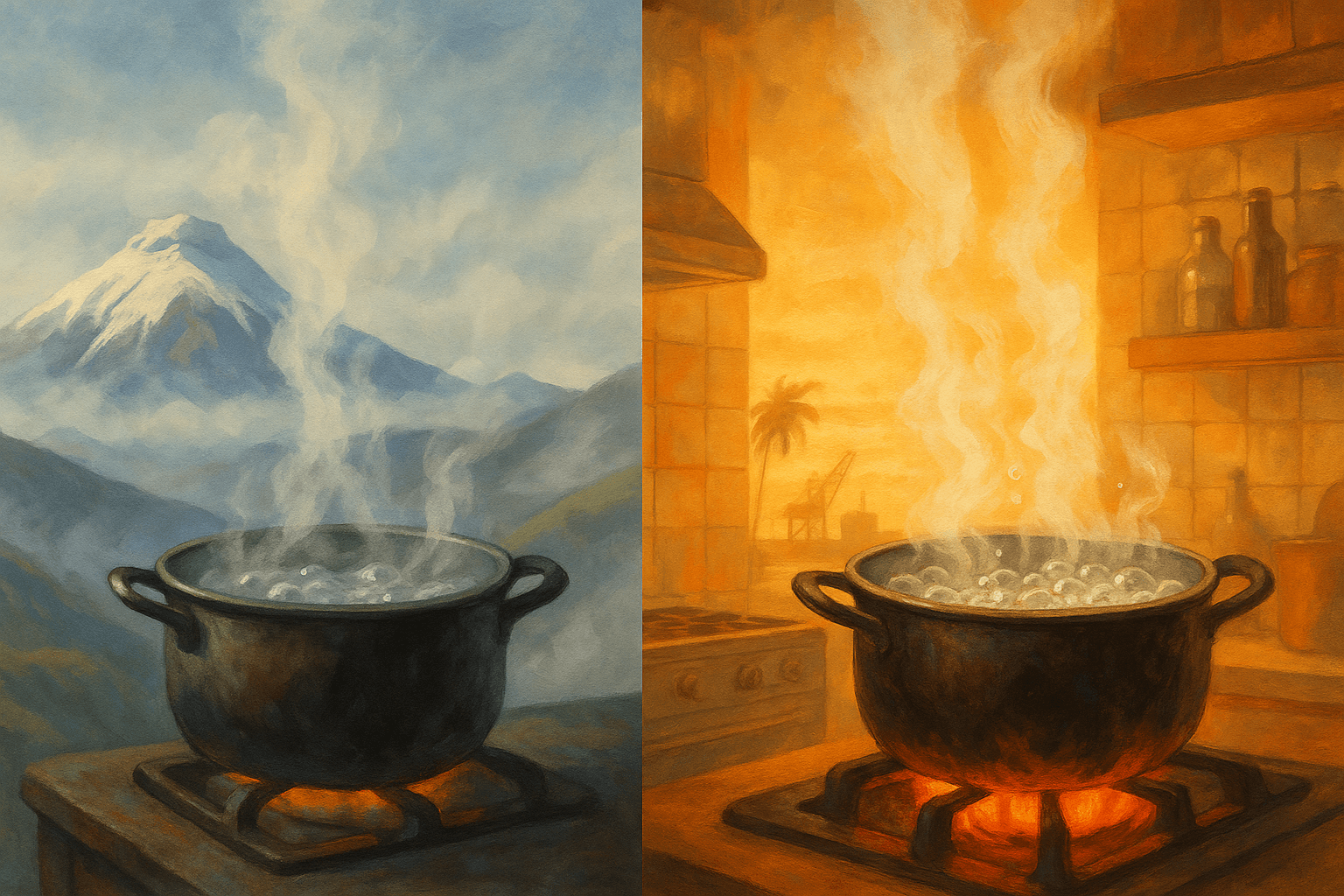
Almost all of us learned in school that water boils at 100 degrees. It is one of those truths repeated so often that it feels like an unbreakable law of the universe. But it isn't: if you put one pot on to boil in Quito and another in Guayaquil, the water in the highlands will start bubbling while it is clearly cooler than the water on the coast. In the capital, 2,850 meters above the sea, water boils at around 90 degrees; in the port city, almost at sea level, it does so very close to 100. It is not a faulty thermometer or a local quirk: it is pure physics, and it has very concrete consequences in the kitchens of the millions of people who live up high.
What "boiling" really means
To understand the difference, you have to stop thinking that boiling is simply "heating something a lot." A liquid boils when its vapor pressure — the eagerness of its molecules to escape as gas — matches the pressure the air exerts on its surface. As long as the air pushes down harder than the molecules push up, the water stays liquid no matter how hot it gets. The moment the two pressures are equal, bubbles of vapor form inside the liquid and the water comes to a boil.
The key is that pressure from the air. We live, as Torricelli wrote in the seventeenth century, "submerged at the bottom of an ocean of air," and that ocean weighs down on us. In Guayaquil the entire column of atmosphere sits overhead; in Quito, almost three kilometers of that air lies below the city. Less air overhead means less pressure, and less pressure means the water needs less heat to overcome it and boil. It is exactly the same principle that makes the needle rise and fall on an instrument we have written about before: the barometer and its history of storms.
A simple rule: one degree per 285 meters
The drop is not random. As a rule of thumb, the boiling point of water falls by about 1 °C for every 285 meters you climb (or, in the old imperial tables, a little under 1 °F for every 150 meters). With that rule you can read the thermal map of Ecuador at a glance:
- Guayaquil (sea level): water boils at about 100 °C.
- Cuenca (2,560 m): around 91 °C.
- Quito (2,850 m): about 90 °C.
- Chimborazo refuge (above 4,800 m): below 85 °C.
The regional record belongs to neighboring La Paz, in Bolivia, at some 3,640 meters: there water boils near 87 degrees. The higher you live, the cooler your water boils. That is why an entire mountain range cooks differently from the coast, even when the flame on the stove is identical.
Why everything takes longer in the highlands
Here comes the trap that has driven more than one visiting cook in Quito to despair. Boiling water at 90 degrees does not heat the food less by accident: it is that the water simply cannot get hotter than that while it boils. No matter how high you turn the flame, the water will not get any hotter; it will only boil faster and evaporate sooner. And since cooking is, at bottom, a matter of transferring heat to food, cooking at 90 degrees instead of 100 means that anything prepared in water takes longer.
The difference shows up most in dense foods. A hard-boiled egg that is ready on the coast in about 10 minutes may need considerably longer high in the mountains. Potatoes, pasta and dried beans such as fréjol or fava beans all demand more time in the pot, and some swear that in the mountains "the beans never soften." It is not black altitude magic: at 90 degrees the reactions that break down starch and fibers simply run more slowly. The same grams of food, the same flame, but less usable heat inside the pot.
The fix a Frenchman invented in 1679
The way to outsmart altitude is not to raise the flame — that does not work — but to raise the pressure. And that trick is more than three centuries old. In 1679, the French physicist Denis Papin presented his "steam digester" to the Royal Society of London, a sealed pot that trapped the steam inside and raised the pressure above atmospheric. With more pressure, water can be heated past 100 degrees without boiling, and food cooks at a higher temperature and in much less time. Without knowing it, Papin had just invented the grandmother of the pressure cooker found in so many Andean kitchens today.
It is no coincidence that the pressure cooker is a near-mandatory appliance in cities like La Paz, Bogotá or Quito itself: it gives high-altitude cooking back the 100 degrees (or more) that the atmosphere had taken away. In a sense, it is the opposite of the vacuum pump that learned to take pressure out of the air: here the point is to add it. Same principle, opposite direction.
Beyond the kitchen
The phenomenon does not stop at the pot. The lower pressure of altitude affects baking — cakes rise too much and dry out, which is why high-altitude pastry recipes adjust the leavening and the liquids — the temperature needed to sterilize instruments, and even how quickly an engine cools. And it explains why measuring altitude precisely is such a delicate matter that even navigation systems struggle with it, as we saw when explaining how GPS works and why vertical position is its weak spot.
So the next time someone repeats that "water boils at 100 degrees," you have an answer ready: it depends on where you are standing. On the seashore, yes. In the middle of the Andes, water gives up sooner, boils cooler, and forces you to be patient with the beans. That neat round number from school was, in fact, a coastal figure that slipped in as though it were a universal law.
References
- "High-altitude cooking," Wikipedia. en.wikipedia.org
- "High Altitude Cooking," USDA Food Safety and Inspection Service. fsis.usda.gov
- "Water - Boiling Points vs. Altitude," The Engineering ToolBox. engineeringtoolbox.com
- "Quito," Encyclopædia Britannica. britannica.com
Enjoy these everyday-physics explainers? Continue with the history of the barometer and air pressure or explore the whole Science & Technology section.
Categories
The books · born from this blog
Atahualpa con su abrigo de pelo de murciélago
y otras 49 historias verdaderas que parecen mentira
Available on Amazon
Tocar madera
Pequeña historia de las supersticiones que el mundo no ha podido soltar
Available on Amazon
100 futuros
Cien escenarios del mundo que viene con la inteligencia artificial
Available on AmazonYou may also like
Why veins look blue when your blood is red
Human blood is never blue—it is always red. So why do veins look blue under the skin? The answer lies in how light travels through your body and how you see.

The nocebo effect: when expecting harm creates it
The nocebo effect is the placebo's dark twin: believing a treatment will hurt can make it hurt. Its origin, real cases and what science says.
The History of the Match: Fire in Your Pocket
The friction match was born by accident in 1826, poisoned thousands of factory women, and only later became the safe fire we carry in our pocket.